


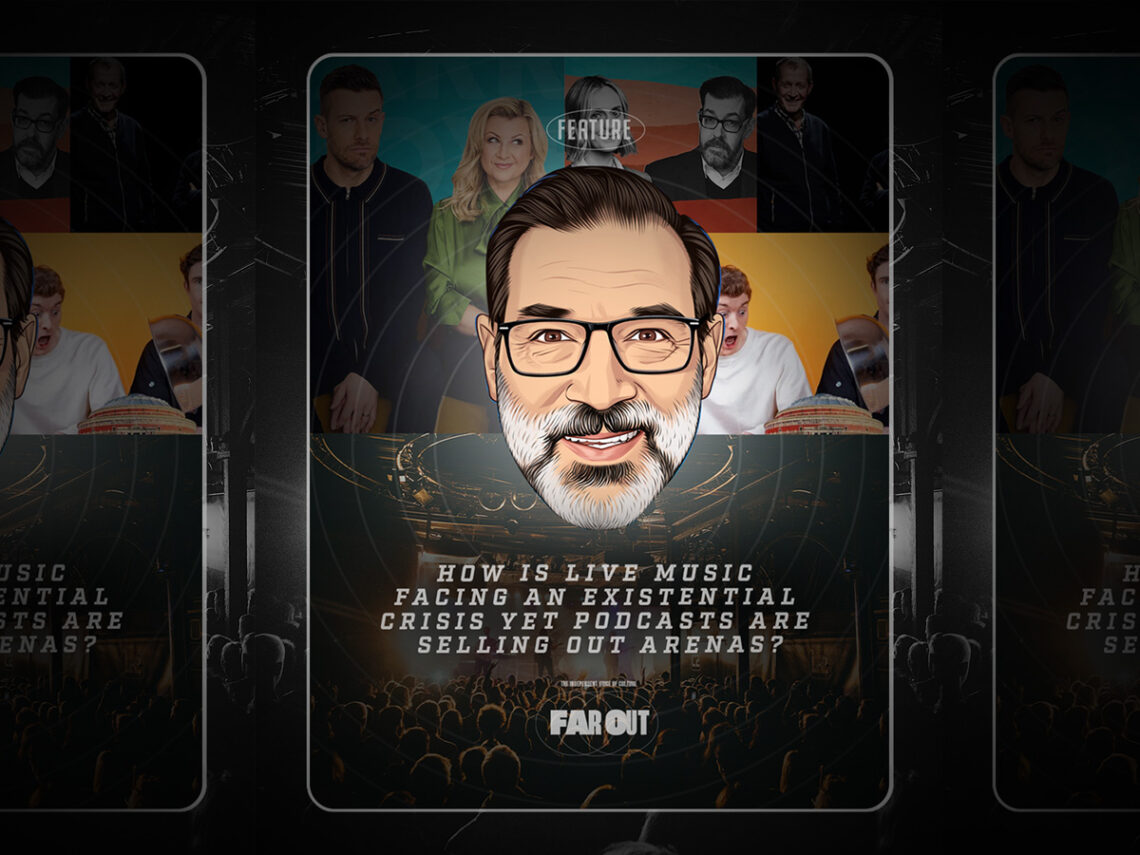
How is live music facing an existential crisis, yet podcasts are selling out arenas?

A little over five years ago, we were all told to stay indoors.
The pubs were closing, gigs were canned, sport was postponed, and the death count rose daily. In total, the UK spent around 282 days in lockdown, and it took a little over two years before life went back to something resembling normality.
However, ‘resembling’ is the operative word there, because along the way, a new phrase emerged: the new norm. It seems we’re still living in the arc of that phrase. The overwhelmingly monumental impacts of Covid-19 on culture and society are still stubbornly refusing to be fully reconciled as we move into an alternate era of human interaction.
Bands struggling to make ends meet is nothing new. In fact, it’s the well-established norm. But podcasts selling out arenas? Now that is very novel, indeed. The stark exacerbation of the former seems as tied to the unfurling impacts of the pandemic as the emergence of the latter. Of course, there’s the ongoing economic effect of the pandemic that has been widely mulled over in myriad dispatches professing the rising prices that bands have to contend with, but there is also an all too often ignored element: that our habits have changed, rendering a boost to podcasts and a blow to good old-fashioned gigs in the process.
Did the sudden slowdown fundamentally change us in a manner that has further compounded the capitalist crunch on live music? And is that fundamental paradigm shift in our social habits proven by the fact that while beloved local venues struggle to stay afloat, a few middle-aged folks simply chatting often results in lofty ticket sales in some of the nation’s largest venues? To answer this claim, I spoke to some social expert psychologists.
The first of which was Dr Michael Swift, who commented, “The emerging trends show that we have become choosier, slower, and more intentional with the way we engage with culture.”
Of course, that is partly to do with the fact that we have less cash to spare, but that doesn’t explain what we are choosing to use that limited spare cash for. “The pandemic didn’t just put things on pause; it made us rethink how we spend our social and emotional energy,” the Swift Psychology expert explained. ‘Energy’ seems to be the paramount word in that sentence.
Live music attendance is now 89% of pre-pandemic levels, and while ticket sales are up 24%, is the decrease really exclusively an econmic issue?
Statisic: Music Venue Trust
In 2023, Far Out‘s lyric of the year was AS Fanning’s line, “Because living young is getting old”. It seemed to reflect what a legion of the typical gig-going 30-something public felt. A regression to a simpler, quieter life held more appeal than ever before. And that extends to what events we choose to attend.
As a music editor who frequently attends gigs for a living, I can attest that they are, in fact, by and large, an energising and life-affirming experience. But that’s a conclusion you come to after the fact. It’s finding the energy to get to them after a tough day at work that proves testing. Given this testing presentiment, it seems more of us than ever are defeated by the lure of the sofa, even when we can summon enough loose cash to head to the Cluny.
However, with the likes of Shagged, Married, Annoyed, a podcast about the comical trials and tribulations of relationships, easily selling out the 9,000-seater Utilita Arena in less than an hour, The Rest Is Politics playing at the 20,000-capacity O2 Arena, and The Adam Buxton Podcast ticking off sell-outs at the Albert Hall, it seems we perhaps are more easily moved from the sofa to engage with live material that we, ironically, usually enjoy on the sofa in the first place.
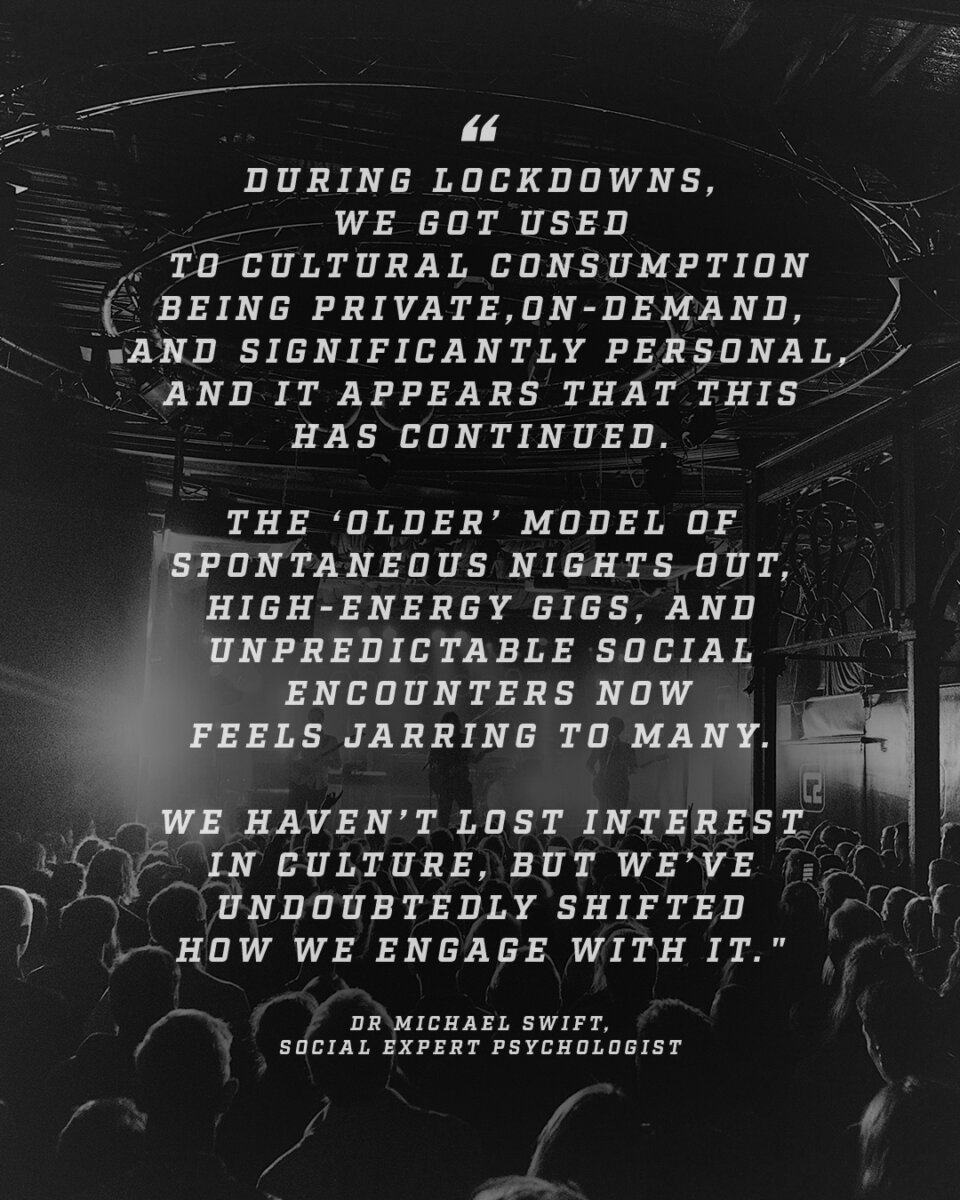
This perhaps isn’t all that difficult to understand given what we went through just a few years ago, as Dr Swift explains, “During lockdowns, we got used to cultural consumption being private, on-demand, and significantly personal, and it appears that this has continued. The ‘older’ model of spontaneous nights out, high-energy gigs, and unpredictable social encounters now feels jarring to many. We haven’t lost interest in culture, but we’ve undoubtedly shifted how we engage with it.”
In fact, when I spoke with the Counselling Directory, they stated that 79% of their therapists have observed a broader increase in general anxiety since the pandemic, and that 67% of therapists reported an increase in clients struggling to make or maintain friendships. The calming and personal nature of podcasts plays into both of those statistics.
So, have we collectively become more insular and controlled in our cultural consumption?
According to D Swift, that clearly appears to be the case. “Lockdown trained us to curate our environments more tightly,” he says. “There’s psychological comfort in predictability, and many people are still seeking that. The result is a type of cultural ‘quiet quitting’ – we still engage, but we want more control over the pace, tone, and intensity. That’s partly a post-stress recalibration, and partly a response to the sensory overload that high-energy culture can now trigger.”
In effect, a music gig might deliver the best night of your life, or it might result in a burst eardrum, a pointless late night, and a student spilling a pint down your new shirt without saying sorry. That used to be the thrill of it all. But now, it is a wearying risk that a live podcast show seems to avoid while still providing the same sense of cultural engagement. As Swift says, “there’s growing evidence” that many people now prefer the slower, safer bet of low-energy events.
“Surveys in the UK and US post-lockdown show a dip in attendance at large-scale live events,” Swift continues, “especially among over-35s. At the same time, podcast listenership, audiobook sales, and smaller venue bookings are up. From a psychological standpoint, this tracks with what we know about post-crisis behaviour: people seek safety, familiarity, and a sense of autonomy.”
We might think that five years on, we have put this sort of thinking far behind us – that we have collectively healed to such an extent that the pandemic age is merely a strange memory.
Still, ever since Covid-19 befell society, the water-spigot of external stress has only gushed with growing intensity, hinted at by ‘permacrisis’ being the Collins Dictionary ‘Word of the Year’ back in 2022. We have never really been afforded the chance to slink back into a mindset of life being knowably mundane and crying out for the shake-up of live music.
“Attention spans have been impacted by digital overuse and pandemic-related stress”.
Dr Michael Swift
We seek out our comfort zones because they have become minuscule sacred ground as work and life become more stressful, eviscerating the age when comfort zones were an expansive norm that we sought to escape. But has the amplification of fraught news and unfurling crises fundamentally changed us? And if so, how?
With our comfort zones shrunken, have our attention spans also been squashed? Have our wallets felt the same squeeze? It is likely that we have seen a combination of all three “simultaneously feeding into each other,” Dr Swift opines. Comfort zones shrank during lockdowns and haven’t fully bounced back. We’ve especially seen a growing prevalence of social anxiety disorder.”
Finally, he adds, “Economically, people are simply making harder choices about what’s worth spending money and energy on. Live music isn’t being rejected outright, but it’s competing with easier, more controllable alternatives that didn’t exist at scale ten years ago.” And with hard choices abounding, it might not be the case that live podcast shows are outstripping music, but there’s certainly “a psychological richness and comfort to long-form, conversational content”.
Swift adds, “That’s very different from the ‘adrenaline rush’ and excitement and communal energy of live performance. In a post-pandemic world where a lot of us are still regulating stress and social overload, introspection often feels more ‘beneficial’ than energy.” And the urge to ensure we’re engaging with things that are ‘beneficial’ has also risen in importance. There is a rising perception of time poverty. We feel more ‘on’ than ever. Even responding to texts and keeping up to date with trends feels like demands that erode our precious leisure time, so we’ve become more careful about wasting it.
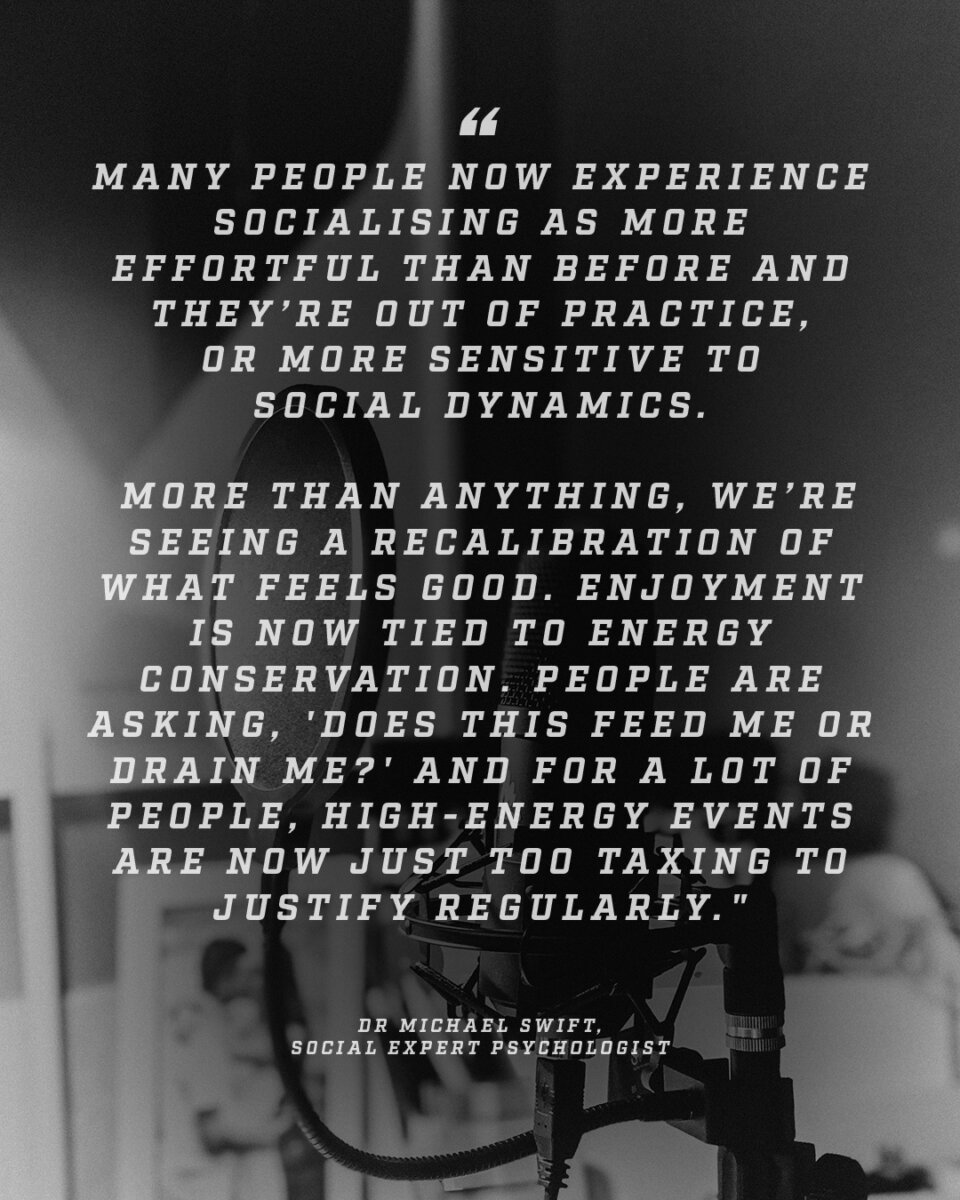
“Many people now experience socialising as more effortful than before and they’re out of practice, or more sensitive to social dynamics,” Swift notes. “More than anything, we’re seeing a recalibration of what feels good. Enjoyment is now tied to energy conservation. People are asking, ‘Does this feed me or drain me?’ and for a lot of people, high-energy events are now just too taxing to justify regularly.”
Ironically, this drive to endlessly protect our energy stores and the imagined richness and achievements we associate with that might actually be fuelling further burnout. In fact, the very philosopher who first coined the term ‘burnout’, Herbert Freudenberger, supposed that our ceaseless drive towards productivity, perfectionism, and high achievement was the main driver. In this case, he would likely claim that we must relearn our capacity to enjoy gigs as fun and frivolous, but deeply vital, even if they are momentarily tiring. In doing so, we might find ourselves less pent-up about ‘making it’ and our hamstrung inability to do so, and more accepting of life’s windfalls outside of the anxiety loop we’re tethered to.
This is where it becomes a problematic trend as opposed to a natural societal stress response. With the notion that many social events ‘drain us’, while insular activities ‘recharge us’, our “in-built cost-benefit calculation” seems to have shifted. However, the lure of the sofa and reserving our time for ‘safer events’ often means more time spent scrolling on our phones. For instance, a recent study published in the Royal Society Open Science journal found that when workers felt fatigued and went on their phone for a rest break, they ended up feeling even more fatigued afterwards. Likewise, while reading results in relaxation, scrolling through social media actually triggers a stress response and diminishes our dopamine levels.
Meanwhile, a study undertaken by Goldsmiths University found that as little as 20 minutes spent at a gig can increase feelings of wellbeing by 21%, and while the study was admittedly commissioned by O2, it also found that regular attendance – defined as around one show every fortnight – can extend your life expectancy by nine years.
Moreover, Personality and Social Psychology Bulletin found that the positive effects of a live music event can persist for up to a week. And that’s before we get into how utterly vital these spaces are for the progressive, collective development of the communities we live in.
