


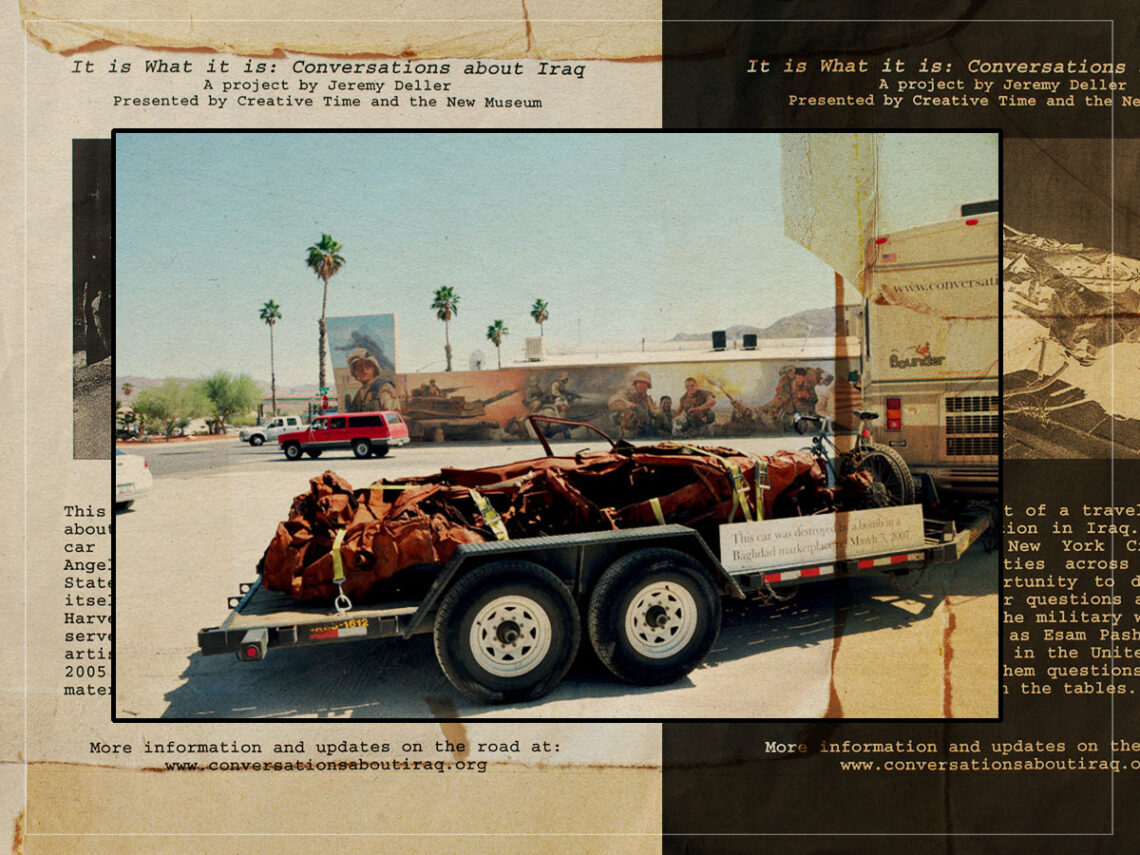
Why did Jeremy Deller take a bombed car to America?

Art doesn’t always have to be made, as long as it makes a statement.
This point is certainly true for ‘It Is What It Is’, the relic of a blown-up car from an attack on a book market in Baghdad in 2007, where 35 people were killed, during the American “war on terror”.
What we look at is the relic of the car, which has now become a sculpture. With no context or explanation, the message is clear. Nothing has been touched or altered; after all, it says it in the name, there’s no hiding it. This is because, as British conceptual artist Jeremy Deller champions through his work, there are not enough words or the right words to describe war’s horrors.
This is why taking the rusted, crumpled remains of a blown-up car just after an attack can be even more poignant than displaying the attack itself. In some ways, the ‘skeleton’ of this car feels like the body of a soldier after war. It embodies the all-consuming horrors of war — psychological, physical, infrastructural, and societal.
The car is completely disfigured, an angular, bony carcass of what once was a functioning vehicle that belonged to someone, most likely a civilian. Now it is useless, just like war. It represents what humanity is capable of doing when power and greed exceed rationality and empathy.
But Deller didn’t just leave it in an exhibition for visitors to come and see. No, he wanted to force it up close to the American people, whose government was waging the war. In this way, they couldn’t escape it or avoid it, rather had to confront the very raw reality of what their government was doing.
When beginning the tour, Deller said, “During the war, America and Iraq were symbiotically linked, and yet the West was largely disconnected from Iraqi people and culture; most Americans had never met an Iraqi citizen.”
Indeed, many wars, for example, the Vietnam War, saw America’s heavy involvement and bloodthirstiness, but given the geographical distance from the conflict, the American people were often unaware of the sheer scale of mass destruction and deaths. So by touring the car relic across the nation, state by state, Deller was able to stimulate political conversation and give people a reality check of sorts.
What’s more, “In a land that worships the car, people want to know what happens to this smashed, scorched vehicle”, said an article by The Guardian. So, many viewers were immediately intrigued to know what happened to it, they were then confronted with the reality they couldn’t avoid. People had mixed reactions, although America had been at war with Iraq for six years, some were in denial, while others felt guilty and saw a side to the war they hadn’t seen before, the Iraqi people’s – civilians like them – side. In this way, one object brings together two people, oceans apart.
Another reason why Deller preferred to tour the car was because “that way people don’t see it as art, but as a terrible relic”. People consciously or subconsciously approach objects differently depending on their intentions, context and location. A car relic from a bomb will be interpreted differently if in a museum or if in an art gallery because it carries a more sensational and less objective element to it in an artistic setting, as if somehow the artist is showing us what he wants us to see.
In this way, Deller has cleverly removed it from the gallery context, going against the traditional norms of what an artist would do to display his works, so it remains as factual and objective as possible. War can never be denied.
