Jeanie and the White Boys aren’t coming for you

Editor’s Note: For 2026, Far Out didn’t just want to recommend ones to watch; we wanted to stick with them. Selecting five artists set for greatness – spotlighting Pem, ELLiS-D, Jeanie and the White Boys, Camille Schmidt and Imogen and the Knife – our Class of 2026 spans genres and countries to back the best of the rising stars.
In a series of repeat conversations pairing each act with a writer, we’ll be checking in with them throughout the year, tracking the highs, lows, trials and triumphs of the talent we believe in. Here, we caught up with Jeanie and the White Boys for an eye-opening conversation.
When Jeanie Crystal lets me into the London pub she lives above, she has half of her makeup done.
For the next ten minutes, I sit and watch over her haphazard morning routine as she jitters on about life in the capital, with its unsuspecting drug dens and its terrible rat infestations, and the art scene that makes it all worth it.
Throughout our interview, strange and unsuspecting characters will flock to Jeanie, asking for a signature for a parcel, offering us a tangy coffee concoction, and taking her order for the local breakfast joint (sausage, egg, brown sauce, white bread). This is the perfect way for us to meet: Jeanie is commotion.
And so the morning will be like this: Jeanie’s shrill, piccolo-like voice leaping through topic after topic in an amalgamation of observational, astute, and disarmingly fervent assertions. Jeanie sits on Far Out‘s Ones to Watch list for 2026, and there’s no wonder why.
It’s a bold assertion, but I’m going to make it anyway: Jeanie is rock and roll in London, distilled down to its core. After three and a half years swallowed up by this city, I’ve finally found it.
The edge between thriving and surviving
The formation of the saucily-named Jeanie and the White Boys seems like an inevitability, born out of mythic smoking areas and the monolithic churn of London alt-scenes. “I knew a few of these boys from just like, going out and stuff,” she shrugged flippantly when I asked for their backstory.
For the frontwoman, where the sound came from was just as important as where she wanted it to go: Gathering her ‘White Boys’ together, she showed them the “lineage of references that I wanted the soundscape to kind of be born from,” and away they went. When I ask for references, Jeanie lands first on female visual artists, such as Yoko Ono, Cosey Fanni Tutti, and Laurie Anderson, before situating the band’s influences at the start of rock and roll and blues.
Jeanie insists that these names matter, because art exists within a canon which, by its very nature, must exclude to promote and platform. We all know who ends up in the exclusion box: the outsiders, the freaks, the lives that don’t align with binaries and definitions, such as working-class people, queer people, and people of colour.
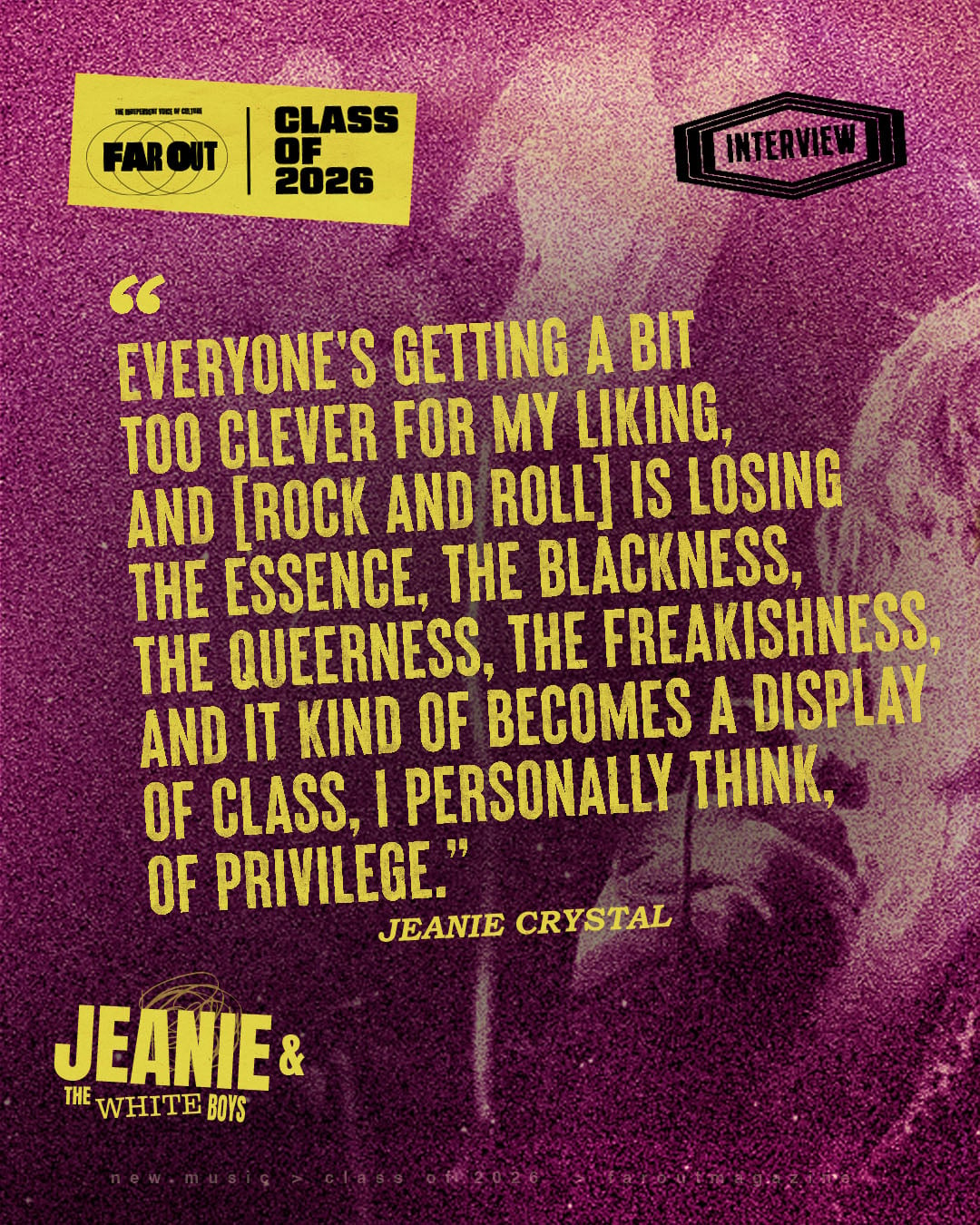
She explained, “Everyone’s getting a bit too clever for my liking, and [rock and roll] is losing the essence, the blackness, the queerness, the freakishness, and it kind of becomes a display of class, I personally think, of privilege.” Incidentally, bands without references “erase a whole fucking history of people’s work”.
Paying respect to this legacy while building upon it is central to the band, whose very name interrogates notions of power and visibility: In light of this formidable task, Jeanie is sanguine, but bares her teeth when necessary. The band’s highlight of the last year? Just getting through it. There’s no gimmicky bravado asserted to rebuff my prying questions; later that day, the band will fail to make it to Bristol because of their van breaking down. Shit, they write online, and move on. Like all the best rock and roll, Jeanie and the White Boys are on the razor-thin edge between thriving and surviving.
In-fighting and music as assault
Plagued by the high volatility of loud music in a loud city, there are quite a few rolling members in the band, for a plethora of reasons. Jeanie reveals that there were only three in the band at one point. “A couple of my band members, we have quite a tempestuous relationship, so there’s a lot of in-fighting,” she smiles. It’s a known fact on the scene that any shit-housery from the men in her band and they’re cut. In an industry that appears to forgive male abusers as soon as the space for a run-of-the-mill guitar band on a dreary East London line-up opens up, Jeanie is doing the dirty work no one else seems to carry out anymore, despite discourse that de-platforming is oh so important.
To Jeanie, it’s no cause for shame: “I demand a certain amount of respect from them that I think they’re used to from other male musicians. I’m not gonna back down on how I expected to be treated in the band dynamic.” Later, she adds, “I’ve lost friends just turning into absolute cunts.” Forget a dislodged aux chord or an amp turned up to 11, it’s the relationship within the band that is sure to sizzle on stage: “I think it creates good shows,” She laughs.
Her audacious confessions are invigorating, and, still, there’s much cause for celebration. “Last year, Iggy Pop played our second single, and he’s a hero,” Jeanie beams, before adding that they’d supported The Black Lips, “another obvious inspiration.” Jeanie isn’t just tallying the wins for her own handbook; there’s a history in her gleaming eye.
Her mother is Caribbean, and her dad is a working-class white man (who happened to live on the same road as Ozzy Osbourne). Both, she insists, should have been artists. “Some of the rage that I’m bringing on is the unjust deal that they both had. There’s a fighting spirit that comes with me that’s for them.”
This impassioned disharmony is a staple of alternative music, no? But, increasingly, an alarming apathy has seeped into much of the rock scene, Jeanie tells me: “A lot of bands don’t have anything to say, yeah, and call themselves rock and roll, and call themselves punk. I find it very hard to ignore what’s going on.”
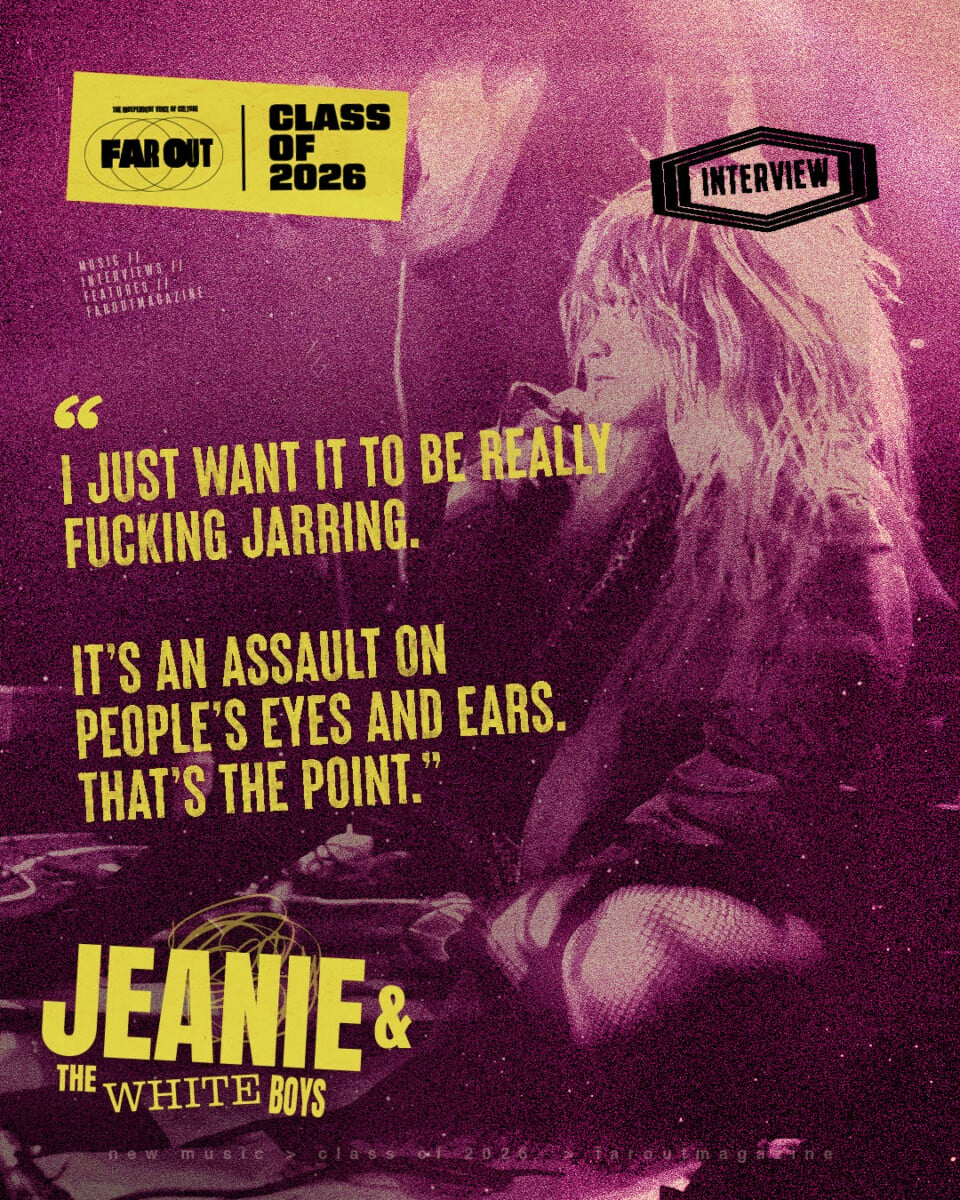
Put your music where your mouth is, Jeanie grins: the current make-up of the band has three guitars. Why? Jeanie leans forward, grinning: “I just want it to be really fucking jarring. It’s an assault on people’s eyes and ears. That’s the point.”
Multiplicity, monsters, and Liam Gallagher
Despite their music being so enjoyably unforgiving and abrasive, Jeanie is surprised when I suggest that the Jeanie and the White Boy sound isn’t delicate or tender. Those are important words to her, to the way the audience, specifically queer, female, and non-white fans, are encouraged to relate to the performance. For the men she often vilifies lyrically, the perception is totally different: “The way I sing can be seen as quite monstrous to a lot of men, and I think subconsciously there might be an element of fear, of me wanting to be less visible.” At a time when all of our reactions are homogenised and sloppified into the algorithmic middle, the band’s sound encourages an eclectic array of responses. Run, Jeanie says. Towards, and away.
The chiming multiplicity doesn’t stop here. There are two Jeanie and the White Boys, too: the “erratic” live band, characterised by what Jeanie perspicaciously deems “all that jumping around”, and the recorded band, tight, particularly, following the formulas left out by the greats. There are two Jeanies, too: our rock and roll star and, curiously, a rave DJ, a pastime to make ends meet but one that allows her to flip the switch, control the sonic circumlocutions of late-night London.
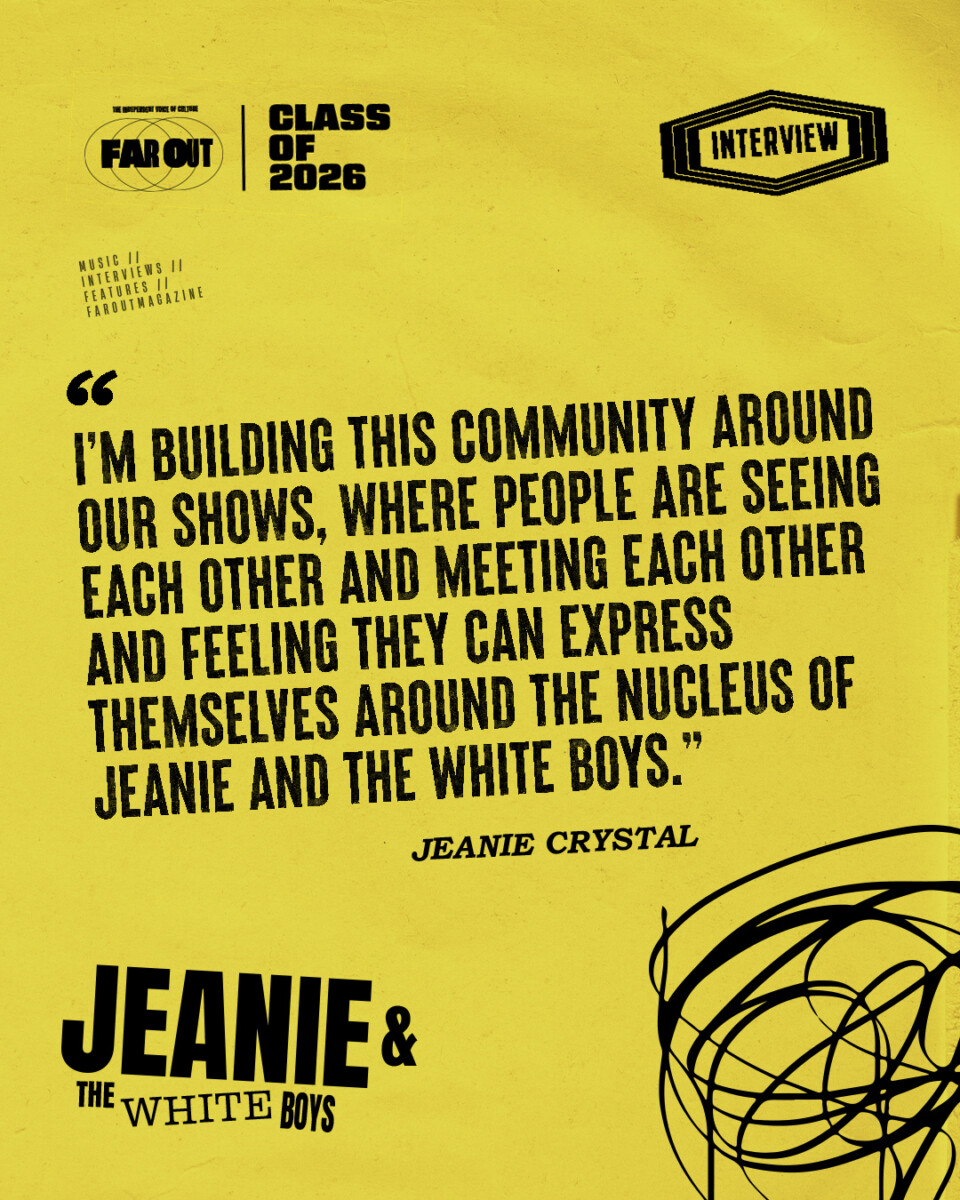
A truth emerges from this neon-lit vision: Jeanie is entrenched in the city, and gestures lovingly that, to her, more community is a real marker of success. The frontwoman is but a star around which a nebula of life-forms cluster: “I’m building this community around our shows, where people are seeing each other and meeting each other and feeling they can express themselves around the nucleus of Jeanie and the White Boys.”
Plus, she wants to wake up the sleep-walkers: “People liking my work, or hating it… Either way, I want a reaction.” Because, we realise as we gather together our voluble musings, fascism hates art: “I don’t think that art has the power to literally save the world,” she clarifies, “but I do think that having an antithesis in culture, voices that give a different option for you to get engaged in, is going to make that whole thing less seductive.”
Jeanie lands us at her great finale, a rallying cry for another Liam Gallagher to worm his way out of the woodworks. I’m momentarily taken aback; I would’ve expected a call for more queer artists in the scene, but Jeanie pins me with a look that suggests I’m not thinking big enough.
That goes without saying, sure, we always need more queer artists… But our situation calls for drastic measures. A lot of the issues we’d touched upon stem from misogynistic idealism spun into far-right sociopolitical advancement, perpetuated by controversial male role models, like Andrew Tate. Art-school head and creative director Jeanie would know a thing or two about the role of cultural symbols, no less because her vocation on stage and in the spotlight makes her into one.
In the late 20th century, she insists, we had plenty of working-class men for young boys with their hands in their pants to aspire to: Blur’s Damon Albarn, The Stone Roses’ Ian Brown, Oasis’ Liam Gallagher. But who do men turn to now, if not the blue-pill red-pill bozo himself? “Sorry, Ed Sheeran, you ain’t cutting it,” Jeanie quips. Jeanie isn’t coming for you, male reader; “We still need that male bravado. It doesn’t need to be erased from culture. It’s OK to be a man, just not a fucking predator, or a fucking rapist.” Say it again for the folks in the back, Jeanie.
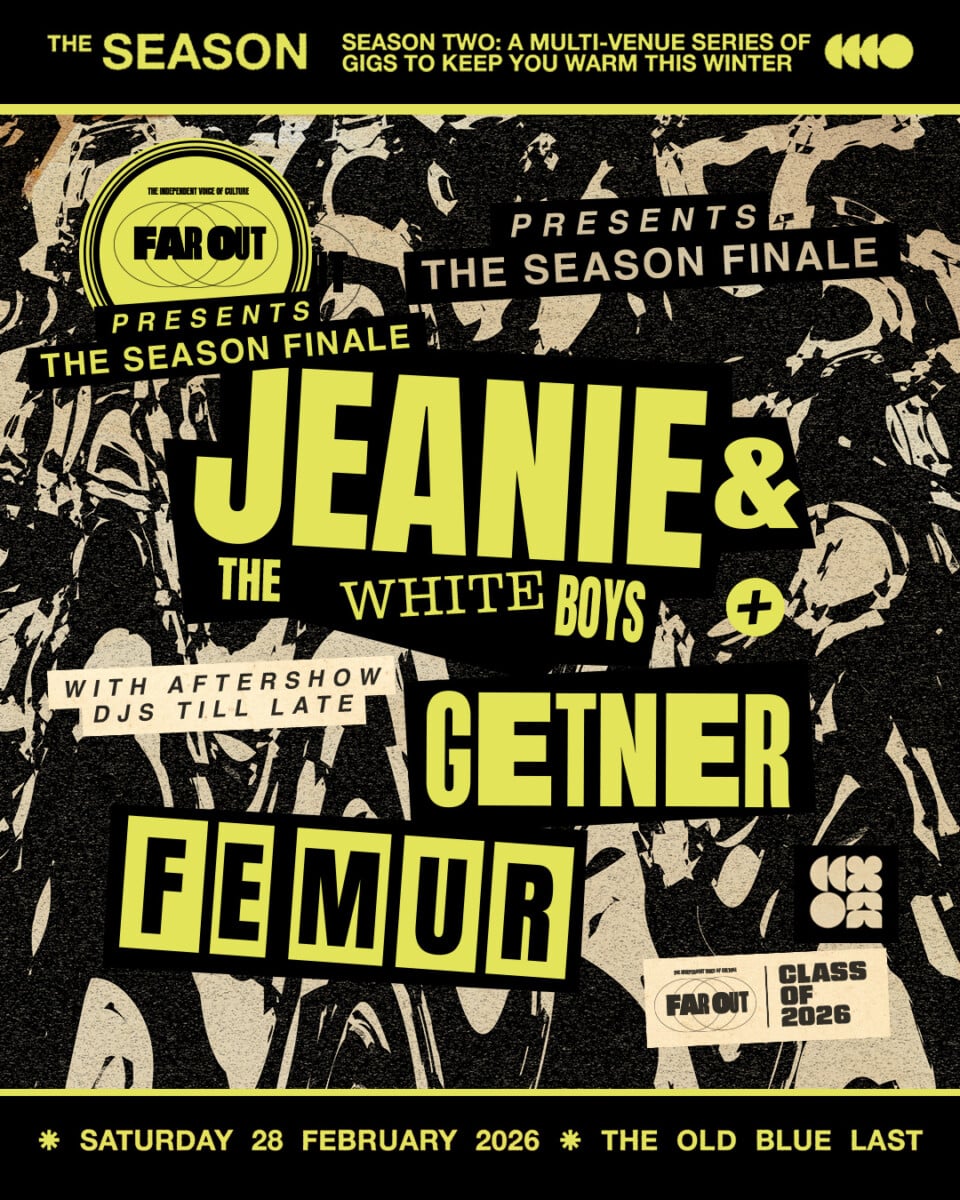
Jeanie and the White Boys are headlining Far Out’s very own live show on February 28th, at London’s Old Blue Last. Come along, one and all: Especially if you look like Liam Gallagher.