


“I started seeing crabs”: the story of Jean-Paul Sartre’s crazy mescaline trip

Although psychedelic drugs are most intrinsically associated with musicians, especially those of the Woodstock generation, some of our literary icons enjoyed a dabble, too. One must remember that, before the pop-rock explosion of the 1960s, legendary British author Aldous Huxley popularised psychedelic drug use in his 1954 non-fictional essay, The Doors of Perception, after which Jim Morrison named his band. Though less overt, another literary psychonaut was the French existentialist Jean-Paul Sartre.
Creative writers from all walks of life, from Oxbridge academics to gun-toting gonzo journalists, seem to have an affinity with consciousness-expanding substances. Such experimentation appears to align with a general curiosity in the arts. In gonzo pioneer Hunter S. Thompson’s case, the crazier the story, the better. Therefore, drugs and liaisons with the Hell’s Angels came hand in hand with a “Tune in, freak out, get beaten” mantra.
In the spectrum of 20th-century writers, Sartre had more in common with Huxley’s academic and philosophical ilk. Accordingly, his approach to drug use was clinical and experimental, as opposed to a wanton venture into the Hell-torn abyss. LSD wouldn’t be synthesised until 1938 and was not purposefully ingested until 1943; therefore, when Sartre made the decision, after much deliberation, to experiment with psychedelic drugs in January 1935, mescaline was the substance of choice.
As Sartre’s bleak 1938 debut novel, Nausea, suggests, he wasn’t the happiest man in France. Taking the book’s central protagonist, Roquentin, as an exaggerated version of Sartre himself, we find a man struggling with the concepts of being and purpose. As he experiences a Godless world, his blurred battles with humanity and nature convey a degree of misanthropy and social anxiety. Are such conditions conducive to a positive psychedelic trip? Let’s see…
On that fateful day in January 1935, Sartre visited Sainte-Anne Hospital in Paris, where psychiatrist Daniel Lagache, who happened to be an old school chum, injected him with a mescaline preparation. He had been lured to the cactus-borne drug while exploring Edmund Husserl’s phenomenology ideas, which advocated consciousness expansion as the key to unbiased perception.
Whether or not Sartre planned on publishing an essay on his experiences, as Huxley would do two decades later, is unconfirmed, but after a somewhat negative experience, published documentation is scarce. Beyond word of mouth and biographical second-hand accounts, Sartre’s experience with mescaline was briefly mentioned in his 1940 book The Imaginary: A Phenomenological Psychology.
“It could only exist by stealth,” Sartre said of the drug, revealing that the insidious illusions were mostly peripheral: when he tried to focus on them, they vanished. He described the various sensory hallucinations as “inconsistent and mysterious” but would later admit to severe discomfort verging on mental breakdown. Quotidian objects morphed into depraved and grotesque spectres in his peripheral vision.
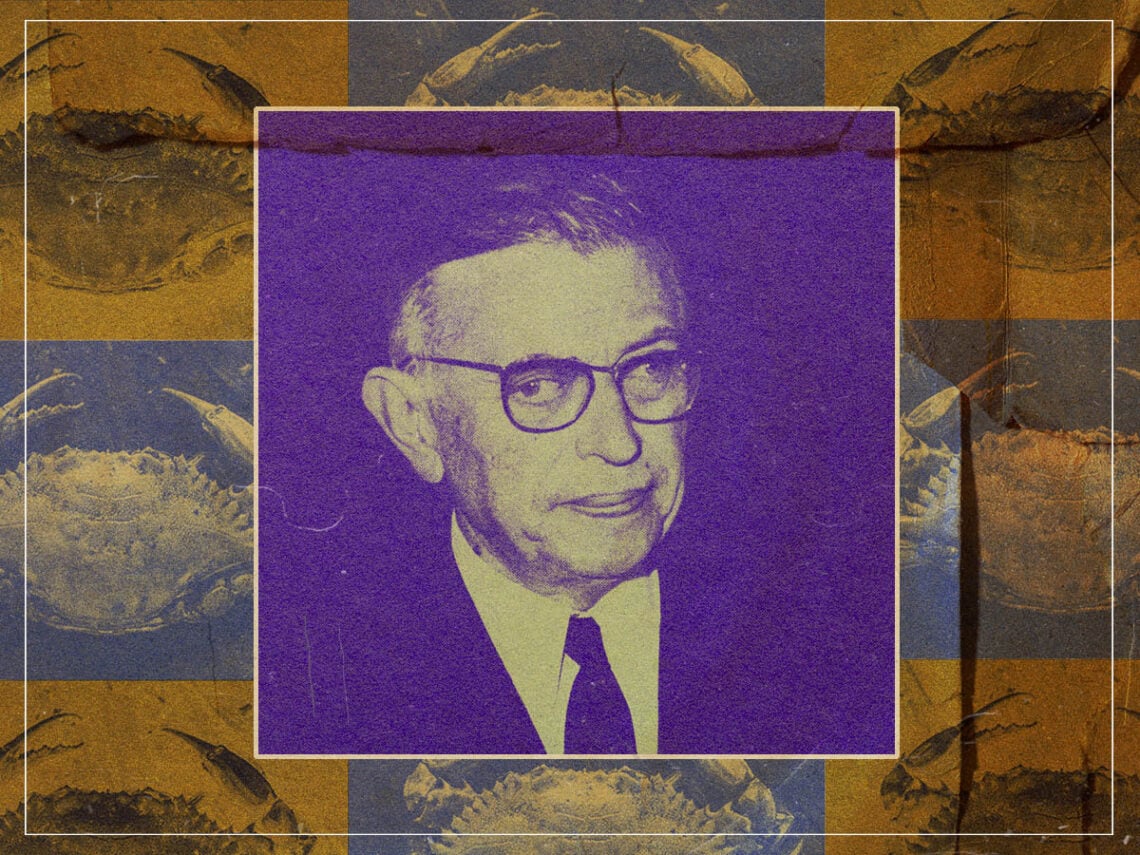
Sadly, Sartre’s “bad trip” endured long after his body metabolised the mescaline. He would later admit to hallucinating crab-like creatures in his periphery, perhaps compounded by his poor eyesight. “After I took mescaline, I started seeing crabs around me all the time,” Sartre told John Gerassi in 1971. “They followed me into the street, into class.” During lectures, students were bewildered on several occasions to see the unhinged existentialist addressing the troublesome crustaceans.
Over time, Sartre became comically genial with his hallucinations. “I would wake up in the morning and say, ‘Good morning, my little ones, how did you sleep?’ I would talk to them all the time,” he remembered. “I would say, ‘OK, guys, we’re going into class now, so we have to be still and quiet,’ and they would be there, around my desk, absolutely still, until the bell rang.”
These hallucinations were undoubtedly the result of a psychological predisposition or a pre-existing condition. Sartre resolved to undergo therapy at the hands of French psychiatrist and psychoanalyst Jacques Lacan. While the sessions failed to uproot anything of significance, Sartre and Lacan concluded that the crabs were likely the manifestation of a “fear of becoming alone”.
“The crabs really began when my adolescence ended,” Sartre noted, either referencing post-adolescent loneliness or confirming that the crabs weren’t solely the product of a mescaline trip at the age of 30.
Sartre cited the crabs as part of his impetus to write Nausea. “At first, I avoided them by writing about them — in effect, by defining life as nausea — but then as soon as I tried to objectify it, the crabs appeared,” he explained. “Then they appeared whenever I walked somewhere. Not when I was writing, just when I was going someplace.”
Fortunately, the crabs weren’t a lifelong ailment. Where Lacan’s psychotherapeutic methods failed, ignorance succeeded. “The crabs stayed with me until the day I simply decided that they bored me and that I just wouldn’t pay attention to them,” Sartre remembered. Around a year after Sartre published Nausea, World War II broke out, giving everyone something significant and external to worry about. “Then the war came, the stalag, the Resistance, and the big political battles after the war,” he concluded.
