


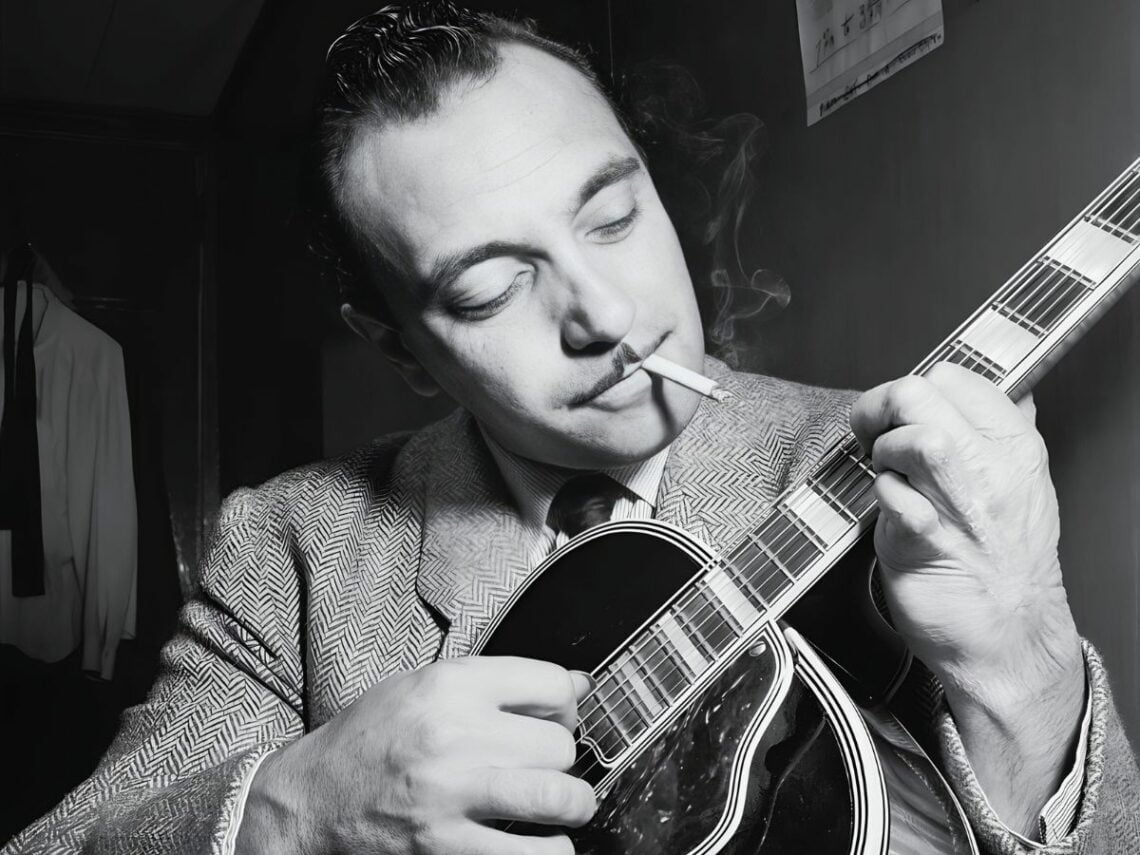
Watch ‘Jazz Hot’ a short film that features Django Reinhardt’s best solo

Fun fact, the line between musicians and movie stars was once basically razor thin. While record players became household appliances in the 1920s and 1930s, they still weren’t ever present until a few decades later. Until then, music was distributed at home as sheet music that you’d play on the piano, and if you wanted to see the biggest stars of the day, from Django Reinhardt to Cab Calloway, you had to either luck out and see them live, or head down to the cinema and see them.
This was because many films were made with the express intention of showcasing the musicians of the day. In fact, it was one of the reasons that developing ‘talkies’, that is, movies with sound, was so vitally important to movie studios. It gave them a whole new dimension of pictures they could sell to the general public, music movies that were built around the stars of the day doing what they did best.
In fact, the very first ‘talkie’ ever produced was exactly this. 1927s The Jazz Singer was a hastily cobbled-together musical biopic where famed singer of the day Al Jolson acted out a fictionalised version of his life story in order to perform a set of numbers from his deeply, deeply racist minstrel show act. The movie was a colossal success, and many other pictures of the same ilk were greenlit and put into production.
Of all of them, one suited the visual medium more than any other. A 1938 short film titled Jazz Hot. This was a picture made to immortalise not only the music of jazz guitar legend Django Reinhardt, but also the sight of him playing the said music. This might sound like a slightly bizarre reason for doing so, but only if you’re unfamiliar with his backstory.
Why was it important to see Django Reinhardt playing guitar?
Born Jean Reinhardt in Liberchies, Belgium, Django Reinhardt took up the guitar at 12 years old and almost immediately proved himself to be a prodigy on six strings. His French-Romani family saw him relocate to the Romani communities of Paris, where he began playing jazz guitar within his community. At the age of 18, though, tragedy struck, which nearly took his life and livelihood away forever.
The caravan he shared with his wife caught fire, and while Reinhardt was able to escape, he did so while suffering severe burns to his body, especially on the fourth and fifth fingers of his fretting hand. Doctors told him he’d never play again, yet Reinhardt taught himself to play with only the remaining two functioning fingers of the affected hand.
Reinhardt became a virtuoso despite his handicap and an international celebrity as a result of this. Thus, the short movie was greenlit to show not only Reinhardt’s music to a wider audience but also the genuine, bona fide miracle that was his playing. For me, the existence of this footage is just as much of a miracle as anything it depicts.
The music of Django Reinhardt is music that, by all logic, shouldn’t exist. Yet, just like the man himself, it persists. Everything that keeps his memory and music alive should be cherished, with this short movie being just one of many.
