


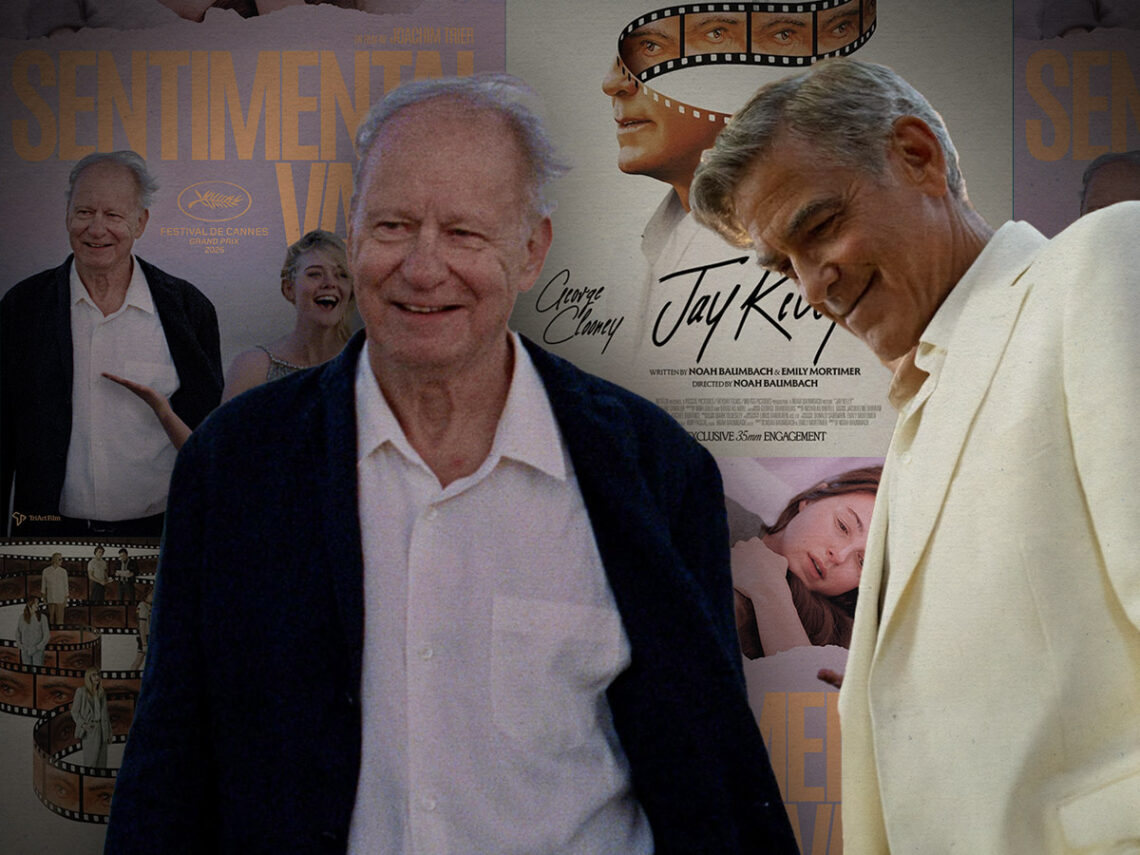
‘Jay Kelly’ and ‘Sentimental Value’ are mirror images: How did one fail so spectacularly?

It’s not unusual for filmmakers to make movies about their industry, but 2025 saw two films that were remarkably similar even by those standards – Noah Baumbach’s Jay Kelly and Joachim Trier’s Sentimental Value.
Both films revolve around an ageing cinematic icon. In the former, it’s the titular Hollywood movie star, played by George Clooney. In the latter, it’s an acclaimed director named Gustav Borg, played by Stellan Skarsgård. Both men have strained relationships with their two adult daughters, who struggled with their fathers’ absence throughout their childhoods. Both men attend glitzy European film festivals, which are presenting retrospectives of their work, and both are floundering to find meaning as they finally reckon with their past and their rapidly shortening future.
There is one key difference, though. Sentimental Value is a life-affirming, deeply human film about loss, connection, and tenderness, and Jay Kelly is a self-important waste of budget. How could two movies that purport to explore similar territory and which were helmed by acclaimed directors end up so different?
There are countless examples of just how bad Jay Kelly is, but one of the most egregious is a scene with a therapist. Jay has gone to visit his daughter, Jessica (Riley Keough), who wants to work through their difficult relationship. She coerces him into seeing her therapist (Josh Hamilton), a man who wears huge sunglasses indoors because of a “retinal disorder” and sits cross-legged on his easy chair.

Jessica has written a letter to her father in the voice of her ten-year-old self, but because she can’t get through reading it without bursting into tears, she lets Carter, the therapist, do it for her. A few sentences into a clichéd memory about how sad she felt when she watched Jay being a better father on screen than he was in person, Carter begins to sob. Jay bursts out of his chair and abandons the session, as Carter and Jessica exclaim in disbelief at his outrageous behaviour. This scene is obviously meant to be an uproariously hilarious send-up of the counselling profession, but it is so absurdly off-base that there is no humour in it whatsoever.
In another scene, Jay goes to dinner with an old theatre school friend who seems overjoyed to reconnect. The friend (played by Billy Crudup) is full of warmth and the sort of genuineness that Jay is missing in his sanitised Los Angeles world. But partway through their happy reunion, Crudup’s character undergoes an instantaneous personality transplant and reveals that he despises Jay for supposedly stealing his acting career.
They have an actual fistfight in the car park, which leaves Jay with a black eye. Later, there is an extended sequence on a train that is so contrived that it feels almost unkind to watch it. Something went terribly wrong with this film, and if the creators aren’t embarrassed by it, that’s a humiliation in itself.

Compare these woefully exaggerated, soulless setpieces with any conversation in Sentimental Value, a film which is both generous of spirit towards its characters and unflinching in its portrayal of their weaknesses. There is one scene between Gustav’s two daughters, Nora and Agnes (played by Renate Reinsve and Inga Ibsdotter Lilleaas, respectively), that is so delicate and moving that you might find yourself weeping quietly so as not to disturb it. It’s a film that conjures deep emotion with exquisite subtlety, a movie that evokes copious tears without being a tearjerker.
Baumbach has the ability to make movies that cut right to the heart of things, too. 2019’s Marriage Story is an almost unbearably intimate portrait of a dissolving relationship that earned near-universal acclaim. But Jay Kelly is the worst-case scenario of filmmakers making movies about filmmaking. It is so hackneyed and self-indulgent that it doesn’t just make you question whether Baumbach has ever been to Hollywood, but whether he has ever actually met a human being.

This was supposed to be an acting showcase for Clooney. Before it was released, the word ‘Oscar’ was even bandied about in some circles. But he should have just stuck with semi-retirement. At the end of the movie, Jay Kelly (whose name, let’s remember, rhymes neatly with the actor who portrays him) watches a highlight reel of his career, which is just a highlight reel of Clooney’s career. Drowning in the backwash of the previous two hours, this scene miraculously rewrites history, making you question whether Clooney is actually a movie star with a respectable filmography that justifies his stature in the industry.
There is no shame in making a bad movie for the sake of a good vacation. Michael Caine made The Marseille Contract without reading the script because he wanted to take his daughter to the South of France for the winter. Adam Sandler has said that he’s been picking films based on their vacation potential since 50 First Dates, more than two decades ago.
He clearly agreed to be in Jay Kelly for the same reason. It takes place in Tuscany and Los Angeles and is packed to the gills with Baumbach’s famous friends. They must have been laughing all the way to the bank by way of a few sun-drenched vineyards. But if you’re going to be shamelessly transactional, don’t pretend it’s a serious project.
To hear the director talk about it, this is a film about memory, mortality, and Clooney’s superhuman ability to play a character who is absolutely not at all like himself (he seems particularly adamant about that last point). In the end, however, it’s a vacuous con that either reveals the cluelessness of the people behind it or betrays their disdain for their audience. Luckily, the audience got the last laugh.
The fact that this came out the same year as Sentimental Value seems like a cosmic joke at Baumbach’s expense.
