


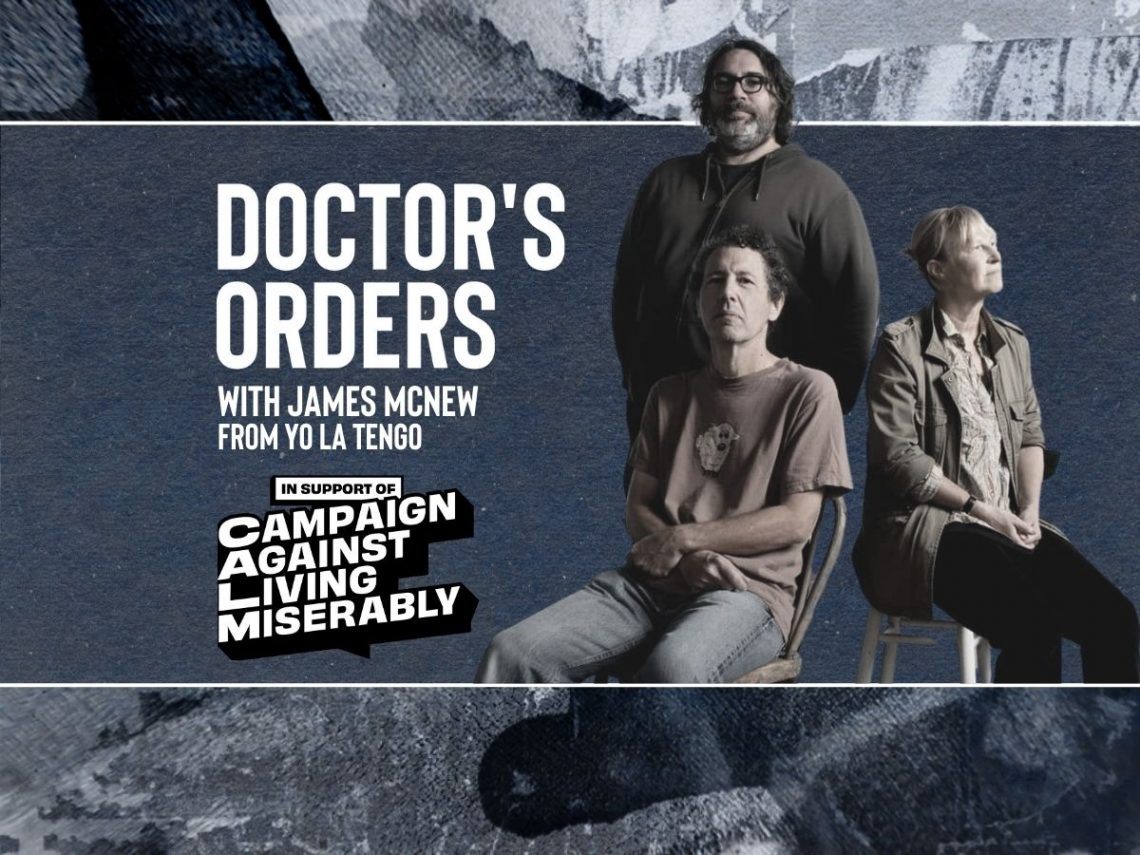
Doctor’s Orders: Yo La Tengo’s James McNew prescribes his nine favourite records

Although frequently hurled under the blanket label of “indie”, New Jersey’s Yo La Tengo have explored such a wide variety of musical styles over their four decades and 16 studio albums that they’re a tricky group to pigeonhole.
The band currently consists of the two core founding members, Ira Kaplan and Georgia Hubley, and multi-instrumentalist James McNew, who joined back in 1992 to play on May I Sing With Me. Embracing the late 1990s as a robust trio orbited by a shifting ensemble, Yo La Tengo enjoyed their most critically and commercially successful spell with stand-out releases like 1997’s I Can Hear the Heart Beating as One and 2000’s And Then Nothing Turned Itself Inside-Out.
Having explored atmospheric soundtrack work, acoustic folk, shoegaze and heavier alt-rock sounds, Yo La Tengo have left few stones unturned and garnered a strong cult following. At the beginning of November, the trio announced the arrival of their 17th studio album, This Stupid World, alongside its lead single, ‘Fallout’.
Judging by the noise rock sound of ‘Fallout’, the forthcoming LP, which hits the shelves on February 10th, 2023, will mark a return to the heavier stuff following 2020’s five-track ambient effort, We Have Amnesia Sometimes. According to a recent press statement, Yo La Tengo recorded, produced and mixed the album at their own freedom, and within each song, there is a live band performance at the core before overdubs.
The absorbing, broadly improvisational tracks on This Stupid World are described as “journeys, such as the three-dimensional swirl of ‘Brain Capers’, which blends guitar chords, bass loops, drum punches, and various iterations of [Georgia] Hubley and Kaplan’s voices (with lyrical references to Alice Cooper, Ray Davies, and Rick Moranis) into shifting layers, or the epic twilight wash of ‘Miles Away’ where a dubby rhythm lurks below Hubley’s bright paint-brush vocals. These touches, accents, and surprises make for a rarity: a raw-sounding record that gives plenty of headphone detail to get lost in.”
Recently, we were lucky enough to get in touch with McNew for our latest Doctor’s Orders prescription. The multi-talented musician and vocalist shared nine albums that hold a special place in his heart and revealed how they turn his creative wheel.
Continuing with our Mental Health Awareness campaign, Far Out has teamed up with the suicide prevention charity CALM to help connect you with your favourite artists and hear how music has helped them during their darker times and day-to-day lives. The organisation, with the full working title of ‘Campaign Against Living Miserably’, offer a free, confidential and anonymous helpline for those most in need of mental health support.
We at Far Out believe in music’s ability to heal. It could be the moment that the needle drops on your favourite song and provides respite from a chaotic world, or, conversely, it might be the fanatic conversation you have with friends about which guitarist was the greatest. Music, it’s safe to say, has always allowed us to connect with one another and ourselves. In support of CALM, we’re asking a selection of our favourite people to share nine records that they would prescribe for anyone they met and the stories behind their importance. Doctor’s Orders sees some of our favourite musicians, actors, authors, comedians and more offer up the most important records, which they deem essential for living well.
So, before we can get stuck into the new album and its accompanying tour next year, let’s enjoy the fine musical tastes of James McNew.
James McNew’s nine favourite albums:
El-P – Fantastic Damage
For McNew’s first selection, he picked out Fantastic Damage from the 2002 debut album of New York City-based hip hop artist, and one-half of Run The Jewels, El-P.
“Still the most psychedelic hip-hop LP of all time,” he said in praise of the unique album. “VERY dark but still somehow funny, and brutally human and revealing, suffused with real tenderness. Still sounds like nothing else. How can this album be 20+ years old already? So much terrible shit hadn’t even happened yet.”
The dark yet revealing humour encountered in Fantastic Damage can help us to embrace life through unfiltered lenses. When it comes to mental health, it’s important for us to find beauty and humour in unexpected places.

Serge Gainsbourg – Histoire du Melody Nelson
While many people can find ecstatic release in listening to upbeat pop music on Radio 1, profound comfort can also be found in melancholy vibrations.
In 1971, French singer-songwriter Serge Gainsbourg released one of his most insightful and compelling albums, Histoire du Melody Nelson. While his lyrics are in French, his English-speaking peers have long found inspiration in the emotional rollercoaster conveyed by his vocals and instrumental composition.
“Speaking of dark,” McNew commented, with the previous selection in mind. “A clammy fever dream of an album. Amazing, poisonous small band grooves (feedback!) and breathtaking string arrangements. I don’t speak French, and I don’t want to know what he’s saying. I think I get it.”

The Beach Boys – Friends
Though it sold poorly, The Beach Boys’ 14th studio album, Friends, has since been marked for its originality. Consisting of 12 tracks, each running for less than two minutes, the release departed from the band’s previously bold and vibrant sound. Instead, Friends takes a tranquil, understated form that retains the band’s beautiful vocal harmonies while massaging the ears and mind.
“Somehow, The Beach Boys made this (brief) album of utter beauty despite their tough times,” McNew said. “Carl [Wilson] steps up and knocks it out of the park. Even more harmonically advanced than Pet Sounds despite feeling lighter than air (the deceptively deep ‘Little Bird’, for example).”

Robert Ashley – Private Parts
Robert Ashley, the late American composer known best for his television operas and other theatrical works, released this overlooked gem of an album in 1978. The music flows gently with ambient textures while Ashley takes the listener through a stream of conscious narrative. If you need to rest your head on a pillow of sound, look no further.
“Minimal, meditative, hypnotic perfection,” McNew pondered. “Ashley’s voice, barely above a whisper, is like a candle burning, as his libretto gently tumbles out. The music itself is barely there, drifting clouds of synth (by Tom Hamilton) and piano (by ‘Blue’ Gene Tyranny). A waking dream.”

Chris Knox – Seizure
New Zealand-born punk rock innovator Chris Knox released his second solo album, Seizure, in 1988. The varied work boasts some of his most enveloping and seminal work.
In 2009, was admitted to Auckland hospital after suffering from a stroke. In a heartwarming gesture, some of his most dedicated disciples, including Yo La Tengo, Jay Reatard, David Kilgour, The Mint Chicks and Shayne Carter, teamed up to record Stroke: Songs for Chris Knox, a benefit album used to raise funds for Knox’s rehabilitation.
“I saw Chris open for The Clean at CBGB in 1989,” McNew recalled. “I was a huge Tall Dwarfs fan and didn’t know what to expect from Chris’s set, I hadn’t heard this record yet. He accompanied himself on electric guitar (an Ovation Breadwinner), mostly distorted (a prototype Crowther Hot Cake). I don’t think he played one Tall Dwarfs song but he did most of these and maybe some new unreleased ones.
“The songs were amazing, personal and funny, and unforgettably catchy. The album is very similar to the set I saw, with the addition of homemade percussion loops (and minus the hilarious stage banter). It contains ‘Not Given Lightly,’ perhaps the most perfect love song ever written. In 1998 in a pub in Auckland, this song came on the jukebox after several popular hits of the day, and I burst into tears. Good times.”

Chrome – Half Machine Lip Moves
When looking to escape the pressures of modern life, if just for a short spell, music can be the best medicine. The bizarre world Chrome created with this unique 1979 release could be the perfect place to let your imagination run wild.
“Apparently, Chrome was just two guys from San Francisco, but If I found out this record was not made by humans, I wouldn’t be surprised at all,” McNew opined. “Instruments, gear and tape being pushed far beyond its will. Songs (?) veer in and out of surprise nightmarish sound washes, neck-breaking jumps from piece to piece. Vocals (?) that feel more like warnings. Guitars (?) that sound like handfuls of corrosive gunk. How did they do it?”

The Bonzo Dog Band – Keynsham
British comedy rock group, The Bonzo Dog Band, took the wit and wisdom of The Beatles and expressed it in enjoyable musical parodies over the 1960s and ’70s. Keynsham is sure to turn the deepest of frowns upside down.
“Their fourth and “song-iest” album, many of the songs by pianist/ occasional guitarist/ singer, and, to me, greatest songwriter in the world, Neil Innes,” McNew said of The Bonzo Dog Band’s fourth album. “‘Quiet Talks And Summer Walks,’ ‘I Want To Be With You,’ ‘Joke Shop Man,’ ‘What Do You Do’, and more. Still plenty of layers of dadaist confusion to keep things blurry. Plus, the unbelievable bass of Dennis Cowan!”

Happy End – Kazemachi Roman
Japanese folk rock groups are something of a rarity, but Happy End, the short-lived group from Tokyo, fill the welcomed niche perfectly. The group released three captivating studio albums over their three-year stint, but Kazemachi Roman surfaces as the jewel to their crown.
“California folk-rock filtered through Tokyo, streamlined and, well, perfected,” McNew said. “Sweetly melancholy, nostalgic songs with aching, vulnerable harmonies by Harry Hosono and Eiichi Ohtake. What a rhythm section, too. My Japanese isn’t so great, either, but this record means the world to me.”

Minutemen – Double Nickels On The Dime
California-based post-punk outfit Minutemen made quite the impression over their active years between 1980 and ’85. The band’s third album, Double Nickels On The Dime, encapsulates the group’s eclectic pool of influence with hints of punk, funk, country, spoken word and jazz.
Tragically, bassist D. Boon died in a car crash, marking the end of the band in 1985. Fortunately, the spirit of Minutemen lives on in the music of their admirers.
“The eternal sound of friendship,” McNew briefly but poignantly reflected.

