


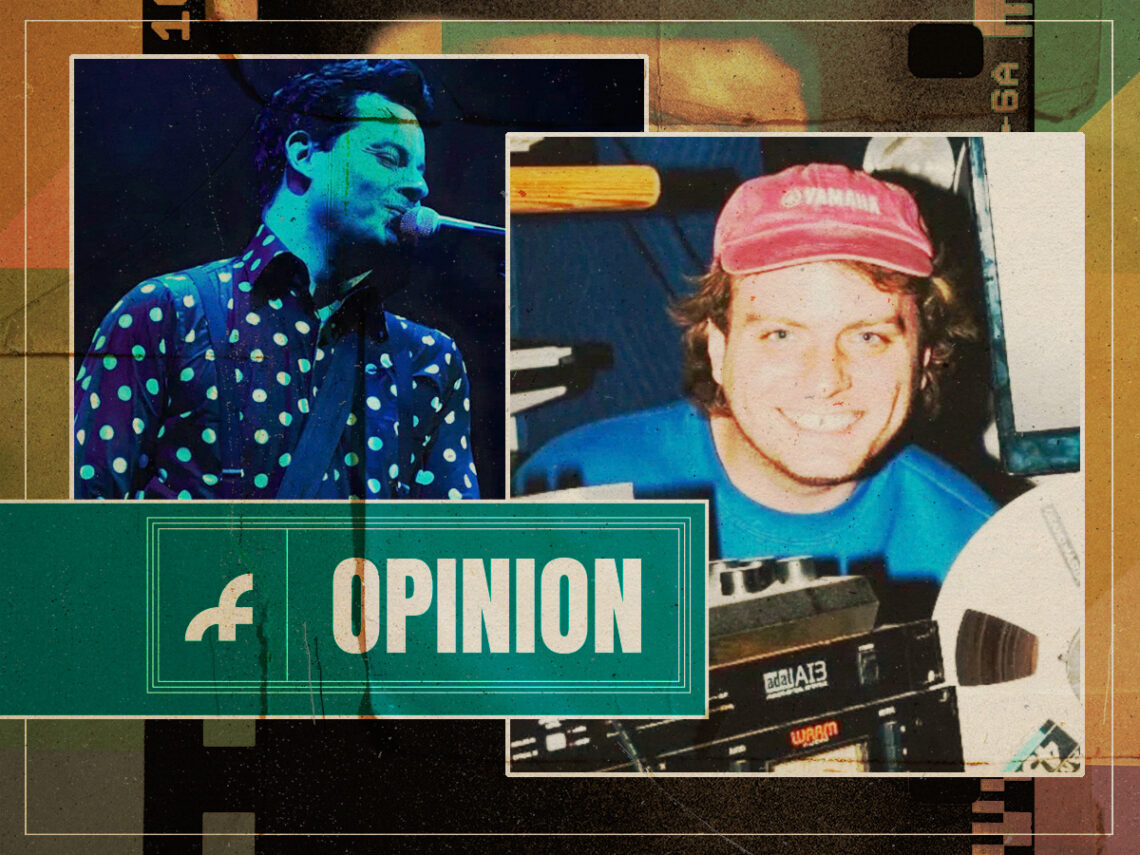
Jack White’s surprise vinyl vs Mac DeMarco’s streaming experiment: radically contrasting album drops in the digital age

Last week, a flock of fans descended on Third Man Records stores around the world in the hopes of snaffling a mysterious freebie, stamped No Name, that was being handed out with every purchase. As it turns out, this plain vinyl was Jack White‘s previously unannounced new album. A few more lucky fans have now managed to pick up a copy after the former White Stripes man gave a batch of blue discs out for free at a recent charity gig.
This furthers the present trend of quirky record releases in the modern age. Last summer, Mac DeMarco came up with a novel release of his own when he simply uploaded 199 songs to Spotify in a single dump with the record One Wayne G. In some ways, these two album releases seem like polar opposite responses to the very same stimulus: streaming.
DeMarco, essentially, summarised his decision to drop nearly nine hours of music in one go as follows: I have a lot of tracks that I like but don’t know what to do with them. In an age where streaming is increasingly rendering culture ‘content’, why not lean into it and creatively give fans something they might like? White’s current campaign seems like the inverse of this, utilising vinyl and live events, the last bastions of analogue and acoustic in a digital and synthesised age.
DeMarco’s approach is made even more interesting when you consider his history with streaming. The Canadian indie slacker said he didn’t even have Spotify until a few years back. He had swerved the streaming revolution and consumed music in the same old fashioned way that White is now flagshipping. However, it would seem he simply acquiesced because music had reached a point where the digital age was unavoidable—rather than fight it, he decided to creatively make use of it.
However, White’s dedication to the old-school analogue ways has proved unwavering, even seemingly impacting his creative mindset by virtue of the fact that the forthcoming mystery release sees him revert to a no-nonsense brand of blues rock, not a synth or laptop in sight. Alas, he’s also not staunchly against streaming. Ironically, he’s more into it than Mac, saying a few years back that he consumed 90% of his music on Spotify and that digital and analogue work best together when it comes to feeding into inspiration.

Nevertheless, his latest release is one that valiantly battles against it, getting people into gigs and record stores to get a copy of something timeless, tangible and terrestrial—getting people off their couch and engaging with that they consume. Naturally, this seems vital, but time will tell whether the digital age will render it futile and more artists will go down the DeMarco route, choosing to see streaming as something that liberates creativity.
However, one thing that certainly seems essential for the future of art is that both work in conjunction. While the word ‘content’ seems dirty at present, it has its place in the digital age. The world is better off with an extra 199 DeMarco songs that would’ve otherwise rotted out of existence. However, ironically, the digital age means that rotting out of existence is the fate that awaits the songs. Meanwhile, even if White decided not to roll out a wider release and simply left it at the few discs out there in the wild, No Name would persevere for longer.
Even as the digital revolution quashed it to the odd ‘mystery vinyl’ stunt, analogue remains the future. You just have to look at how much of Netflix’s original, purely digital content has already begun to disappear forevermore. Entire works of art, evaporated and rendered redundant. They’ve been deleted out of existence to make space for the next ephemeral shot at a hit.
As Steve Albini said, “I feel like my day-to-day job is being a vector of history. I’m making recordings which are going to sit on a shelf and then at some distant time are going to be discovered again. Making a permanent record, I take that aspect of it very seriously. I’m certain that analogue recordings will survive over a scale of centuries. I have no certainty about any digital formats surviving that period.” However, DeMarco’s argument is that songs that were going to sit an unreleased shelf and disappear without anyone bar him ever hearing them may as well be released and maybe garner some precious revenue in the process.
But that doesn’t mean that Albini’s statement about digital uncertainty isn’t already proven true. It is estimated that an unfathomable 100,000 songs are uploaded to Spotify each day. Routinely, Spotify will purge 750,000 of these tracks at a time because they have broken terms of service in one way or another, and deleting them helps to streamline their data. That seems fair enough, but the issue is that Spotify is often the only place where that song exists; the uploader may not be aware of breaking terms of service or even the deletion, and the end result is the disappearance of art.
I’m not sure Mac would mind all that much if One Wayne G wasn’t around in 100 years, but that shouldn’t be the modern outlook of art. As both White and DeMarco prove, the digital age should be used as source of creative impetus, whether that’s using tech as a liberating democratised tool, or rallying against it and honouring the past, but one cannot and should not entirely replace the other.
