


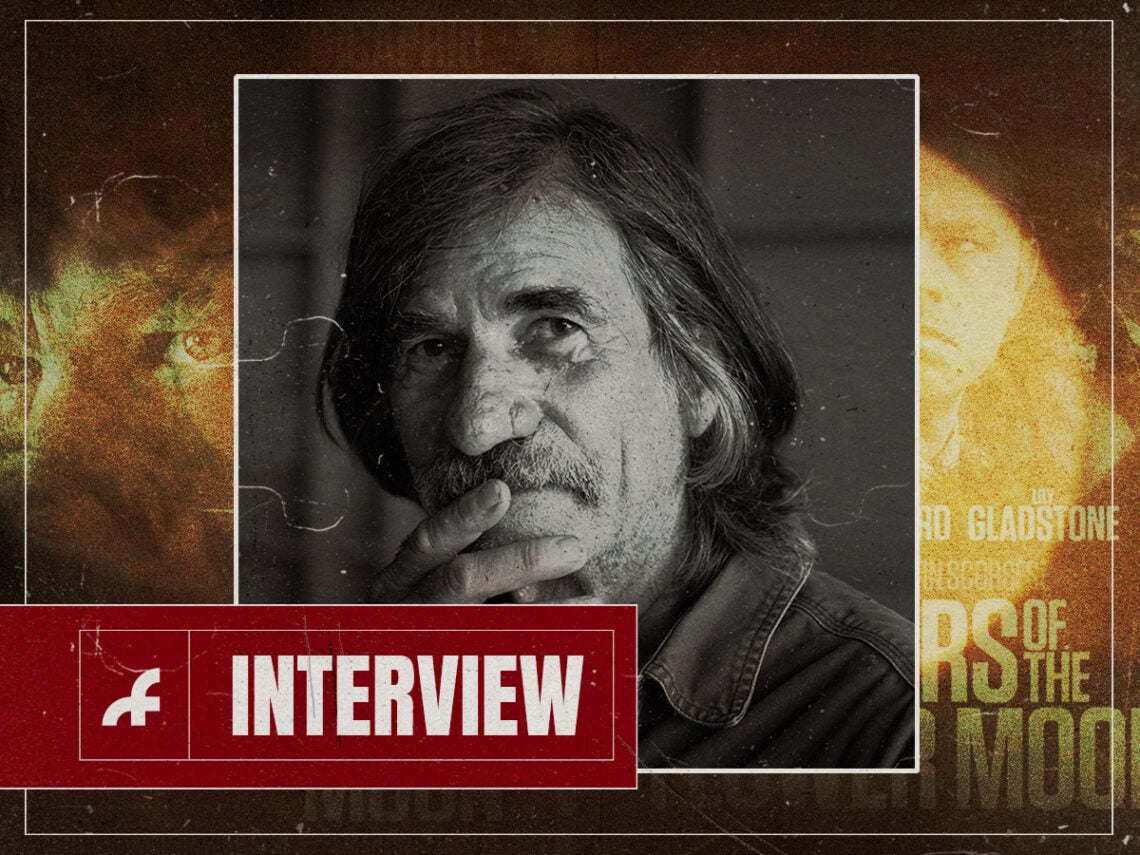
Jack Fisk talks becoming an Oscar-nominated historical detective in ‘Killers of the Flower Moon’

Behind every great auteur is a legion of masterful pioneers who create the soundscapes, design the wigs, and construct the sets that every cinematic titan stems from. Jack Fisk is one such man, a stalwart of modern American cinema who has been erecting houses, sourcing classic cars, and painstakingly recreating historical facts as a production designer for countless movies from the dawn of the Hollywood Brat Pack until the 2024 Academy Awards.
Speaking to Fisk feels like conversing with a fundamental fixture of the lost mysticism of the cinematic process. He is the man who managed to conjure the potent vibrancy of Brian De Palma’s Phantom of the Paradise in his debut credit and who now is hoping for Oscars success decades later for his marvellous work on Martin Scorsese’s great American epic, Killers of the Flower Moon.
Taking audiences back to 1920s Oklahoma and the dying days of the American Wild West, Scorsese’s film, adapted from the book of the same name by David Grann, details the systematic murder of the Osage people in the pursuit of the oil which their land stood upon. A tragic period piece that speaks to the savage hounding of the capitalist ‘American Dream’, Scorsese’s three-and-a-half-hour film was a vast undertaking which initially intimidated Fisk.
Yet, this quickly passed, with the production designer seeing the task as nothing more than a systematic challenge, “The first thing I did was when I ran into some Osage homes in Gray Horse, and I started meeting the people, and I started understanding more about them,” he said—seeing the inhabitants of the land as the key to understanding the environment itself.
“I was surprised that the homes were so humble,” he added, “In the urban legends and tales that you read about, from the period, they were talking about how rich the Osage were, how foolish they were with their money and I just didn’t see that. I saw the houses were all kinds of nice craftsman homes from the period of teens and 1920s”.
But, time had not been kind to this land, with the sweeping scythe of time swallowing up much of its history. Many of the houses were crumbling with rot, while tornados had swept the roofs off several other buildings. Still, Fisk maintained his confidence, armed with every DIY expert’s best friend: “We can change things so dramatically with a little bit of paint… I would go into these white buildings, and then I would look under the wallpaper or the light switch, and I see colour. Suddenly, I realised what was back then and what it could be again”.
A determined perfectionist, like many of his own peers, Fisk took it upon himself to find the actual home of the real-life protagonist, Mollie Kyle, played by Lily Gladstone in the movie, despite the fact that not even author David Grann could allocate during the writing of his comprehensive novel. “You become sort of historians and archaeologists in that you’re looking for hints,” Fisk excitedly states, “For me, the most important thing was to find Molly’s house, where she lived, and what it looked like. I thought, ‘If I found that it would give me the key to the rest of the film’”.
Seeing Grann’s failings to find the house as a beckoning challenge, Fisk explains: “I started going through real estate records, and I found three houses that she had in Osage County…then I found in research that David [Grann] had collected itemised furniture and rugs and stuff that she wanted for her house… and in that, she had for $1,000 to include a sleeping porch. And then, when I looked at a house, I saw where the porch had been enclosed for a sleeping area. As you start finding these little clues, it gets really exciting. You know, you’re like a detective, and you are figuring out a puzzle”.
While the goals of their efforts were, of course, wildly different, Fisk’s detectorist dedication isn’t all that dissimilar from Jesse Plemons’ police officer Tom White in the film itself, an admittedly underwritten character whose real-life counterpart could be compared to the ardent efforts of a stereotypical sheriff of the Old West. Like White, Fisk was also successful in allocating Mollie’s house after painstaking efforts, discovering much about the designs and colour palettes that made up the houses of 1920s Osage County.

Still, even one of Hollywood’s most tenacious behind-the-scenes designers, who worked through the late 20th century and the new millennium with such visionaries as David Lynch, Paul Thomas Anderson and Malick, isn’t a martyr for the sanctity of classic Hollywood processes. He also isn’t afraid of a lick of CGI here and there to enhance and transform a scene.
“You know, we’re able to do stuff we couldn’t do,” he says, reflecting on his use of CGI in the film, “We only had two blocks of abandoned buildings that we could use. So we put a blue screen at both ends and then I sketched what I thought it should look like based on pictures of Fairfax. So it looked like it was set up in the prairie…CGI was able to do that. They took out a lot of trees because, in the early days, there were a lot of fires in the prairie, and trees would burn…I can’t tell sometimes when they’ve done stuff”.
While it may not seem to be the case when glancing over his recent filmography, Scorsese has been sneaky with his use of CGI, utilising the tool as many other directors should: sparingly. The digital work on The Wolf of Wall Street in 2013 has long since made multiple rounds on social media, and 2023’s Killers of the Flower Moon takes notes from the same book, with CGI making its way into the film in the form of neat final flourishes and finishing touches.
The work of Fisk and his choice to merely pipette CGI helps to give the film a visual timelessness that outdoes the efforts of the narrative itself, which leaves little to be desired. Translating a story of this magnitude for the big screen was always going to be a monumental task. Still, Scorsese’s eventual effort feels more like an admirable peep into the past rather than a comprehensive study.
Indeed, in uncovering the secrets of Osage County, meticulously going through the pages of history, Fisk came across several truths that served as the perfect analogy for the plight of the central tribe, namely, when searching for Bill and Rita’s house, which is blown up in the real-life tale. With pictures of the house found in newspapers of the same era, Fisk eventually found a house that shared similarities to the actual location.
“’Ask him if we can blow it up,’” Fisk recalled joking to the location scout who was sent to negotiate a price to use the house, “He came back the next day and said, ‘They said yes, you can blow it up’”.
Continuing, he added: “I was curious, like, ‘Why would they want us to blow up their house’? Their house was vacant, they had some old furniture in there…but their grandfather had lived in that house, and he had a white wife. She was his guardian, and she spent all his money and made his life miserable. He ultimately died, and they just wanted to get rid of it. It had nothing but bad memories”.
The tormenting reality of history remains raw in the county, with the buildings, which have been held in families for generations, housing haunting memories of the past that have only recently begun to wain in potency. “The story of the Osage just rang so true of how they were taken advantage of by whites,” Fisk added before explaining how they pulled the house apart to recreate the explosion, simultaneously crashing to close decades of racial oppression in the same abode.
Even behind the scenes, Scorsese’s epic was an odyssey of discovery in which justice and reparations for the past were uncovered and exposed, with Fisk being a key fixture in such a dedicated, close evaluation. From allocating the correct shade of paint to lifting the stones of America’s troubled past, Fisk’s work as a historical detective gives weight and substance to Scorsese’s film that few others can muster.
