


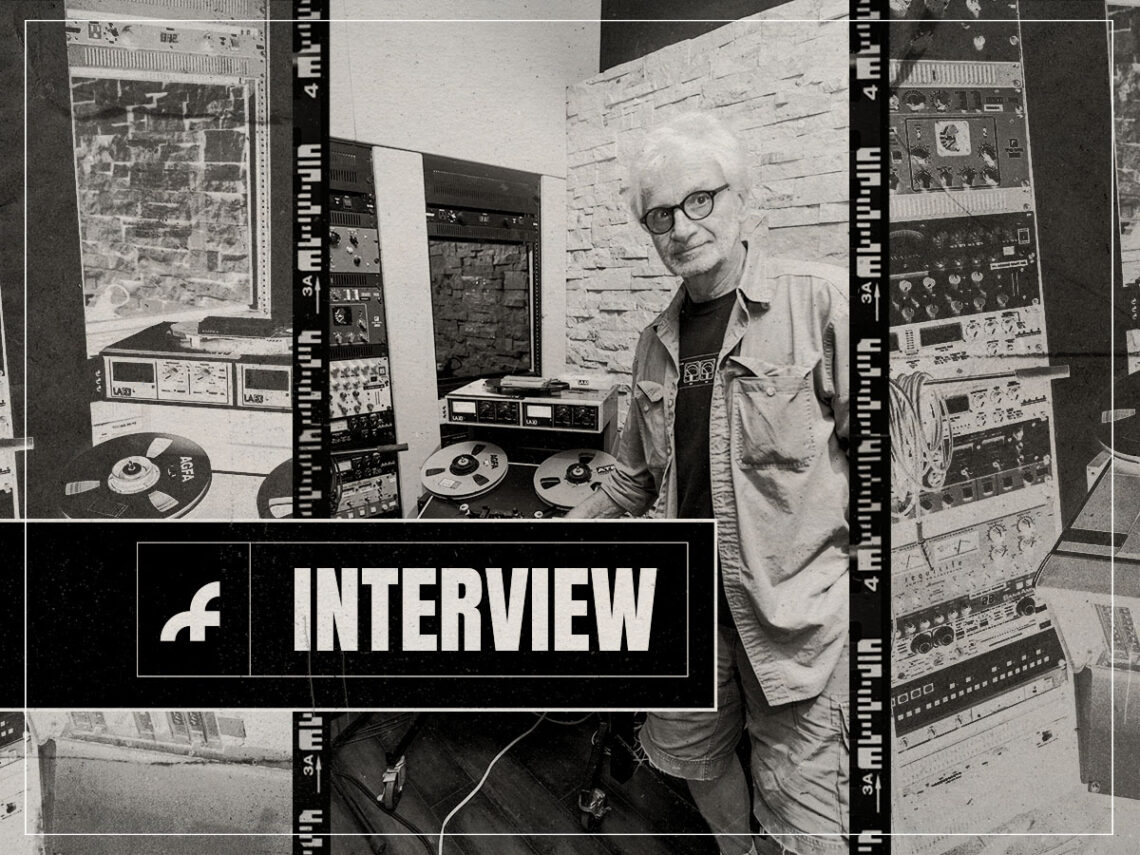
Jack Douglas on producing John Lennon’s final album, soundtracking Robert Kennedy and Patti Smith: “I had years of regret”

“There’s something happening here,” Buffalo Springsteen once sang, “and what it is ain’t exactly clear”. Despite the obscurity behind the sudden zip in the zeitgeist, it was clear to the kids of the revolution that something was happening, and whatever it was, it was unfurling at a startling rate of knots. The desire to be there among it in some capacity proved intoxicating. Given his fledgling skills as a young musician, it made perfect sense that Jack Douglas would try to follow in the footsteps of his heroes, John Lennon, Bob Dylan and the other icons of the day who promised that a brighter future was possible.
However, he could never have known, as a teenager strumming out little political folk songs, quite how directly involved he would become in the dreamy revolution. The world had been shocked and irrevocably changed when John F. Kennedy was assassinated in 1963. So stunned were the status quo by this shocking atrocity that much of the reconciling was done by young musicians, still trying to spearhead his message of change. When the mantle fell to Robert F. Kennedy, he knew it was music where change was reverberating most radically. The musicians knew, in turn, that he was most closely mirroring the revolution they were projecting. So, Robert set about hiring young folkies to soundtrack his campaign trail.
This was the fitting introduction to life as a professional musician that Jack Douglas received. He has never been left in any doubt about the power of music ever since. “During the ’60s and the ’70s,” he tells me, “The most important social thing to people was the impact of music lyrics. It was all about music. Everyone couldn’t wait for their for their favourite band to come out. We were obsessed with reading the lyrics on records and listening to the messages being sent across the speakers. It was the most magical thing in our lives at the time. Until MTV came along, artists weren’t as accessible. It was more important than movies, or books, or religion. It was all about the music.”
Fans clung to these fleeting releases, building up the mythology of the icons of the 20th century, icons who still dominate the cultural landscape today, and perhaps for many more years to come, during the interim periods of mystic retreat. Ironically, it was when these bands regressed into the shadows, looking to concoct the next chapter of the future in a studio, that their most important work was done. This became clear to Douglas when he made his own final solo album. “The last record I did as an artist was produced by the Isley Brothers,” he explains. “It was at that time I decided I wanted to go to the other side of the glass. That was the time the other half of my career started as a producer.”
Prior to that moment, he had inadvertently gathered up an esteemed music education simply by following the whims of the counterculture movement, venturing to England’s folk scene on Bond Street and the Merset Beat of Liverpool. “It basically dictated what was happening around the world in music,” he says of the latter. “Eventually, the USA took the torch. We started to listen to what was going on in England, and we began to emulate them. We went in a couple of different directions, and we got the LA sounds and the newer New York sound. The time that I was in New York, it was the capital of pop music.” Now, it was the capital of cutting-edge counterculture, and Douglas had seen this all unfold first-hand.
So, with the Big Apple proving to be the happening scene, he took up a job at the Record Plant, and it was there he encountered luminaries like Miles Davis, who would eventually inspire his own work as a producer. “Miles surprised me because, first of all, I was a huge fan. I love contemporary jazz, and I have been a fan since my teenage years. He had this bad rep live as turning his back on the audience and being tough on the other musicians, but in the studio, he was the opposite. He was super cooperative with the crew and the other musicians.”

He continues: “He used to mess with Jay Messina a lot in the studio and joke around. He would make him get him pieces of clothing that Jay wore that he liked. He would see a cool pair of shoes Jay had, and he would say, ‘You gotta get those for me. I’ll cover it.’ Jay would bring them to him because they were neighbours on the Upper West Side. Miles was super cool. He liked the way Jay dressed. Miles was always a great guy to be around in the studio. There were other jazz artists like Nina Simone that were very hard to work with in the studio. She was scary. She was very hard to please. She would give us young white guys a hard time.”
All the while, Douglas was making notes. Steadily, he began to shift his weight from menial studio jobs towards the title of ‘Record Producer’. “I got to work with so many great artists. Just getting to work with them, you can imagine what that was like,” he says of his awed early days. “I worked on ‘American Pie’ with Don McLean, and so many amazing groups, classic after classic after classic, were coming out of there. And jazz and big commercials. It would be very hard to recreate that anywhere now. It was just a really special time.”
Something was, indeed, happening, and the humble, mild-mannered Douglas was now inadvertently controlling the heart of it. “I got my first big production break with Alice Cooper. I was engineering on Billion Dollar Babies and mixing as well. Then I got to produce Alice Cooper’s ‘Muscle of Love’, so that was the start of the ascent.” By beginning with the emerging master of shock rock, Douglas became known as someone capable of handling radicals, and it just so happened to be at the start of an era where they would be all the rage.
No band quite signifies this like the ground-breaking project that lay ahead for him. “I did the first New York Dolls album. That was a huge one,” he says. By doing so, it became clear that Douglas had a knack for capturing the heart of rock ‘n’ roll’s sacred attitude, an attitude that many felt had been lost. Punk was about to reclaim it. Douglas was set to be the less is more producer at its core.
“Then they came to me and said we have this baby band called Aerosmith. I really identified a great deal with that music because, as a musician, most of the bands I played with after 1966 were Yardbirds, Led Zeppelin, Cream influenced. They were all that rolled into one, so that was a great fit for me,” he explains. “As we got more and more comfortable with each other as we did Get Your Wings and Toys in the Attic and Rocks, which I really think was the pinnacle of their ’70s work, I became a friend, a confidant and a sixth member of the band.”
But his scope was still expanding. He continues to rattle off a slew of legends who make up his favourite studio experiences, citing, “Patti Smith, which was amazing. Then I did Alan Ginsberg. I co-produced that with Bob Dylan. It was a great experience to be hanging with those two. Then, of course, Cheap Trick, who I discovered in a Wisconsin bowling alley and got them a record deal because I absolutely loved them. Group after group after group of stars.”
This all led to the moment when John Lennon came knocking. He was after Douglas’ ability to let bands revel in their own style and simply focus on finding the energy within it. “I was such a Beatles fan. I couldn’t believe I was actually working with John producing him,” he says, still in disbelief. “I had worked as an engineer on the Imagine sessions and I had done three records with Yoko, so I was familiar with them, but it was basically as good as it could get to be working with John Lennon at that time.”
Recalling fondly, he continues: “He was just such a great person and a huge star and so humble.” But that didn’t make cutting Double Fantasy a straightforward process. “It was like making four records because we did a lot of stuff separately. I’d have breakfast with them, and then Yoko would come in and work all afternoon. She felt more comfortable not having John around during her vocals because he was critical of her, and she was comfortable with me. She would go home around 6pm, then John would come in, and we would work til around midnight or 1am.”

Despite being an icon of unrivalled status, “he was very open to suggestion and very easy to work with. He took direction without any problem. He would let me comp his vocals without being in the room saying this one or that one; he left it totally up to me. There was a lot of trust. Early on, he let me do arrangements on the songs from cassettes that he gave me. I arranged Double Fantasy with the rhythm section without him even being there. He didn’t want the band to I know it was his record they were working on,” a trick David Bowie would later borrow, “so we put together the list of musicians he wanted and I got them rehearsing.”
Unfortunately, “a few of the more savvy ones figured it out that was Lennon’s album”. However, Douglas was assured that a bit of distance was perhaps key when working with Lennon. “You had to really stay ahead of him,” he recalls. “If you bogged down and he was waiting to record something, he would become very impatient. So, I had to stay a few steps ahead of him. As long as I was doing that and the rhythm section was attentive it all went really smooth.”
Tragically, it all went so smoothly that Lennon seemed to have slipped back into his prolific spurt that soared The Beatles, a fact that was not lost on him and fatally brought him back to New York. “We shouldn’t have gone back to work,” Douglas sighs. “He was planning on going back to Bermuda, but he called me about a month after Double Fantasy was done, and we were back in the studio a month later. He didn’t want the creative flow to stop.”
“We finished ‘Walking on Thin Ice’, and then he was assassinated,” Douglas bluntly puts it. The ripples of this atrocity continue to permeate, but few were closer to the epicentre of it all than Douglas at the time. The impacts were profound. “I went into post-traumatic stress syndrome,” he sadly admits. “That lasted for years. I hid out, I did drugs, tonnes of heroin. I was pretty messed up from that whole thing.” Understandably so—one day, he was helping his hero reclaim a lofty status that saw him launch the dream of counterculture that had propelled Douglas into his path. Grief, the postlapsarian loss of that dream and its forecasted revival were realisations thrust upon him hours after being by his side.
“The thing that made it really hard on me is that we were neighbours,” Douglas expounds. “We lived two blocks apart. I usually rode the limo home with John.” However, on that fateful night, he didn’t. “I had a young band that wanted to come in and work late that night. I always think that if I would have ridden home with him maybe I would have seen the guy, jumped on him or jumped in the way.” Myriad hypotheticals would unfurl after the event, but the starkest vignette of their futility can be found in David Bowie’s concert the following evening, where he performed with three empty seats in the front row—they belonged to Yoko Ono, John Lennon, and Mark David Chapman. Alas, despite the redundancy of lamenting impossible what-ifs, the cataclysmic weight rested no lighter on Douglas’ psyche.

For a while, he bowed out of music. “I had years of regret, and that final take running through my mind over and over again. The only way to put that to sleep was to do some heroin. That would put me to sleep. It was horrible. Such a loss. We were such great friends,” he says.
It was Supertramp who coaxed him out of this stupor having tracked him down and asked him to produce their latest record. Since then, he has never looked back, rekindling with Aerosmith and now completing somewhat of a cycle as he begins a new project. At the age of 78, he has produced new music by SilverPlanes, the band spearheaded by Aerosmith drummer Joey Kramer’s son, Jesse Kramer.
“SilverPlanes, for me, is a chance to catch up with the kind of music that I really love,” he says. “It reflects all of the best older English music from the late ’60s and early ’70s and the contemporary late ’90s and early 2000s English music. There’s some Americana as well. It feels like an American reflection of both of those periods. It’s got melody, it has depth, and it’s intelligent, different and original. Originality has always been important to me, and SilverPlanes has that. We are hoping for acceptance on a commercial level. There is a truth to everything about it.”
Indeed, that sacred confluence of originality and purpose has always been the fuel throughout Douglas’ quietly trailblazing career in music. It was certainly true when he became part of a senatorial campaign looking to embody the counterculture in legislation, as no more than a kid armed with an acoustic guitar. Whether it is true now is for the future to reveal.
