


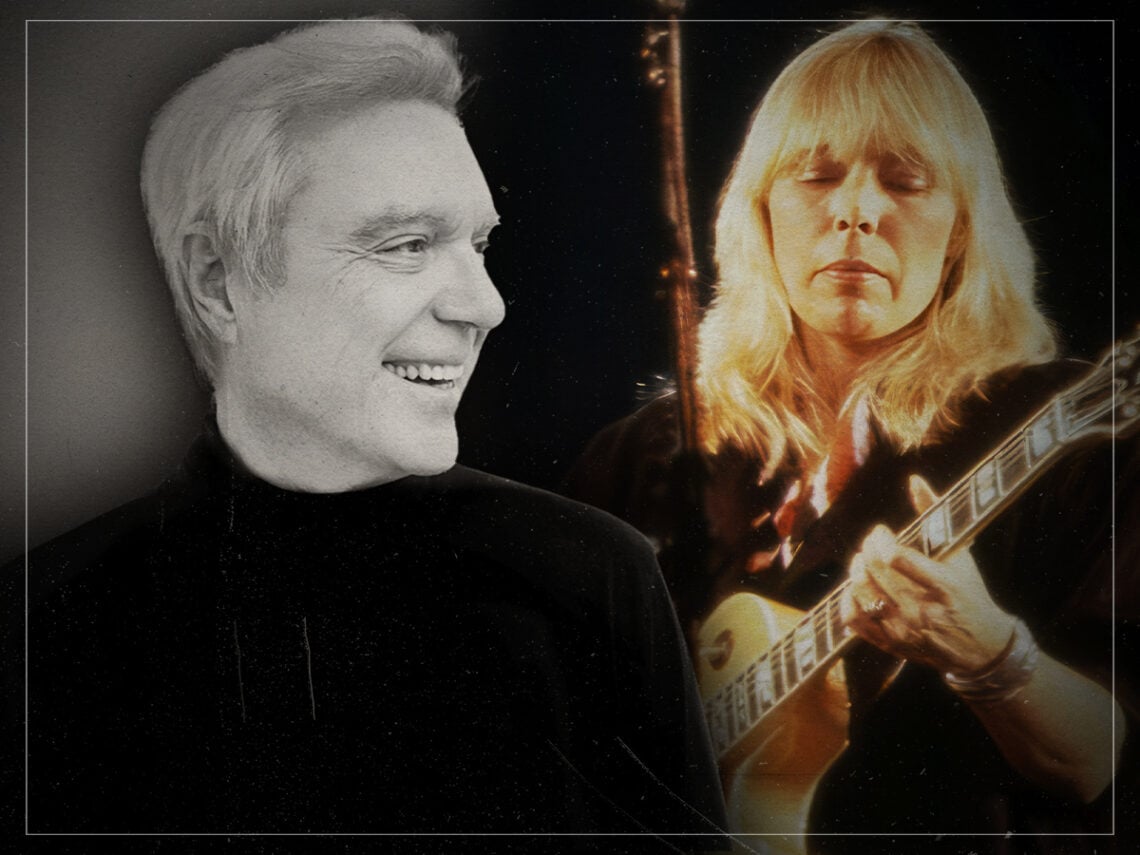
“Opened up this world”: It took David Byrne decades to understand Joni Mitchell

We all get things wrong as music fans, and by wrong, I mean not liking an artist you simply should. I’m not afraid to admit that it took a certain age for me to truly understand the brilliance of Talking Heads, and when I did, I swiftly realised how deprived my life had been up until that point.
But up until that point, I was an angsty teen preconditioned to like rock only in its purest form. Plug it in and turn it up was my unspoken mantra when it came to music, and so the textural realms of experimental music and new wave fell flat on my otherwise simple mind. Then I reached the cusp of adulthood and suddenly, more nuanced takes of traditional rock music began to make sense, realising that frustration and joy didn’t have to be presented in simple reflective forms.
What do you mean ‘Once In A Lifetime’ is an existential song? What do you mean ‘This Must Be The Place’ is a love song? The heightened impact of art that is paradoxical suddenly dawned on me, and in one fell swoop, crunching rock and roll was left in the dust.
But it didn’t just end with Talking Heads either, no, my newfound appreciation for the band enabled a more widened view on all art. The genius of the band is how their music helps contextualise a myriad of different genres, perhaps most notably funk, soul and hip-hop.
So I was willing to concede that with Talking Heads, I got it wrong so drastically at the very beginning. But like most mistakes in that regard, I had my age to blame. I took comfort in that, along with the fact that my new hero, David Byrne, made similar fuck-ups in his artistic youth and allowed his adolescent naivety to overlook the work of the great Joni Mitchell.
Despite Mitchell being a vital voice in the late 1960s and early ‘70s, a time when Byrne was cutting his teeth as a young musician, the brilliance of her work was somewhat lost on him. It wasn’t until his elder years that the true magic of her observational artistry began to make sense to him.
He recently recalled, “I’m old enough that, yeah, I heard a lot of her stuff when it came out, but it wasn’t until decades later that I went back and started listening to Blue, that record, the fact that she kind of opened up this world of personal transparency and talking about things that people could relate to, even though it’s just her own experiences, I thought, this is unbelievable.”
It often takes a song or a record to definitely change a view on something, and in the case of Joni Mitchell, there is no record to do so other than Blue. It was songwriting craft at its very finest, all the way from the orchestral arrangement to the emotionally profound lyricism that proved Mitchell to be one of the most important voices of the era.
But more than that, Byrne’s relationship with the record proves its timelessness. Mitchell’s understanding of the human condition meant that songs written in 1971 still had the emotional profundity to rock a wise and worldly Byrne decades later.
