


Hebridean Sun: When the Isle of Skye became the unlikely site of a hippie commune

London is invariably where the attention is focused when it comes to Britain’s countercultural explosion back in the 1960s, when skirts became mini, the streets became colourful, and rock and roll was emanating from every art school and underground nightclub in the capital. A few notable figures, however, rejected London entirely, setting their sights much further north.
It is easy to get lost in a scene as busy, constantly-moving, and ear-piercingly loud as that which transformed the airwaves of the English capital during its most swinging of eras. One person who soon grew sick of its sheen rather quickly was Donovan, who had traded his comparatively rural childhood in Hertfordshire to rub shoulders with the movers and shakers of London’s music scene around 1964.
Make no mistake, London was exceedingly kind to the songwriter; he forged close ties with the likes of The Beatles and Bob Dylan, penned a litany of folk-pop hits, and established himself as the poster boy of the flower power age. It is, however, difficult to find many flowers in the concrete surroundings of inner-city London. So, before the decade was up, Donovan took his newfound riches and influence and plotted a map some 600 miles north, to the Isle of Skye.
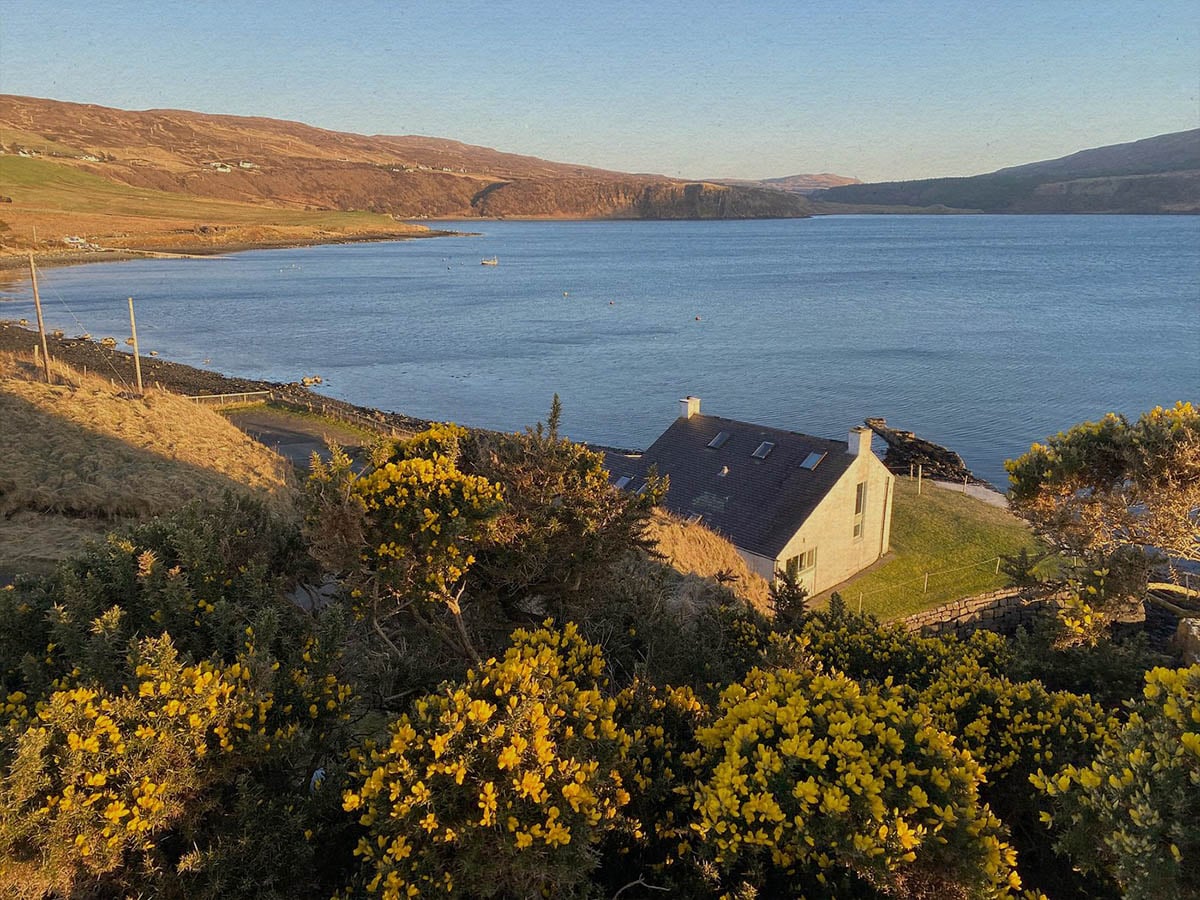
With its blue seas, idyllic landscapes, and jagged beanntan stretching high above the clouds, Skye couldn’t be much further away from the overwhelming nature of London’s sardine-packed pavements. Although Donovan is Scottish, having been born in the Maryhill area of Glasgow, he had no real connections to the Highlands, but he soon found it the perfect setting for escapism, buying a run-down old boathouse on the shores of Loch Bay on the north-west of the island.
Donovan’s plan was to transform that boathouse into a kind of commune, where a community of like-minded artists, musicians, and tripped-out hippies could similarly find an escape from the increasingly overwhelming nature of mainstream society and city-dwelling. As time went on, the songwriter took things even further, purchasing the uninhabited islands of Isay, Mingay, and Clett.
It should, of course, be noted that Donovan’s purchasing of property in the Hebrides did evoke some rather uncomfortable reminders of the Highlands’ history, in which rich landlords and noblemen ousted communities from Skye and the surrounding islands to create farmland. The idea of a rich English (or, at least, culturally English) musician purchasing vast swathes of land in the same areas – and, what’s more, inviting hordes of his friends with him – inevitably caused some unease within the surrounding community.
Nevertheless, Donovan’s Loch Bay commune attracted some legendary figures to bask in the natural beauty of the Hebridean island. Vashti Bunyan, for instance, spent years travelling from London to Loch Bay via a horse and cart, having abandoned her musical dreams some time prior. In the end, that colossal journey formed the basis of Bunyan’s Just Another Diamond Day, one of the greatest albums of its generation, even if it took a few more decades to be truly appreciated by the masses.
Another visitor to the island was George Harrison, who sought solace from the unshakable attention of The Beatles’ break-up by escaping to Skye in 1971, staying in Donovan’s then-renovated commune along with Pattie Boyd.
His time in Skye clearly had an impact on Donovan, both as a songwriter and as a person. There is a discernible change in his musical output towards the tail-end of the 1960s, for starters. His adoption of a more tranquil, folk-orientated, and an increased focus on his Celtic roots – his parents hailing from Ireland – is undeniably indebted to the inspiration of Skye. Aside from anything else, he went as far as to name his daughter Ione Skye.
Today, the commune once owned by Donovan is still owned by musicians, though it now operates as a B&B rather than a hippie free-for-all. There is no doubting that, just as Skye changed Donovan forever, the songwriter introduced the wonders of the island to his followers.
Fittingly, though, neither Donovan nor his commune, nor even a visit from a former Beatle, managed to change the Isle of Skye. There are no blue plaques, the house is not beset by music tour guides; Donovan’s time on the island was simply another chapter in the history of that old boathouse. Still, it is worth remembering a time when its picturesque surroundings were invaded by hippies.
