


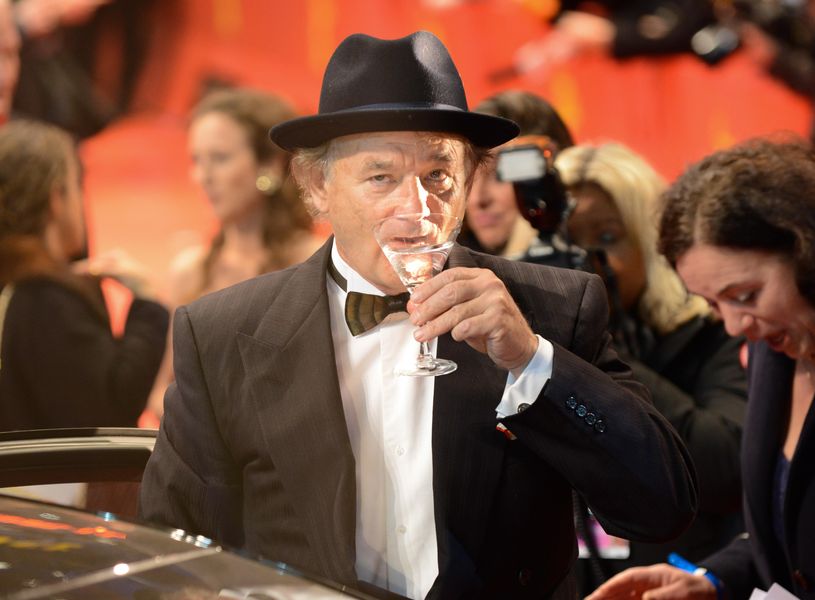
Is there a dark side to Bill Murray?

The ironic, coolly-detached persona of Bill Murray has been a permanent fixture in American pop culture ever since the late 1970s, when he arrived on Saturday Night Live (SNL) with an air of self-confidence that was as natural as a lifetime under the spotlight. Alongside the likes of Christopher Guest, Brian Doyle-Murray and Billy Crystal, Murray delivered a rousing performance, demonstrating why he would be such a seminal star of American comedy in the following decades.
Without an agent or manager, Murray operates on his own plane of existence, only accepting offers for roles through a personal telephone number and voicemail that he infrequently checks. An idiosyncratic star of Hollywood who refuses to abide by the standards of the modern celebrity, the star of classic comedies Caddyshack and Groundhog Day, appears at odds with the requirements of the contemporary screen star. However, of late, his image as your favourite lovable, possibly drunk uncle is beginning to lose its shine.
Following the allegations of sexual misconduct that saw the star’s latest movie Being Mortal, being pulled from production, however, the career of Murray is being put under the spotlight, forcing his many thousands of fans from across the globe to question his character.
Indeed, Murray’s latest legal incident, which recently saw him settle for over $100,000 with a younger woman, is merely the latest in the long line of allegations, including physical assault and general inappropriate behaviour. Such allegations, which have recently been brought back to public attention following his on-set behaviour, stretch far back to his early days in the industry and range from stories of him being a standard Hollywood diva to a predatory individual.
Back in 1978, for example, Murray and his SNL castmate Chevy Chase got into a fight when the latter returned to host the show after being ousted by Murray himself. A moderate piece of workplace rivalry, as the SNL member Jane Curtin recalls, “You could understand, you know, there were these two bull mooses going at each other, so the testosterone was surging, and stuff happens”.
Later feuds also arose, with Murray coming to blows with his Ghostbusters director Harold Ramis during the 1984 film, before reconciling prior to his death in 2014, as well as with the actor Richard Dreyfuss who said in a 2019 interview that Murray behaved like “an Irish drunken bully” on the 1991 movie What About Bob. Murray was no fool to Dreyfuss’ views, however, admitting that he and the actor “didn’t get along on the movie particularly…I mean, I drove him nuts, and he encouraged me to drive him nuts”.
Further allegations of sexual misconduct have also emerged more recently, detailed in Geena Davis’ memoir Dying of Politeness, which details her experience with the actor in the film Quick Change in 1990. Recalling how Murray insisted on using a massage machine on her back, despite her explicit refusal, Davis doesn’t recall her time with Murray fondly, particularly after he screamed at her on a set of “more than 300 people”.
The recent release of Davis’ memoir has also prompted perceptive readers to drag up a video in which Murray tries to pull down the actor’s strap on the set of the Arsenio Hall Show back in 1990. Since going viral online, the clip has been used as a piece of primary evidence pointing to Murray’s years of abuse.
Such incidents were not limited to the wild west of entertainment in the late 20th century either. Murray was also accused of inappropriate behaviour in 2000 while working on the McG movie Charlie’s Angels. Working closely with Cameron Diaz, Drew Barrymore and Lucy Liu in the action movie, Liu reported several incidents of “inexcusable and unacceptable” comments that severely affected her experience on the set of the production.
Continuing, the actor added, “I was not going to just sit there and take it. So, yes, I stood up for myself, and I don’t regret it. Because no matter how low on the totem pole you may be or wherever you came from, there’s no need to condescend or to put other people down. And I would not stand down, and nor should I have”.
Director McG wasn’t too fond of the actor either, with the filmmaker claiming that Murray headbutted him on the film’s set, telling The Guardian, “An inch later and my nose would have been obliterated”. Murray later denied this, fuming, “That’s bulls—! That’s complete crap!..I don’t know why he made that story up. He has a very active imagination,” in an interview with the Sunday Times, where he attacks McG’s claims with quite some venom.
In May 2008, Murray’s ex-wife Jennifer Butler added to the weight of allegations against the actor when she filed for divorce after accusing him of infidelity and abuse. In divorce papers sent by Butler, the Hollywood costume designer alleged that the comedian had “hit her in the face and then told her she was ‘lucky he didn’t kill her’”.
In another instance of bullying, Anjelica Houston claimed that the actor deliberately isolated her while working on the set of Life Aquatic: “He was a shit to me on Life Aquatic. The first week I was there, we were all in this little hotel, and he invited the entire cast to go and have dinner, except me. And everyone came down for dinner, a little dog-faced about my not being invited, and they were all like, ‘Oh, you know, we don’t really want to go.’ That was worse than anything. … I think we met again in Florence, because that movie was shot all over Italy, and we were doing a scene at Gore Vidal’s house in Ravello, and he said, ‘Hey, how’ve you been? I missed you.’ I said, ‘You’re full of shit. You didn’t miss me.’ He looked all confused for a moment. He’s been a little nicer to me since. He showed up at my husband’s funeral. He couldn’t have been nicer that day. He showed up. A lot of people didn’t.”
For Murray, many of these allegations seem to emerge from a difference of ‘professionalism,’ with the actor regularly stating that he ‘would never act in such a way in a professional setting. Responding to the claims of Lucy Liu, for example, Murray told The Times, “Look, I will dismiss you completely if you are unprofessional and working with me…When our relationship is professional, and you’re not getting that done, forget it”.
Most recently, Murray also addressed the incident between him and the Being Mortal crewmember, telling CNBC Television, “I had a difference of opinion with a woman I’m working with. I did something I thought was funny, and it wasn’t taken that way…As of now, we’re talking and we’re trying to make peace with each other…I think that’s where the real issue is, we’re both professionals, we like each other’s work”.
Whilst such violent outbursts and accusations of sexual misconduct are certainly at odds with the character that Murray projects to the public, they are precisely the kind of reports one would expect from a Hollywood star who has spent almost half a century being praised and pampered by contemporary pop culture. Just as we learned from the emergence of the #MeToo that came around shortly after the arrest of the convicted rapist and ex-Hollywood movie mogul Harvey Weinstein, such abuse of power is prevalent across the industry and often emanates from those who hold the most magnetising media presence.
An avalanche of new allegations has since been launched against the actor as a result of his recent behaviour, with the $100,000 pay-off to the crewmember of Being Mortal standing as a significant moment in the actor’s history, especially after having batted away allegations for decades. Earlier this week Rob Schneider, Murray’s former castmate claim that he “absolutely hated” working with the crew on SNL. “He hated us on Saturday Night Live when he hosted. Absolutely hated us. I mean, seething.” It all speaks to a darker side of the affable Murray.
As we begin to discover the true extent of Bill Murray’s persona behind the Hollywood cameras, what is becoming clear is that he is little like the chilled character he has projected to the media for decades, indeed few celebrities are. These continuing allegations against the actor are slowly stripping back the allure of the actor and removing height from his remarkable pedestal whilst forcing him to address years of publicly-known abuse.
