


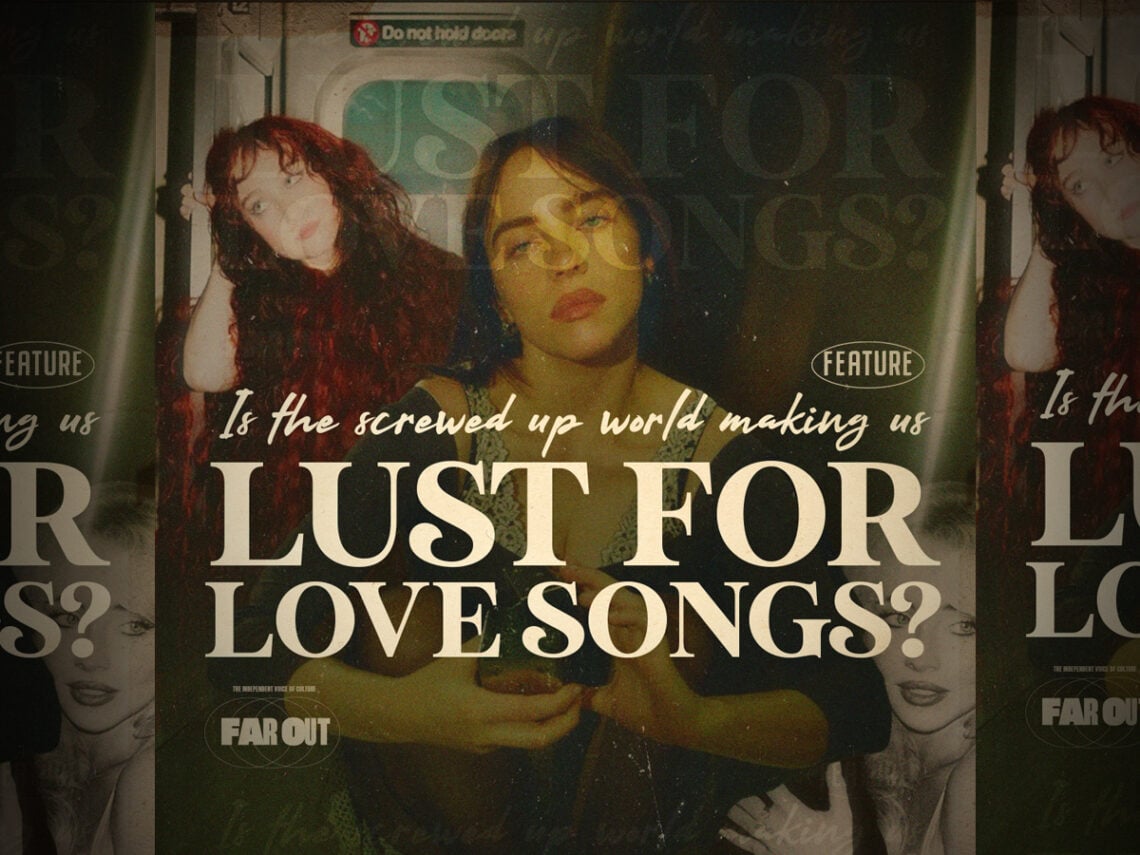
Is the screwed up world making us lust for love songs?

“We’ll make a love song for the first time that doesn’t have some weird twist to it, and then, we twisted it.” – Billie Eilish on ‘Birds of a Feather’
When analysing the cause and effect nature of music and politics, it doesn’t take you long to come across that one famous quote by Nina Simone. “An artist’s duty is to reflect the times,” she once said. Bob Dylan echoed a similar sentiment when he once said, “Don’t stand in the doorway, don’t block up the hall.”
Obviously, it’s not hard to read into the implications about resisting progression from a song called ‘The Times They Are A-Changin”, but the point is that music almost always reflects the political climate, whether it’s direct in its approach or not. Some of the best movements throughout music history have hinged on the sociopolitical developments of their time, like the British invasion, counterculture, Britpop…but these almost always adhere to a disparity that follows the general rule that when the world is fucked, the music is better.
Of course, that might be one of today’s more oversimplified, rage-bait-esque observations that would prickle the skin of any chronically online music lover, but there’s a fairness to it that you can’t really overlook, at least, not when you apply the magnifying glass. Because that’s also the thing, some of the best music of all time is music that ventures into the politically-charged protest category, or ones shaped by the context of living in a nightmare, like Oasis’ youthful celebration of blissful resignation, or almost all of The Kinks’ discography.
But all of these examples (and there are many, countless) follow a similar pattern. It’s the reason why British music history pans out like some sort of emotional litmus test, like the audacity and vehemence of punk to rattle the bars that shackled the oppressed to their spot with no way out other than to shout loud about it. Or even in the fatigued nature of something far less immediately political like shoegaze, and bands like Cigarettes After Sex wanting to take you somewhere away from the cesspit of everyday life.
As Greg Gonzalez told Vice in 2016, “Maybe it’s a sense of place, which is what I wanted from the records. Going back to my influences, like on Aphex Twin’s Ambient Works II, it feels like you’re in a space, like you’re actually in a landscape, and I wanted that sense too—it makes you feel like you’re somewhere, like there’s this depth of place in the songs.”
Ultimately, there’s almost always some kind of deeper, more existential context that makes the music hit particularly well, through 1980s crises to deeper, local disillusionment, even when the music itself sounds and feels completely different, more upbeat and escapist, like it’s sometimes about fighting back with quiet defiance and leaving your woes at the door than surging forward face-first into the pits of the fire.
But what about now? It doesn’t take an expert to know the current climate is in complete and utter shambles. But what does that mean for music? A few years ago, around 2019 or 2020, there was a more commanding pop-surge helmed by explosive fads across social media like TikTok, where it was all about the hook, the sugar-y pop escapism that made people get up and remember the simple joy of enjoyment and escapism that filtered through in the haze of songs like The Weeknd’s ‘Blinding Lights’ and Harry Styles’ ‘Adore You’.
Even in the more indie spaces, like The Strokes’ The New Abnormal and Haim’s Women in Music Part III, there was something more feverish and immediate in the grooves of the pop sensibilities, where things could be bleak, but we could also have fun with it. Fun with the idea that in brokenness lies unity, and even immunity. But we’ve since moved away from these more simplistic ideals, which is likely also why current artists like Benson Boone are falling flat, because there’s an inherent lack of reading the room, a lack of understanding that we’ve been there, done that, and now culture calls for something different.
What is it, then? Well, if we’re to look at some of the current major players, and beyond the broader eclecticism that’s bringing masses back to quintessential, familiar sounds of dance and techno (like, for some reason, we’re gunning for escapism in the form of lowered inhibitions somewhere like the Berghain), there’s also a call for 1980s-inspired love ballads, or modern-day love songs with a twist. Songs that sound and look like the sweet smiles of all those hits we already know and love, with a hidden truth beneath the surface.
Like Billie Eilish’s ‘Birds of a Feather’. Although she’s not necessarily renowned for her stories on sugar-sweet love and romance, ‘Birds of a Feather’ masquerades as such, pulling from the melodies and rhythms of beloved love tunes that pull you in because that’s all they are: lovely, beautiful ruminations on the blissful state of a love done well. A love done wholeheartedly, limitlessly, like that’s all we’re put on this earth for. But at the same time, Eilish poured in different real-world inflexions that made it a love song with a bite.
As she explained, “It’s almost like someone slamming you into a wall and being like ‘You look really pretty!’ and you’re like, ‘Wow, that’s really a lot!’. That’s what I wanted the verse to do. I wanted it to feel like toxic and a little bit love-bomby.” This is also one of the quintessential facets of so-called ‘sad girl’ music – to write in a way that never minces words, never sugar-coats – but when infused with more open pop sensibilities, therein lies the deception at the crux of our screwed up world, and why we might be drawn to things that seem comforting and escapist, when it’s not like that at all.
It’s the same with Chappell Roan’s ‘The Subway’. Although a breakup song, those love ballad essentials are still there, layered on the surface with lighthearted hues that almost entirely cover up the insidiousness that lurks within. And maybe, when considering all parts of the political climate versus our need to run and hide from that familiar 2020-esque pop in all its flourishes and technicolour, we’ve reached an impasse where it’s not so obvious what we all like anymore.
Or more specifically, a point of contention where it’s the contention that thrives the most, like Sabrina Carpenter, and her constant ability to simultaneously charm and baffle listeners with her glossy, anti-male world of taking ownership of your sexual self. But even still, songs like ‘Manchild’ already feel somewhat dated, for reasons that make it hard to decipher whether it’s to do with our inability to read the right interpretation where there’s satire, or a cultural mishap where we’re not quite ready to place female empowerment in spaces where there’s such a heady push-back.
More than ever, though, we’re looking for those deeply hidden surprises, the ones like above which can present a certain way with sparkly, glittery embellishments but with sharp edges that morph into different shapes upon closer inspection. Or the complete curveballs like The New Eves, which harkens back to older, more traditional folk styles with a sharp evolution towards something else, something completely unexpected, and yet completely obvious when looking at the fact that, right now, all bets are off. And still, all cards are on the table. Nothing is off limits, so long as it has depth, something that feels real in a world where nothing does anymore.
