


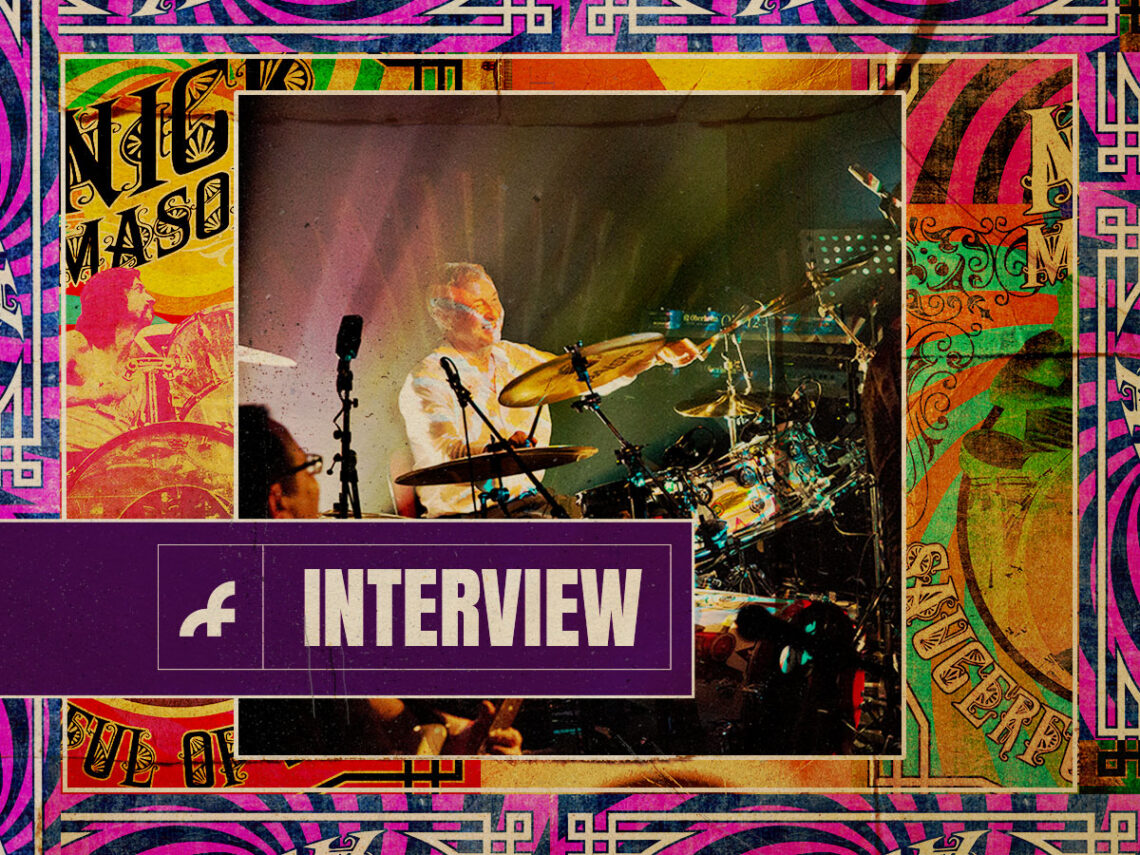
Nick Mason on drumming influences, Pink Floyd and artificial intelligence

Over the past few weeks, the fat old sun has returned triumphantly following a winter that waned with the painful sloth of a foot-powered jalopy. Like myself, Nick Mason doesn’t devote much time to small talk, but with the sunshine pouring in through the windows, glorious weather dominated the first minute of our recent phone call. With this introductory chapter neatly squared off, we delved into the heart of his illustrious career.
Mason is the only constant member of Pink Floyd, having co-founded the band with Richard Wright, Roger Waters and Syd Barrett in 1965. He persevered through three decades of tumult and subsequent reunions, thus conveying a stature of both rhythmic and physical backbone within the band.
Although Mason played an essential role in grounding Pink Floyd through ecstatic highs and catastrophic lows, he doesn’t subscribe to the idea that he was a mediator between Waters, Wright and David Gilmour through the band’s precarious chapters in the late 1970s and ’80s. “I wouldn’t ever suggest that I was a mediator, actually,” he told me. “I’m quite fond of saying, you know, that people think I’m the Henry Kissinger of rock ‘n’ roll, but actually, I’m Neville Chamberlain waving that piece of paper.”
Like a percussive Chamberlain banging a gong with his umbrella, Mason campaigned in vain for peace between his fellow bandmates. After a prosperous spell in the mid-1970s, Pink Floyd’s composure began to falter during the creation of The Wall. Another of Waters’ conceptual brainchildren, the 1979 album began to take shape during Wright’s divorce from his first wife, Juliette Gale.
The Wall was an intense project fraught with tight deadlines and ambitious concepts. As Waters led a relentless charge, Wright dragged his heels amid strain in his personal life, causing a rift within the band. “Most relations within the band were fine,” Mason reflected. “It really sort of shifted when Roger lost patience with Rick, who’d not had much to do for a very long period, so he’d wandered off.”
When Waters sought Wright’s keyboard expertise to complete some of the songs, he struck a brick wall. “Sony offered us a lot more money if we got the thing done by Christmas [1979], and I think that was the instigator of Roger getting really ratty with Rick,” Mason added. Following the arrival of The Wall, Waters fired Rick from the band and subsequently re-hired him as a salaried session musician for the ensuing world tour.
An acrid atmosphere prevailed throughout the 1980s. Waters’ intended bookend, The Final Cut, was the first album not to feature Wright and marked the beginning of disputes between himself and Gilmour. This creatively centred animosity soon mutated into a bitter courtroom drama when Gilmour, Mason and Wright rekindled Pink Floyd sans Waters in 1987.
As my conversation with Mason seemed to confirm, Gilmour and Waters are still far from reconciliation. Though he may not be a “mediator”, the drummer maintains friendly relations with both former bandmates today. “Although, I haven’t seen much of David at all,” Mason noted.

Mason has also yet to preview Gilmour’s upcoming album, Luck and Strange. However, he has listened to the first single, ‘The Piper’s Call’. “It’s all terrific, apart from the fact that he’s stolen my bass player,” Mason laughed, evaluating Gilmour’s solo return. “So [Saucerful of Secrets] have had to slightly reschedule when we’re working so that Guy [Pratt] can go and work with David.”
Fans will be pleased to hear that after a scheduling reshuffle, Pratt is able to perform with Mason and Gilmour on their respective tours this year. Since 2018, Nick Mason’s Saucerful of Secrets have kept Pink Floyd fans entertained with performances focused primarily on the band’s early material. The band will return to the stage for their ‘Set The Controls Tour’ in June.
As the name suggests, Mason and his bandmates revisit some old favourites from the 1968 album A Saucerful of Secrets as well as some of its neighbouring early releases. “When we first started five years ago, one of the things that came up was this thing about trying not to be in competition with tribute bands and actually to do something a little bit more interesting than trying to recreate what we did 40 or 50 years ago.”
Mason discovered a niche in the market where he could rejuvenate the early Pink Floyd catalogue, which was “eclipsed very much by The Dark Side of the Moon and Wish You Were Here“. Playing the ‘Comfortably Numb’ solo exactly as it is on the record wouldn’t cut in this new project. “What I really liked was the idea of going back and playing the early music in the style of [the later material],” Mason explained. “And that really meant restricting ourselves to those first seven years.”
A band called The Piper at the Gates of Dawn would undoubtedly raise a few eyebrows. Still, while Mason doesn’t see A Saucerful of Secrets as an “underrated” album as such, he feels that it is “enormously worthy of being revisited”. During their early psychedelic rock phase with Syd Barrett at the helm, Pink Floyd had a “different sense of how things should be done,” which Mason enjoys exhuming 60 years on. “I think Saucer’s one of my favourite albums because it’s got this extraordinary variety of things on it,” he added. “It’s got a sort of ‘goodbye to Syd’ element, and then it’s got ‘Set The Controls’, which for me is still one of my favourite pieces to play live.”
One aspect of the early material, and specifically ‘Set the Controls For The Heart Of The Sun’, that attracts Mason is the psychedelic instrumentation. During the late 1960s, Mason fell under the spell of his two all-time favourite drummers, Mitch Mitchell and Ginger Baker. “I was influenced by everyone who was around at that time. You’d pick up things from all of them and try it,” he said, before adding Keith Moon to his list of favourites.
Mason became entranced by Baker, who identified as a jazz drummer among rock stars, before his rise to fame with Cream. “The whole double bass drum thing completely bowled me over, and I said, ‘Oh yeah, that’s where I’d like to be, what I’d like to do,'” he recalled. “Ginger was a huge influence on me actually getting a bit more serious about playing and being in a band.”
Elaborating on his love for ‘Set The Controls’, Mason noted Baker’s influence on the song. “That was one track that’s got something very different about it,” he said. “Other people – it’s not that they couldn’t play it, but they just didn’t have that sort of track. Funnily enough, Ginger, I think his mallets on ‘We’re Going Wrong’ [were an inspiration]. For me, it’s such a different thing to just hammering out fours to being able to work the dynamics of the song backwards and forwards with mallets rather than sticks.”

Baker was famous for his dry wit and lack of patience, which occasionally put him out of favour with bandmates and rival musicians. Mason rubbed shoulders with the Cream star several times. “He was always delightful to me but not to everyone else,” Mason chuckled, adding, “He was a great character.”
Mason is a conscientious, caring musician and a stranger to feuds, even with incendiary characters like Baker. Still, he formed a much stronger bond with Mitch Mitchell, his counterpart from The Jimi Hendrix Experience. “I got to know Mitch when we were touring with Jimi Hendrix in ’67,” Mason recalled. “He was a sort of mentor for me and I loved his style. There’s something very jazzy about it, that thing of holding things back and playing slightly behind. And I just love that light feel that he had, playing at a time when everyone was smacking out fours as hard as they possibly could.”
As Pink Floyd’s style developed from psychedelic to progressive rock, Mason channelled the greatest aspects of his drumming heroes, from the delicate jazz dynamics of ‘Careful With That Axe Eugene’ to the Keith Moon power of ‘Young Lust’. The band’s eclectic catalogue reflects a drummer of accomplished and altruistic musicianship, acutely aware of the less-is-more policy yet capable of injecting innovative fills as required.
Even with 60 years of experience, Mason feels excited and nervous in equal measure before live performances. He told me this hasn’t changed much since the early shows with Syd Barrett and isn’t liable to change depending on venue capacity, either. Similarly, Mason’s approach to drumming has remained largely the same, although he has noticed one intriguing phenomenon: “I used to break a lot of sticks. But in the last 20 years, I don’t think I can remember ever breaking a stick.”
“Something has changed drastically there,” Mason admitted, suggesting that perhaps “sticks have just got stronger.” However, he seemed more convinced that it was a reflection of a gradual, subconscious shift in his drumming style as he became increasingly aware of adrenaline’s interference. “It’s very easy to overplay,” Mason explained. “Being onstage with a band is quite exciting and it’s quite a lot of adrenaline. So, the tendency is to play more and play faster. Perhaps one gets slightly better at controlling that.”
As he looks to the future, Mason seeks ongoing satisfaction in rejuvenating Pink Floyd’s early material with his touring band. His legacy is sealed, but the same cannot be said for artists looking to make their first musical impressions in an age destabilised by the uncertainties surrounding artificial intelligence in the arts.
Mason admitted that he doesn’t know much about AI and would be cautious about prognosticating its impact on the creative industries. “Obviously, what everyone’s worried about is that AI will enable people to actually dispense with creativity, which is a very bizarre concept,” he pondered. The drummer seemed to have faith in people’s tendency to seek a lack of refinement exclusive to human creativity. “This whole business of vinyl coming back is interesting because vinyl is not as good as a CD in terms of quality. But the reality is we actually do like certain analogue things.” After observing that analogue media are closer to the experience of live music, Mason concluded, “It’s interesting as to where we’re going to go with that, too.”
Indeed, at present, a virtual holographic Pink Floyd concert seems more likely than a reunion of the three surviving band members. It was at least encouraging to hear that Mason maintains friendly contact with both Waters and Gilmour. Though I must admit, when I questioned Mason on the truth behind his unique solo songwriting credit on ‘Speak To Me’, he said he “hadn’t registered” that Waters seems to have slyly picked up a co-writing credit on streaming platforms.
I feared I may have opened a new wound with this revelation, but a nonchalant Mason posited, “I would have said that I did that on my own, but I’m not going to start a war with Roger.” I found this statement wholly illustrative of Mason, both as a drummer and a human being: dignified, assertive and diplomatic.
Nick Mason’s Saucerful of Secrets will embark on a 14-date UK tour in June. Further details and any remaining tickets are available here.
