


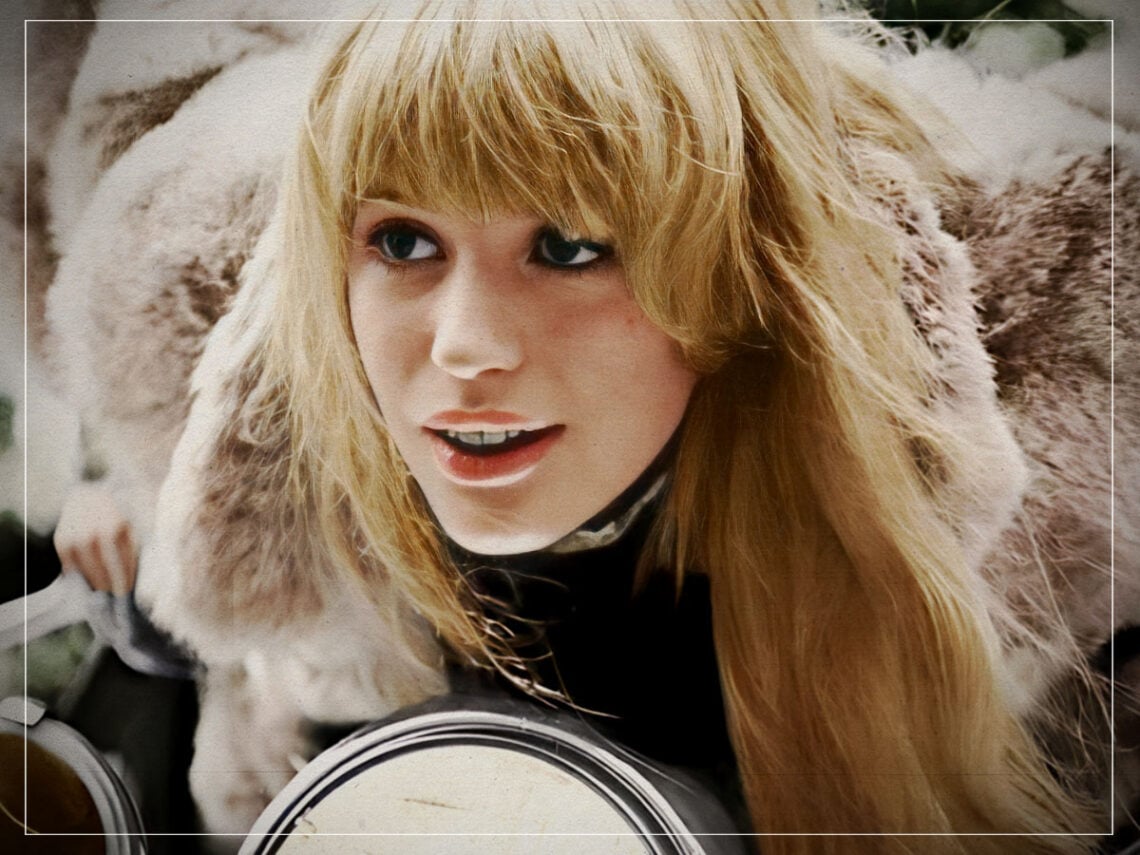
The important lesson Marianne Faithfull learnt from being homeless: “I was lucky”

While Marianne Faithfull’s name usually prompts thoughts of an infallible 1960s queen of cool, there is much more to her story than ‘As Tears Go By’. From the onset, her existence was not typical, and she cut a much different image from that of her future boyfriend, Mick Jagger, who was born into a distinctly middle-class family in Dartford, Kent.
To say that Faithfull came from ordinary stock, like most of those she would become most closely associated with when she burst onto the scene, would be a complete untruth. Her father, Major Robert Glynn Faithfull, was a British intelligence officer and professor of Italian Literature at London University’s Bedford College. Even more astoundingly, her mother, Eva, was the daughter of an Austro-Hungarian nobleman, Artur Wolfgang Ritten von Sacher-Masoch, and styled herself as Eva von Sacher-Masoch, Baroness Erisso. She was also a ballerina who worked for the famous director and avant-garde innovator Max Reinhardt.
As the surname suggests, they had other famous family members. Not only was the maternal side related to the Habsburg Dynasty and, by extension, their notorious chin, but Leopold von Sacher-Masoch, whose name underpins the word “masochism” thanks to his novel Venus in Furs, is also her great-great-uncle. It’s a fitting familial connection given how important his work would also be to the sexual and cultural revolution of the 1960s, mostly thanks to The Velvet Underground.
Despite being born into a learned, aristocratic family, things would change starkly after Faithfull’s parents divorced when she was six, and she moved to Reading with her mother. They lived in markedly reduced circumstances in comparison to what they were used to, but this still meant they could travel in similar circles, with Faithfull securing a bursary to a private Catholic school in Reading, where she was a weekly boarder. In another sign of how things weren’t so straightforward anymore, Faithfull would suffer bouts of tuberculosis when a child.
If you were looking at this story through a sort of Thomas Hardy-esque Tess of the d’Urbervilles lens, you could suggest that the change in fortunes Faithfull experienced as a child was the foreshadowing of what was to come after Andrew Loog Oldham had discovered her, she scored a number one hit with ‘As Tears Go By’, and became Jagger’s girlfriend.

For a time, she was on top of the world, but by the dawn of the 1970s, drugs had started to take their toll on Faithfull, as did the tumultuous relationship with Jagger. Not only would her hedonism seriously affect the quality and range of her voice, but astoundingly, given the success she had in the 1960s, her career and personal life went into such a sharp decline that she was homeless for a couple of years.
Characterising how fame had sent Faithfull on this path, her old friend Pamela Mayall said in a 1999 documentary about her: “Well, she was playing really two roles then; she was being the glamorous star and the gorgeous girl on Mick’s arm, and at the same time, I think her inner self was like sinking.”
Many questions remain about how this could happen to such a well-loved star, with her living on Soho’s streets for two years as a heroin addiction and anorexia nervosa engulfed her. Still, in a reflection of her character, by the end of the decade, Faithfull would be back on her feet and find herself artistically, releasing her finest album in 1979, Broken English. This was a resurgence of the most splendid kind.
Faithfull has always been open about her oscillating existence and frankly discussed the travails she’s experienced that would be the undoing of much lesser souls. When speaking to The Guardian in 2013, she reflected on her period of homelessness and revealed the vital lesson it taught her. Given the present state of the world, it makes for a pertinent read.
She said: “Oh, I don’t know what they’d do now. I was lucky. People looked after me, the meths drinkers, junkies. I learned that human beings are really all right. I didn’t know that from my posh life in the 60s. It was very bitchy and people were cruel to each other. I was on the street for two years, but it was better than staying at my mother’s and being under her thumb.”
Many musicians are bitter for much lesser reasons than Marianne Faithfull’s been through. As well as being a creative legend, her balanced takes have always set her apart from the ill-natured industry in which she made her name, instilling her with a tangibly human, and relatable essence. In times like our own, her example is a key one.
