


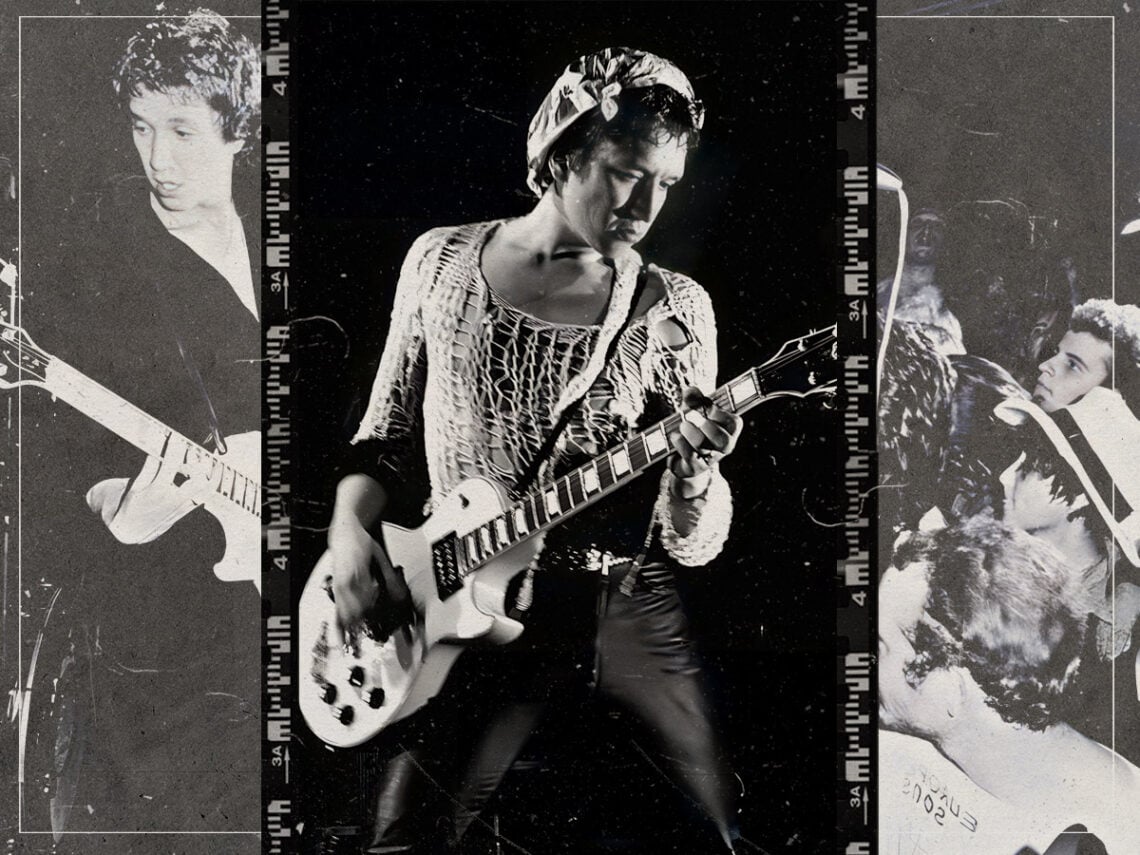
How to play guitar like Steve Jones

The great cultural tsunami of punk achieved many things, yet one of the most important was how it made being an autodidact acceptable. Following its emergence, to become a successful musician, people did not have to have money or intense classical training like the Pink Floyds and the King Crimsons of the world. This deeply anti-traditional ethos created an explosion of new sounds on every instrument. One man who had a defining hand in this sea change was Sex Pistols axeman Steve Jones.
Undoubtedly, Jones was the defining power behind the quartet, something that became clear following the acrimonious dismissal of bassist Glen Matlock. Outside of co-founding the band and having a defining hand in them plucking John Lydon off the street, his guitar playing was always the force that drove their efforts.
Without his amped-up rock ‘n’ roll re-energising the formula by fusing the influence of genre greats with that of contemporary innovators, it’s safe to say that the Sex Pistols would likely not have risen as the phenomenon that they were. Proof of Jones’ sharp impact on the culture is that guitar lovers cherish his name despite having such a comparatively small catalogue of work, with only one Sex Pistols and seven other records accredited to his moniker.
The king of the punk autodidacts, Jones had a rougher upbringing than most. With 14 criminal convictions to his name and the subject of a council-care order when a youth, he spent a year in a remand centre, which he later remarked was more enjoyable than his home life. Revealing that he was functionally illiterate until his 40s, Jones maintains that the Sex Pistols saved him from a life of crime. Despite the notoriously illegal means he might have undertaken to acquire some gear, his dedication to music as a way out of such a background serves as a great example to all.
While it is commonplace in the contemporary era thanks to the internet, Jones was a self-taught player in a world where lessons were always advisable. Noted for the meaty sound of the humbucking Gibson Les Paul Custom in his early years, he claims that he had only been playing for around three months before the first Sex Pistols show and that recreationally taking Adderall, as so many punks did, helped him focus on refining his craft. Taking influence from the swaggering proto-punk of Iggy and The Stooges and The New York Dolls, as well as Faces-era Ronnie Wood and Roxy Music’s Phil Manzanera, he fused their respective approaches to create a crunching but melodic style.
Heavily reliant on bar chords with added hammer-ons played on the pinky, Jones is known chiefly for his chugging sound. He achieved this by deading the strings using the side of his palm and using downward pick strokes. Not only did this create an appropriate sense of attitude, but it also added another dimension to the rhythm section, something that added a fuller sonic structure to punk’s otherwise flimsy musical ethos. While he was also known to use an MXR Phase 45 and MXR Phase 90 in his time, Jones went light on the use of effects. In the studio for Never Mind the Bollocks, he played with minor amounts of sustain and echo, which were then overdubbed to hide their use.
Although Steve Jones has an array of excellent tracks across his career, with him refining his work in the short-lived Professionals at the start of the 1980s, it is his work with Sex Pistols that offers the most distilled version of his work. A time when money and fame hadn’t impacted his craft and the lure of effects hadn’t quite hooked him.
Arguably, ‘Anarchy in the UK’ is the definitive Jones cut. On the song, he provides a swollen undercurrent thanks to his use of phase, with an infectious groove created by sticking to a 4/4 time signature in a 12-bar blues style. Not only does he demonstrate his rhythmic chops here, but his incisive work as a lead guitarist also stands out. He serves the song without any technical peacocking.
The first solo, which is fuelled by atmospheric multiple-string bends, provides a compelling mid-point until the song locomotes back around for the chorus. Furthermore, the second solo, which boasts a minimal, choppy riff before segueing into a sustained, albeit compressed, bout of feedback, was so artistic that it provided a blueprint of what would eventually become a post-punk playing.
Three other vital tracks demonstrate the parameters of Jones’s style. The next is ‘God Save the Queen’, which kicks off with the unmistakable sliding riff that even Chuck Berry would have been proud of before it pounces into its chugging main rhythm. Gliding and melodically chromatic, this punk classic fuelled everything from hardcore punk playing to the work of Seattle’s dirtiest grunge guitarists. Then, there’s the noisy solo, comprised of bends, hammer-ons and pull-offs, which is more technically accomplished than many give him credit for.
The chiming central riff is also a demonstrator of Jones’ artistic scope. Establishing a sense of excitement, he then ramps up this sentiment with bold open chords until the pressure gives way to the fast blues of the main rhythm. Clearly, this is directly derived from Johnny Thunders and Sylvain Sylvain’s work in The New York Dolls with its notation and preference for tricky short licks. For a final reflection of the Londoner’s brilliance, ‘Holidays in the Sun’ is his most animated performance with Sex Pistols. From the anthemic main riff to his smattering of licks, this song goes a long way in undoing the reading that he is a simplistic player.
Jones famously used the cream 1954 Gibson Les Paul Custom he acquired from Sylvain Sylvain in his Sex Pistols days; this is the model with the stickers of pin-up girls on it. Exclusively using Les Paul Customs in his time with the punk pioneers, he also played a black 1974 Gibson Les Paul Custom.
Since then, Jones has switched it up. He was offered free Burny Les Paul Customs in the late 1990s, as well as cables, straps and picks to do so. He accepted and was awarded two specially made models, which he played on the Pistols’ North American Piss Off Tour in 2002 and 2003. However, in 2005, Jones returned to mostly playing Gibsons, using his Burnys now and again. Three years later, to celebrate his inextricable relationship with the brand and achievements, Gibson released the Steve Jones Signature Les Paul, with the exact specs as his trusted 1974 model, stickers and all.
In terms of amplification, Jones has tried his sound with a selection. Recording Never Mind the Bollocks, he used a silverface Fender Twin Reverb with Gauss speakers. It can be seen in the video for ‘God Save the Queen’, with the Sex Pistols’ name scribbled on it. Allegedly, it was stolen from Bob Marley at the Hammersmith Apollo. Elsewhere, during the band’s doomed 1978 US tour, he used Musicman Amps and a Fender Super Reverb. However, since the 1980s, Jones has primarily used Mashall JCM 800 stacks.
While all of the technical nuances, employed in the right way, may give the student a chance at sounding like Sex Pistols’ Steve Jones, one thing must also be mastered: the attitude. Skill and guile will only get you so far in the world of punk guitar. The rest of the spit, grit and pig-headed determination comes from within.
