


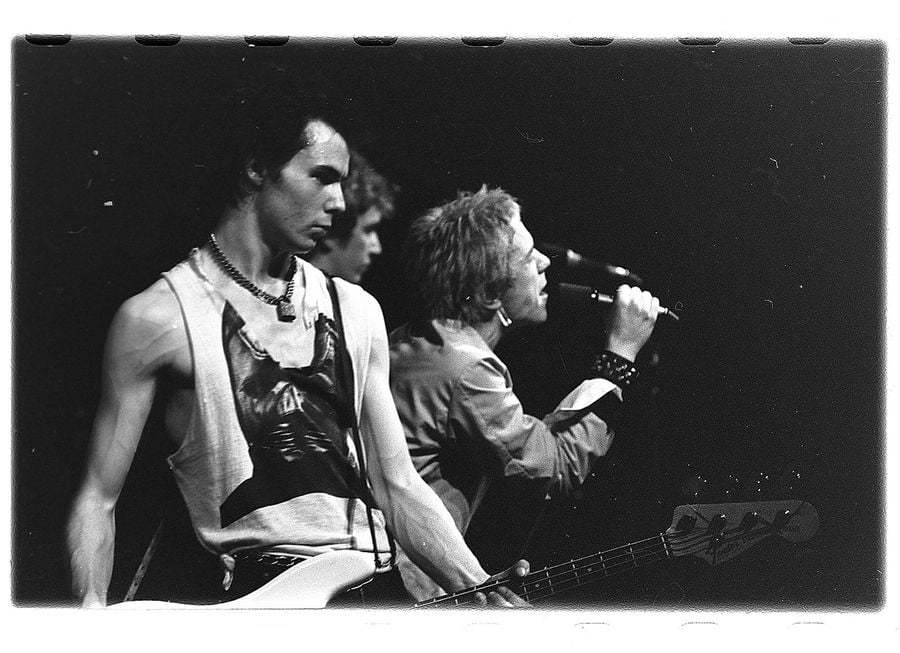
The arduous journey to the Sex Pistols’ only album, ‘Never Mind the Bollocks’

It was a minor miracle that the Sex Pistols ever released an album at all. Over two short years, the original punk rockers had already lost their bass player and co-songwriter, Glen Matlock, and were already showing signs of fracture by the time they officially entered the studio to work on their first full-length LP. Replacement bassist Sid Vicious was hopeless on the instrument, and scattered recording sessions saw the band burn through three different record companies while scorching a path of controversy everywhere they went.
Officially, Never Mind the Bollocks, Here’s the Sex Pistols had its first recording session in October of 1976. It would take one full year for the album to be finished and released finally, and the time between saw the band go toe-to-toe with television host Bill Grundy in an expletive-filled appearance on Today and nearly got arrested for crashing the Queen’s Diamond Jubilee.
They were far from the bar-crawling teenagers who first formed back in 1975 under the tutelage of manager Malcolm McLaren. In the time since their initial formation, the band’s principal instrumentalists not only learned how to play but became a lean, mean, hard-rocking machine. At the front of the stage, John Lydon had developed his own signature singing style. More importantly, Lydon began to come into his own as a songwriter, taking direct aim at controversial topics like abortion, Naziism, and anti-royalism.
Shortly after signing to their first record label EMI, the group released their debut single, ‘Anarchy in the U.K.’, in November of 1976. Although he had helped produce some of the music that the Pistols were attempting to destroy, producer Chris Thomas made the band sound more precise and impactful than they ever had before. Thomas would be retained for Never Mind the Bollocks, but a few obstacles kept the album in limbo for nearly a year.
After the Grundy incident, the way the Pistols viewed themselves changed dramatically. “Grundy was the big dividing line in the Sex Pistols’ story. Before it, we were all about the music, but from then on, it was all about the media,” Steve Jones writes in his book Lonely Boy – Tales From a Sex Pistol. “In some ways, it was our finest moment, but in others, it was the beginning of the end … In terms of the Sex Pistols having any kind of long-term future, this sudden acceleration was the worst thing that could possibly happened.”
An immediate setback was that EMI pulled the band from their roster after the Grundy incident. Their appearance on national television also raised their profile amongst concerned citizens, some of whom rallied to cancel the band’s concerts across the UK. By February of 1977, Matlock was officially out of the band, and a new contract tied the band to A&M Records… for roughly one week.
After a notorious singing session and a brawl with some rowdies who happened to be connected with A&M brass, the Sex Pistols found themselves dumped from a major label for the second time in a month. Eventually, Richard Branson and Virgin Records came to the band’s rescue, putting up the funding that finally got Lydon, Jones, and Paul Cook back into the studio. There’s some debate as to whether Vicious was always meant to join them or not.
“Sid wanted to come down and play on the album, and we tried as hard as possible not to let him anywhere near the studio,” Jones recalled. “Luckily he had hepatitis at the time.” While Vicious was laid up in hospital, Matlock was briefly rehired as a session player in order to complete the sessions. When he wasn’t paid ahead of time, Matlock opted not to play, so Thomas suggested that Jones lay down a demo bass line for reference. Jones played so well that he wound up recording the majority of the bass lines for the record, with Vicious’ only contribution being a low-mixed bassline on ‘Bodies’.
The final mix of Never Mind the Bollocks proved to have an immediate impact, topping the UK Album Charts and going gold just a few days after its release. While the album was a commercial success, the band were already on its last legs by the time it finally saw the light of day. Vicious’ antics became more erratic, and Lydon began to distance himself from both his bandmates and McLaren. A disastrous tour of the United States was all it took to break the band for good, although the band briefly attempted to carry on with Vicious as the lead singer. Less than four months after the release of Never Mind the Bollocks, Vicious would be dead.
The road to getting their only album out into the world proved to be too much for the Sex Pistols to handle. The results, however, would be timeless. Never Mind the Bollocks continues to resonate far beyond the realms that even the four Sex Pistols themselves were capable of taking it. It wasn’t easy, but eventually, the Sex Pistols were able to hang their legacy on a truly monumental album.
