


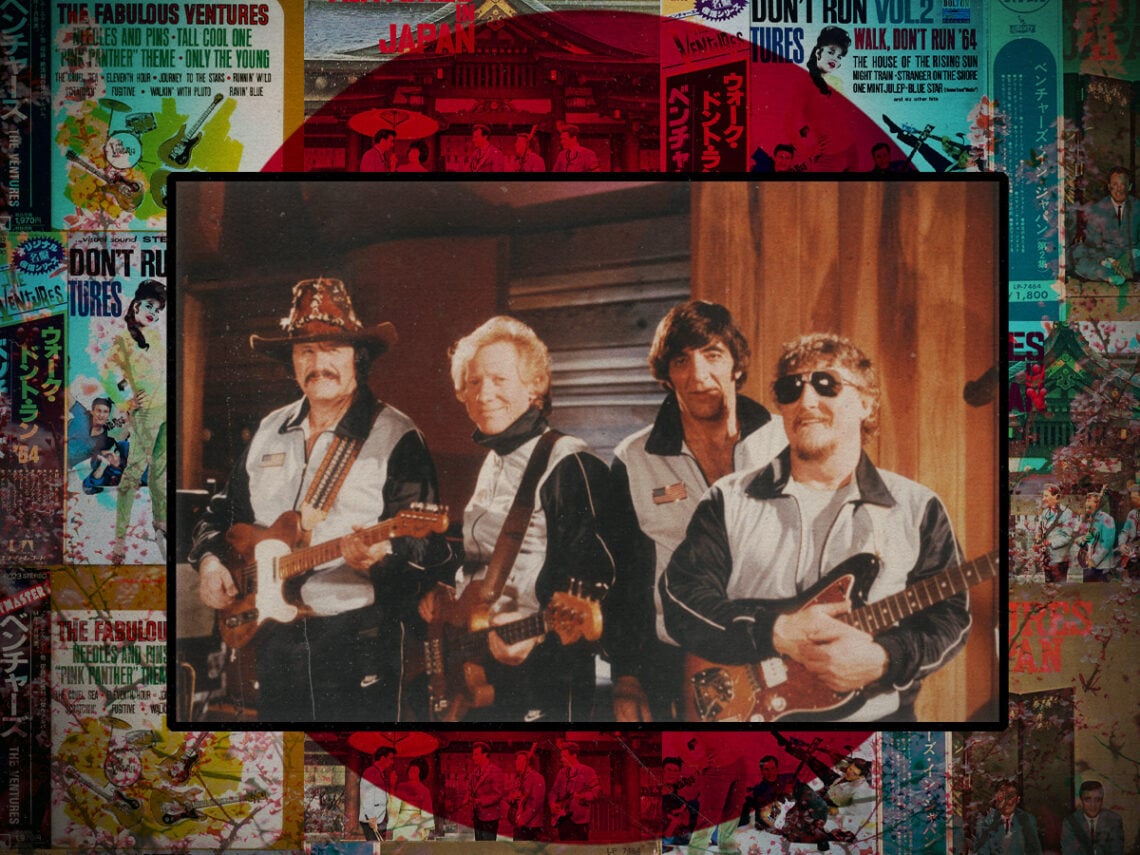
‘Eleki boom’: How The Ventures became the biggest American band in Japan

“When we started, we were doing pretty basic three-chord stuff,” guitarist Bob Bogle said in 1998, recalling the late 1950s origins of his instrumental rock band, The Ventures, “We knew we’d never be as sophisticated as Chet [Atkins] or Les [Paul], and there wasn’t room for two Duane Eddys, so we took the territory that was left.”
That territory, both geographically and stylistically, awaited them in Los Angeles, California, where the band, originally from Tacoma, Washington, started its recording career in 1960, putting out their distinctive cover of a jazz instrumental tune called ‘Walk Don’t Run’.
You might not instantly recognise the song’s title, but you’ve almost certainly heard the version, as it has lived on for 65 years as one of the unimpeachable, wordless anthems of surf rock, used in countless films and TV series to either capture the feel of a SoCal beach or the mood of early 1960s Americana.
The members of The Ventures were not the surfboard types themselves, but “we got pegged as a surfing band because there was a scene then with The Beach Boys, The Chantays, and so on,” Bogle told the New York Daily News, “But before we got to LA, we’d never even heard the phrase ‘surfing music’.”
Historically, Dick Dale’s 1961 single ‘Let’s Go Trippin’ is usually credited as the launchpoint for the surf rock craze, but Dale was working with the established principles of reverb-heavy, Fender-centric instrumental rock and roll, and his breakout moment was preceded a year earlier by both ‘Walk Don’t Run’ and another big hit of the summer of 1960 from across the pond, The Shadows’ ‘Apache’.
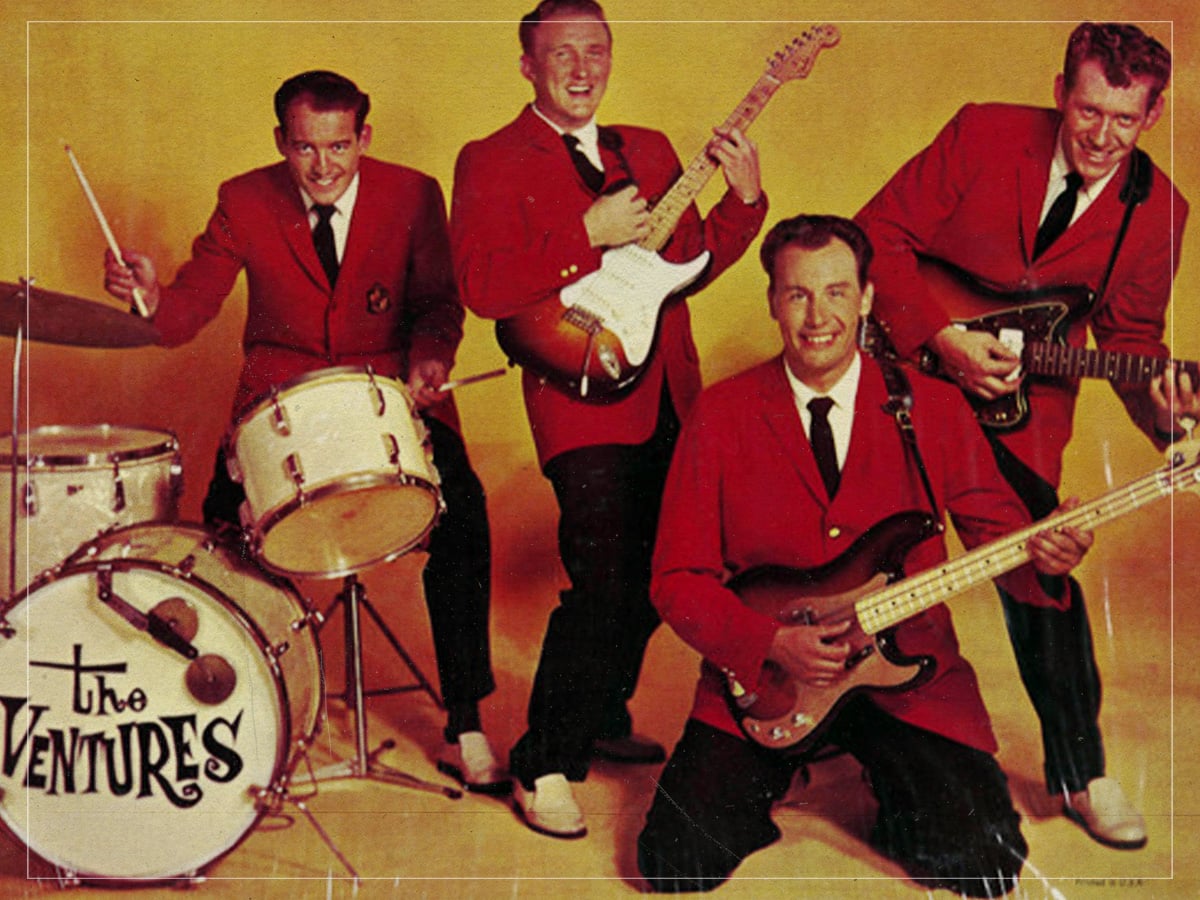
Whereas The Shadows had already cut their teeth and generated plenty of fame as the backup band for Cliff Richard, The Ventures had seemingly arrived out of the blue with the sound of a new decade blasting out of their amps.
“It was just basically the way we played; it wasn’t anything planned,” bassist and eventual lead guitarist Nokie Edwards told the Register-Guard in 1996, “It was two guitars, a bass, and a drum; we just played that way. And we’re probably one of the most copied bands.”
The Ventures were both prolific and consistently successful throughout the 1960s, despite increased competition in the surf universe, not to mention the changing guitar pop preferences that the British invasion brought with it. While the band only had one other single reach the top ten in the US singles chart (the ‘Hawaii Five-O’ theme in 1968), their full-length albums almost always landed in the top 50, and there were usually about three new ones each year, often distinguished by their own amusing themes; long before The Beatles had supposedly pioneered the rock ‘n’ roll concept album.
1961’s The Colorful Ventures, as an example, had songs titled ‘Yellow Jacket’, ‘Greenfields’, ‘Red Top’, and ‘Blue Skies’, among others, while 1964’s The Ventures in Space offered up a slightly more complex thematic thread, with sci-fi songs like ‘Moon Child’, ‘Love Goddess of Venus’, and ‘Twilight Zone’. There was an obvious playfulness and silliness to it all, but like a lot of the cheap pulp fiction paperbacks of the same era, there was also plenty of genuine talent, skill, and precision behind the commercialised exterior.
No one seemed to recognise this more than the rock and roll fans of Japan, who got their first look at The Ventures when the band toured the country with Bobby Vee in 1962. Actually, there wasn’t enough money to send the whole band overseas, so it was just Bob Bogle and rhythm guitarist Don Wilson on that first tour, playing as a duo.
Rock and roll was already gaining a foothold in Japan at the time, but there was something about the sound of The Ventures, and the lack of any language barriers with an instrumental band, that fully broke down all cultural divides. Overnight, the humble quartet from Tacoma became the top-selling American guitar band in the ‘Land of the Rising Sun’, and the poster boys for a new ‘eleki boom’ in the country: a complete obsession with electric (or eleki) guitar music.
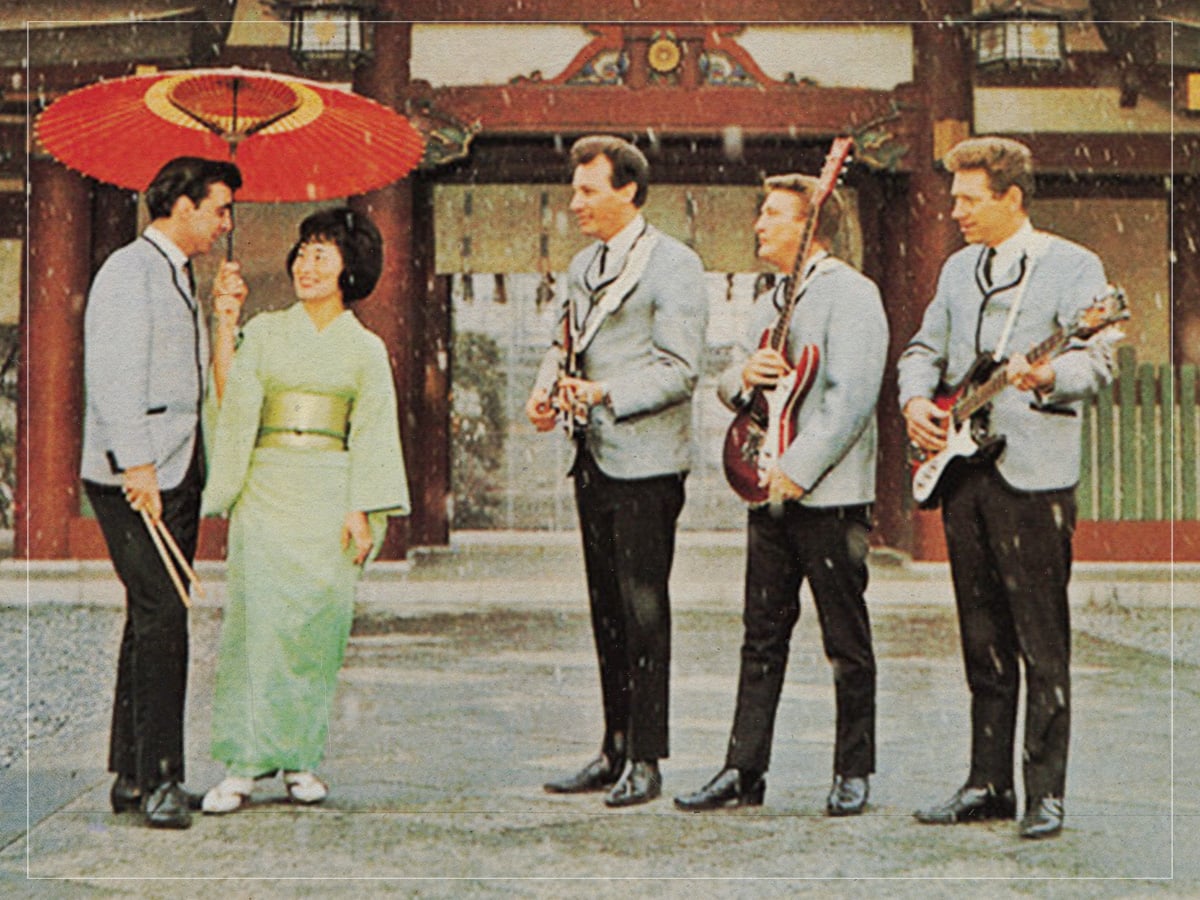
“The eleki boom has hit Japan with a resounding twang,” the San Francisco Chronicle reported in 1965, “Inspired by such swinging electric guitar combos as The Ventures, The Arrows, and The Surfaris, Japanese teenagers are stampeding their way to music shops and dance halls in a sudden frenzy to get with it.”
Naturally, in the same way early rock was met with severe resistance in conservative Christian America, the prim and proper elements of Japanese society weren’t entirely thrilled about the eleki boom either. For a while, the Board of Education in the city of Ashikaga tried to prohibit kids from buying electric guitars or watching eleki bands on TV, and over 300 teens were also arrested for popping pills at eleki dance nights.
Fortunately, plenty of aspiring Japanese musicians found a way to pursue their ambitions, as more than 700,000 new guitars were manufactured in the country in 1965 alone. With no guarantee of when bands like The Ventures might tour their country again, many of the new, upstart Japanese rock bands that were forming chose to emulate, or just outright copy, their heroes.
One Japanese instrumental surf rock group, cleverly called The Adventures, started cutting hit records under a label owned by the major electronics corporation Toshiba, while another group, Tokyo Ventures, included members of the Sokka Gakkai Buddhist sect, who adapted old Japanese military tunes into electric guitar jams. Hiroshi Tsutsumi and his band All Stars Wagon jumped to the front of the eleki boom, followed by two of Japan’s original, homegrown electric guitar gods, Yuzo Kayama and Takeshi Terauchi, both of whom were heavily influenced by The Ventures’ sound.
The Ventures, in a lovely bit of cultural exchange, became aware of these emerging Japanese artists, as well, and embraced opportunities to work with them or cover their songs. This included a highly publicised appearance on Japanese television with Yuzo Kayama, when The Ventures served as his backing band.
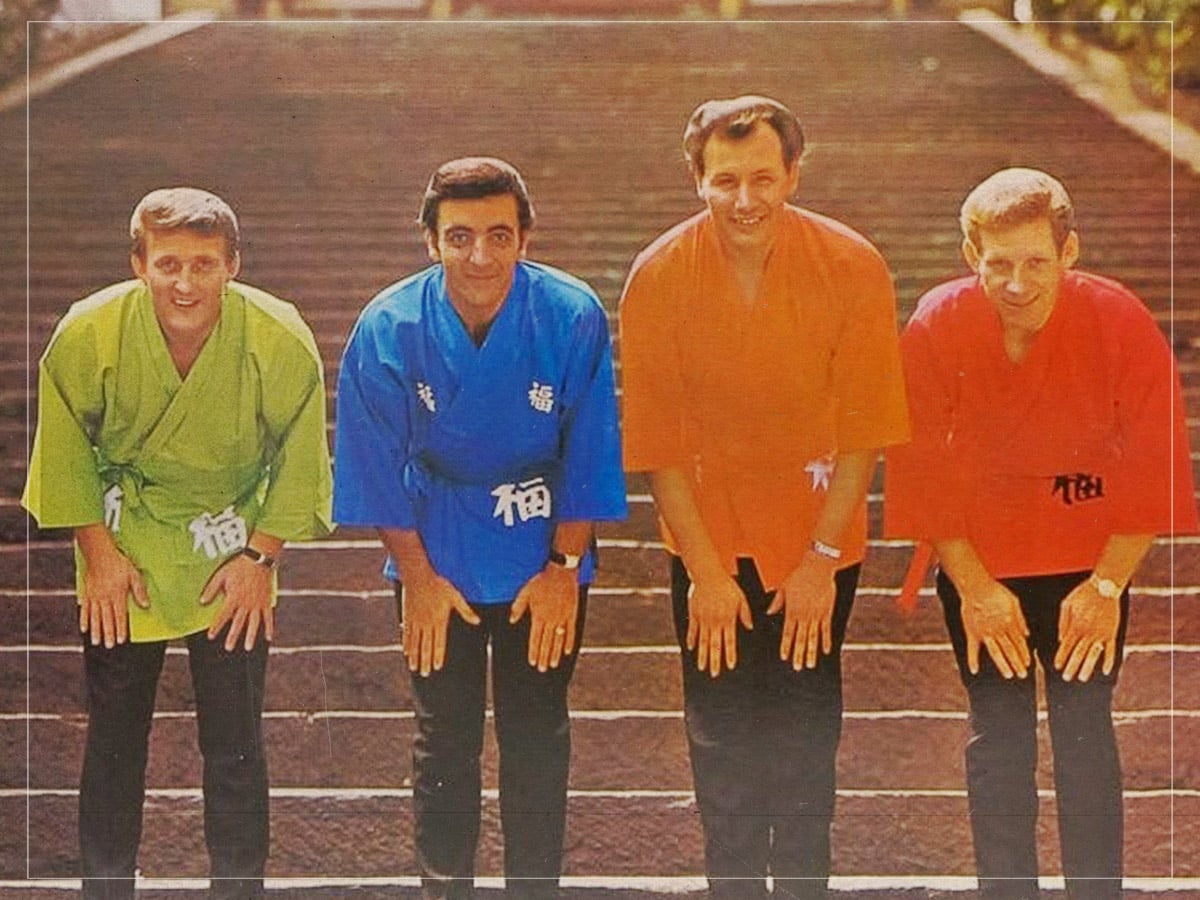
By the mid 1960s, The Beatles were certainly a big deal in Japan, but The Ventures continued to outsell the Fab Four by a two-to-one count, and when the surf rock pioneers finally returned for their own headlining tour of the country in 1965, with the full line-up in tow, they experienced their own unique version of Venture-mania, mobbed by adoring fans everywhere they went; that year, according to Billboard, five of the top ten selling singles in Japan were Ventures records.
The eleki boom didn’t last forever, of course, but the popularity of The Ventures far outlasted the original fad, as the band remained one of the most revered and best-selling acts in the country for years, releasing dozens of records exclusively for the Japanese market and returning to the country for regular tours well into the 2000s.
In 2010, two years after their induction into the Rock and Roll Hall of Fame in the US, The Ventures were honoured with the Order of the Rising Sun by the Japanese government, “in recognition of their contribution to the development and enrichment of music culture in Japan, as well as to the promotion of cordial relations between Japan and the United States”.
Before his death in 2022, founding member Don Wilson spoke with classicbands.com about The Ventures’ half-century-long love affair with Japan.
“Well, we’ve sold about 40 million records in Japan,” Wilson said, “So, we really are a mainstay there. They just continually want us, and continually buy our records. In 1970, we were the number one composers in Japan. And, in 1971, we were the number one composers again, which put us in the top ten of the Japanese composers, and the very first foreigners to ever get in it, in music history. We’ve written standards for Japan.”
The Ventures still exist as of 2026, carried on by a line-up of Bob Spalding, Leon Taylor, Ian Spalding, and Luke Griffin. All four original members of the group are no longer with us, but they’re still hanging ten and breaking down cultural divides in that great big gig in the sky.
