


Martial arts, death threats, and the night Japan actually heard The Beatles

It was 1966, and The Beatles were about to land in the middle of a Typhoon, almost literally.
Their flight to Japan had been grounded in Anchorage as a cyclone swept over East Asia. This hold-up did little to curtail the turbulence… in every which way.
The Fab Four’s imminent arrival had already caused rife division. In the mid-1960s, the Second World War still barely seemed to be over in Japan. Officially, the US had occupied the country for seven years as they initiated demilitarisation and democratisation before handing control back over in 1952. But many thought that this handover was a sham.
After ‘52, the US still maintained military bases and funded the conservative ruling LDP party, while the CIA lined the pockets of pro-American politicians and brutally suppressed student movements in ‘The Red Purge’, attempting to mould the ideology into one that they agreed with rather than one of Japan’s own choosing. In ‘66, they were even pushing the nation towards involvement in the Vietnam War.
While The Beatles, of course, were British, their rampant success in the States made many wary that they effectively operated as a cultural extension of the US. This viewpoint wasn’t restricted to Japan. As the Soviet Studies expert, Dr Yury Pelyoshonok explained, “The Soviet authorities thought of The Beatles as a secret Cold War weapon.”

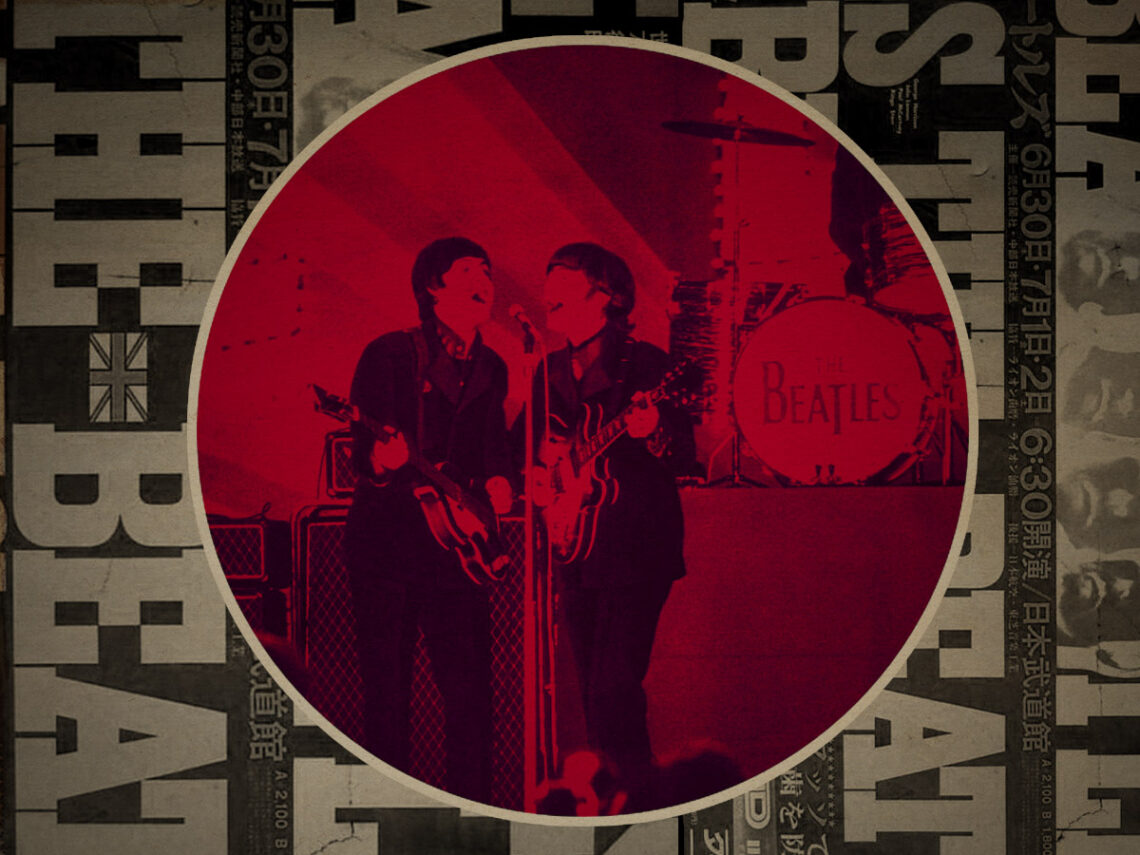
So, for myriad reasons, the Fab Four venturing to Japan was already politically loaded upon announcement. Things, however, grew even more volatile once their tour plans were drawn up. The Liverpudlian group were set to play five 30-minute sets over the course of three days at the only indoor venue deemed big enough to host them: the Nippon Budokan.
While the venue was hardly steeped in tradition, given that it had only been built two years earlier for the Tokyo Olympics, it was positioned between the historic Yasukuni Shrine and the Imperial Palace, and it was specifically constructed to host martial arts competitions. So, rock ‘n’ roll taking to the stage caused no small degree of uproar.

As their arrival grew closer, political tensions mounted. With the controversy reaching a fever pitch, both Prime Minister Eisaku Sato and Budokan President Matsutaro Shoriki pushed for a cancellation. But it was too late, contracts had already been signed. Besides, while there might have been plenty of pressure in opposition, a huge legion of fans were all in favour of the Fab Four gracing this corner of the world with their progressive presence.
Sato needed things to go off without a hitch, so his solution was simple: 35,000 police officers were placed on duty for the duration of the Fab Four’s fraught stay. When a break in the Typhoon allowed the band to land, it was 3:40am, but already the cops got a warning of what they were up against as over 1,500 fans flooded the arrivals lounge in hope of even the slightest glimpse of the band.
If any fans did manage to spy the cheeky chaps between a crack in the police battalion, they would’ve seen the Liverpool lads in relatively chipper form. That’s because their management decided that they’d be better off not knowing that a death threat against them had been received. It claimed that beetles are nasty insects that must be crushed, including those spelt with an ‘a’. This colourful caution was one of the many brandished against the oblivious band.

However, they wouldn’t be in ignorant bliss for long. They were swiftly shepherded to their hotel, where police officers occupied all the adjacent rooms, and they were informed that they mustn’t leave their suite. While Paul McCartney managed to persuade the police to give him a heavily escorted tour of Meiji Shrine and the Imperial Palace, and John Lennon supposedly slipped off disguised as a photographer, they were soon reprimanded when fans spotted Macca out and about, and restrictions on their movements grew even stricter after that.
Confined to their hotel room, the band famously painted ‘Images of a Woman’ together and found serene content despite the furore beyond the walls of their guarded domain. A similar atmosphere pervaded the remarkably strange concerts they embarked upon at the Budokan.
In some ways, The Beatles had already quelled some of the negative spirit espoused by nationalist protestors by firmly proving they weren’t mere pawns of an American system when they spoke out against the Vietnam War for the very first time at the Tokyo press conference prior to the shows. If that caused confused ambivalence, then they would be on the receiving end of the same emotion when they took to the stage.
At this point, on most of their tours, they instantly couldn’t hear themselves from the second they walked out into the spotlight to the moment they were back on the bus. However, at the Budokan, security had ensured fans were so far back from the front of the stage that, for once, the band could barely hear them. And with heightened fears of a sniper in the venue, for every ten fans present, there were three police officers, and nobody could stand up.
So, it’s not without a degree of irony that the Japanese audiences on the ‘66 tour perhaps got to hear The Beatles like no other. With the band at their pivotal midpoint between smiling teenboppers and avant-garde revolutionaries speaking out against regimes, the Budokan audiences saw everything that they represented at once, and they heard it all clearly, too.

This wasn’t the only refreshing upshot of the tour for the group. Because of the death threats and heavy police presence that went along with it, ironically, they felt calm and cared for, unlike in the States (and everywhere else for that matter), where remarks about being bigger than Jesus had landed them in hot water without 35,000 enlisted officers surrounding them at all times.
But above all, while the tour might have been peculiar, it typified their transformational potential to boot. As Junichi Mizusawa, who runs a John Lennon museum in Saitama, told the BBC, “We really felt that they were singing for us. They sounded completely different to Japanese music, or jazz, or American pop, so initially it was rather shocking.”
But ‘rather shocking’ was entirely apt, as Mizusawa continues, “But young people in the ’60s had no problems accepting them because they seemed to be giving voice to our feelings. It was a new sound that excited a generation which had nothing to do with the war.”
That defiant spirit, the confounding joy that The Beatles undoubtedly brought about, and their refusal to adhere to presupposed expectations, left even the firm naysayers reflecting on the changing times once they departed and headed on to the Philippines for what would become their final days on the road. As the UK embassy would reflect in confidential memos at the time, even the nationalists began to find them “agreeable”, and the impact of Tokyo was everlasting.
In some ways, beyond Tokyo, the tour was reflective of a modern pop concert. From the parasocial fans’ futile flocking to the foot of their hotel to the fact that ticket prices were double the typical going rate for a pop act in Japan, right through to the fact that plenty of people in the crowd were there just to say they’d been, much about the manic visit is now spookily synonymous with live music.
It might’ve only been a few fabled dates and a curious confinement to the Tokyo Hilton, but played forward, The Beatles’ stint in the Land of the Rising Sun captures a band, country, and culture in rapid transition with more clarity than the screaming noise that surrounded the three prongs of those movements in the main.

Never Miss A Beat
The Far Out Beatles Newsletter
All the latest stories about The Beatles from the independent voice of culture.
Straight to your inbox.