


‘Is This It’ at 20: How The Strokes changed music forever

“I was talking to Lou Reed the other day and he said that the first Velvet Underground record [The Velvet Underground and Nico] sold 30,000 copies in the first five years,” Brian Eno once said in 1982. “The sales have picked up in the past few years, but I mean, that record was such an important record for so many people. I think everyone who bought one of those 30,000 copies started a band!” he added.
Is This It, the debut album from New York rock and roll band The Strokes, is the most influential, most important, and perhaps even the greatest album of the past 20 years. The bands and musicians that it inspired, the effect the members themselves had on fashion and culture, the cross-continental acclaim, the endless critical praise, and now the numerous retrospectives solidifying its divinity can all be cited as evidence. It also only sold 16,000 copies in America during its first week of release.
The sales for Is This It can no longer be the basis for ridicule. It has since sold over one million copies in the band’s home country, and in the UK, where the group were embraced as Gods by the music press of the day, the album peaked at number two. But just for reference: the album arrived at number 74 on the Billboard 200. Earlier that month, at a time when the global record-selling industry was still robust, Alicia Keys released Songs in A Minor through the same record company, RCA, and sold 236,000 in its first week.
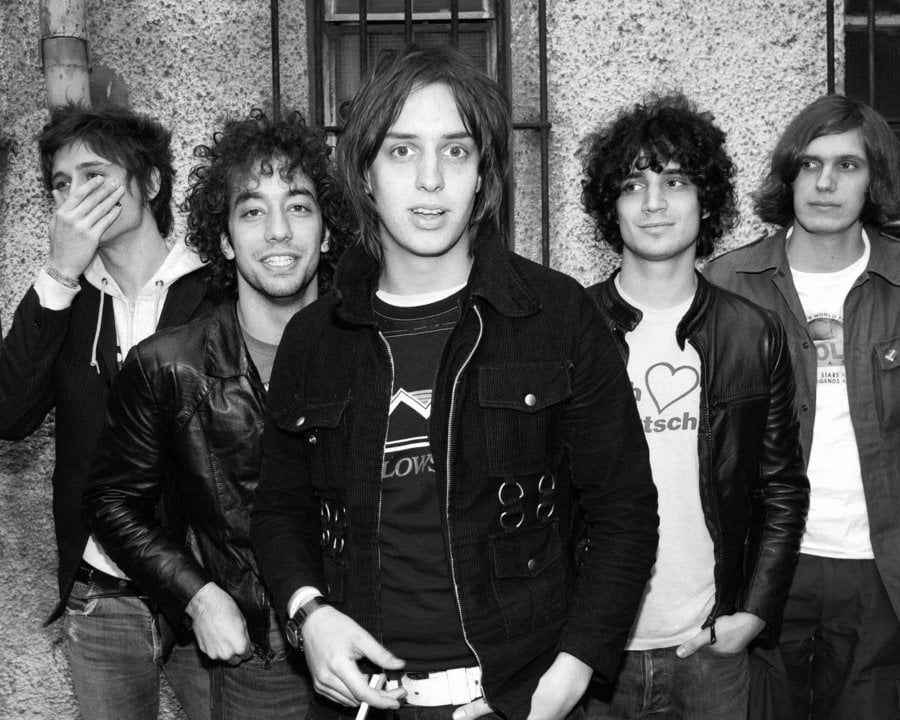
There was obviously something beyond sales figures that translated about The Strokes, five young men in their early 20s by the names of Julian Casablancas, Nick Valensi, Nikolai Fraiture, Fabrizio Moretti, and Albert Hammond, Jr. With their distinctly lo-fi garage rock sound and their simultaneously ragged/sharp-dressed appearances, critics and journalists practically fell over themselves crowning the band as the new saviours of rock and roll. So much so that for the next fifteen years, The Strokes were victims of their own insurmountable hype.
“Victims” isn’t exactly the right word. They were successful, they had hordes of adoring fans, and they made a succession of good-to-great records that continued to poke at, if not fully permeate, the mainstream. But the narrative that surrounded The Strokes as early as 2003 was that the global resurgence of Stratocaster guitars and live drums and croaky, uniquely sardonic vocalists singing about girls and drugs that they were unwittingly, and perhaps somewhat unfairly, positioned as the leaders of was not to be. Teen pop continued to reign, hip hop continued its rise as the predominant genre of choice for suburban youth, and rock and roll stubbornly refused to become the culturally dominant force that it once was.
Perhaps you’d be forgiven – if you were an English rock critic or a hip New York Mercury Lounge dweller – for thinking that Is This It was the flashpoint. If you had heard The Modern Age EP in 2001 or had survived Woodstock ’99 and read the writing on the wall, maybe you could feel a certain changing of the guard or a turning of the tide. If you were a true believer in the power of Marshall stacks, biding your time as rap-rock and nu-metal and post-grunge were what the public at large saw as “rock” at the turn of the new millennium, then yes, Is This It could very well have been the moment confirming that rock and roll was back and here to stay.
A few electronic buzzes and a simple drum pattern. That’s how album opener ‘Is This It’ kicks off. But within seconds, every element of The Strokes’ signature sound comes to the fore: the twin guitar attack of Valensi and Hammond, Jr., the alternatingly simplistic and complex bass lines provided by Fraiture, the driving foundation of Moretti, and the baritone bray of Casablancas that sounds like he was recorded through a broken guitar pickup. ‘Is This It’ is a bit of a red herring as the album’s only slow ballad. For the next 33 minutes, The Strokes are lean, hungry, and ferocious in their tenacity, intent on stripping away any excess.
The lo-fi scuzz of Casablancas’ voice is the ultimate X-factor on Is This It: recorded through a small Peavy amp, the distorted vocal performance adds an extra bite to lines like “Like my sister don’t give a fuck” and “I took too many varieties”. Producer Gordon Raphael took great pains to make the immediacy and excitement of the band’s live performances translate to record. Even though the record sounds off the cuff and improvised, it is intentionally so. There are a million guitar bands that sound like they never got out of the garage, but The Strokes were able to bring the garage directly to you, and make it sound like the garage was a hundred-foot tall monolith dedicated to punk ideals and youthful abandon.
What sometimes gets lost in talking about the album is that Casablancas, the sole writer for the album’s tracks, had quite the ear for melodies and hooks. ‘Someday’ and ‘Last Nite’ are thinly disguised pop songs, while ‘Soma’ and ‘Hard to Explain’ are rock tunes that extend an olive branch to those who need catchiness in their favourite music. Even the more brash and aggressive songs like ‘Take It Or Leave It’ and ‘The Modern Age’ retain that same ear-catching and memorable power. There’s no fat, even when the band had to make a last-second change.
The quintessential New York band, of course, had a quintessential New York anthem. ‘New York City Cops’ doesn’t really have anything at all to say regarding heavy political issues involving the police. Instead, it’s another gutter punk song about one night stands and getting caught flaunting the rules that are supposedly kept by the powers that be. But in the wake of 9/11, the song’s chorus could far too easily be taken at face value, so the band substituted a newly recorded song, ‘When It Started’, without missing a beat, sequence or thematic wise.
Substitutions would have to be made for the album’s cover as well. A stark black and white shot of a woman’s naked hip and crotch with a black leather glove suggestively placed on the butt, the original album cover was a perfect representation of the grimy sexuality that the band projected. But Casablancas didn’t like the cover and, instead, found a new photo of a subatomic particle to replace the original on the American and reissue copies.

The sex, drugs, and rock and roll allure of Is This It did have an immediate impact. Skinny jeans and blazers were back, as were long dirty shags of hair. But more importantly, the idea that a young, dangerous, and debaucherous rock band could take over the world was back as well. Rarely photographed without cigarettes or beer bottles, The Strokes were easily identifiable to a certain kind of mystique that had been sorely lacking. The last time rock music made a major cultural impact was in the late ’90s, and it wasn’t cool to be cool. It was better to be mumbly and angsty and to be doing harder drugs. But The Strokes knew how cool they were, and did nothing to diminish their own hipness. They were the first rock band in a long time who felt fun and reveled in their own good times.
As much as it was embraced and instantly canonised, Is This It also became the band’s albatross in a relatively short period of time. When Room on Fire was released in 2003, critics couldn’t decide whether The Strokes should have changed or stayed the same. The band chose to retain its sound and were met with tepid approval, if slight disappointment for their lack of innovation. With each subsequent album, the band had to decide whether to subvert or acknowledge Is This It and, subsequently, were trapped in an echo chamber of their own design. 1980s synths, drum machines, surf rock baselines, and confused direction became the predominant aspects of The Strokes sound, and relationships frayed as the band’s reputation as rock and roll saviours faded to its inevitable conclusion. The band has since returned to the top of the rock and roll mountain with The New Abnormal, but as the elder statesmen, not groundbreaking innovators.
Still, the impact of Is This It was undeniable. Just as grunge had ostensibly wiped out the hair metal faction of the late ’80s, The Strokes immediately rendered nu-metal bands and rap-rock clowns as terminally uncool. Behind them, a whole subculture of bands, from the gothic suaveness of Interpol to the harried riot grrrl blast of Yeah Yeah Yeahs and the art-punk experimentalism of TV on the Radio, suddenly made New York City the centre of the rock and roll universe. Around the world, Is This It found its audience and inspired them to either start up or get on board: The Libertines in London, Arctic Monkeys in Sheffield, Franz Ferdinand in Glasgow, The Hives in Fagersta, Kings of Leon in Nashville, and The Killers in Las Vegas. A relatively new term, “indie rock”, began to take hold, and the aftershocks are still around for anyone who picks up a guitar and eventually figures out how easy it is to play ‘Someday’.
What keeps Is This It from faltering under its own weight or going passe is how out of place it sounds within any context. Sure, it reads as early 2000s New York nowadays, but only because The Strokes staked their claim so enthusiastically. Musically and lyrically, Is This It takes the best elements of rock and roll from the previous 50 years, weaponises them, mixes in a liberal amount of inner-city coolness, and reflects it back on the world. The sales would pick up, the narratives would fluctuate but eventually stabilise in a positive outlook on the band’s work, and The Strokes were finally able to escape their past by embracing the more timeless aspects of their style. Everything always come back to Is This It, but the album finally feels like a chapter in The Strokes story, not the entire story itself.
