


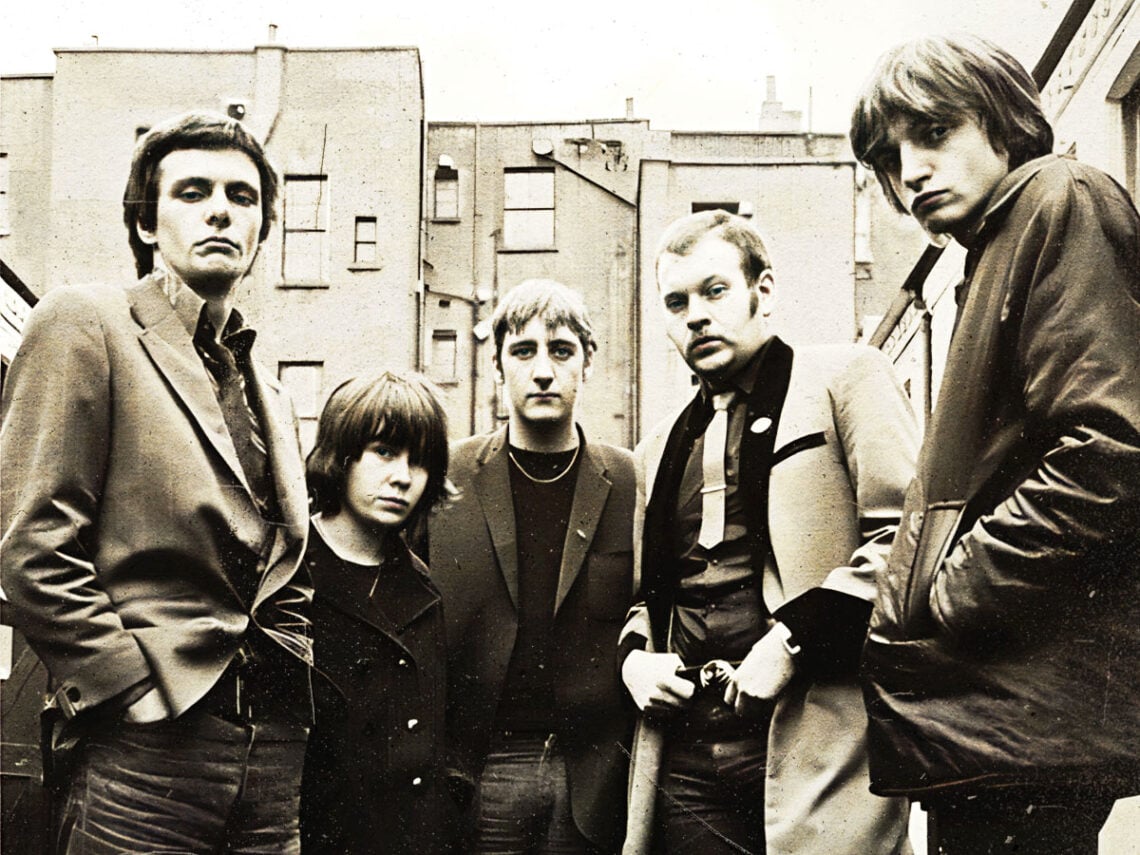
How The Fall got their name

In the murky streets of Prestwich, Greater Manchester, a legion of well-read youths, namely, Mark E. Smith, Martin Bramah, Una Baines and Tony Friel, coagulated in the mid-1970s, bonding over a shared passion for music, literature and hard drugs. Musically, the group were inspired by experimental rockers of the ’60s and early ’70s, including CAN, The Velvet Underground, Captain Beefheart and The Stooges. As The Fall emerged, these passions would merge into a force of which shockwaves can still be felt today.
Turning pages and spinning records had never been difficult for this group of pub phantoms, but a cataclysmic event was required for the future to unfold as it did. Said event occurred at Manchester’s Lesser Free Trade Hall in July 1976, the night Sex Pistols paid a rather influential visit.
As legend dictates, Peter Hook, Ian Curtis, Bernard Sumner, Morrisey, Mick Hucknall, John Cooper Clarke and future Factory Records boss Tony Wilson were among the audience that night and have since described it as a pivotal moment of inspiration.
“It was just about the attitude,” Hook, the bassist of Joy Division and New Order, said while discussing the Sex Pistols gig in a 2022 interview with Far Out. “The fact that what they were doing was so different. The week before, I’d been to see Led Zeppelin, and that was great; they played fantastically, but they weren’t inspiring – as in, come along and change your life, inspiring. So, yeah, the Sex Pistols spoke to me and said, ‘Pack it in’, okay, ‘give up your job, and get out and join the circus.'”
Smith and his friends had been keen writers, reciting their own works of literature to one another during drug binges, according to Simon Reynolds’ 2006 book Rip It Up and Start Again: Postpunk 1978–1984. When the group beheld John Lydon’s adolescent snarl and Steve Jones’ raw, abrasive riffs, they discovered the perfect outlet for their creativity. Within weeks, they, too, had joined the circus.
With their sights set on forming a punk band, the formative foursome just required a name. As avid bookworms, the group appeared dead set on a literary name. According to Reynolds’ book, Smith’s favourite authors included H. P. Lovecraft, Raymond Chandler, Albert Camus and Malcolm Lowry.
Smith argued a case for the band to be named The Outsiders, ostensibly after Camus’ 1942 novella The Outsider; however, bassist Friel suggested The Fall, which ultimately garnered a majority vote. The Fall (or La Chute) was the last complete work of fiction published by French philosopher Camus in 1956.
The Fall is a short novel comprised of a series of monologues professed by the self-proclaimed “judge-penitent” Jean-Baptiste Clamence, formerly an upstanding lawyer in Paris, who now sits in an Amsterdam bar describing his “fall” from grace to a new friend. Navigating the philosophical realms of existentialism, justice, and morality, Camus deftly exposes life’s many anxieties, challenges and hypocrisies.
Camus layers the book, as with much of his previous material, with references to classical literature and allegories. For example, early in the book, Camus justifies his vital setting by comparing Amsterdam to Dante’s vision of hell in Inferno: “Have you noticed that Amsterdam’s concentric canals resemble the circles of hell? The middle-class hell, of course, peopled with bad dreams. When one comes from the outside, as one gradually goes through those circles, life — and hence its crimes — becomes denser, darker. Here, we are in the last circle.”
Other notable works by Camus include The Plague, The Rebel, The Myth of Sisyphus and The Stranger, all worthy contenders for naming punk bands.
Throughout their first few years in the studio, The Fall established a distinctive style noted for raw repetition adorned with catchy and circular guitar riffs. The late broadcaster John Peel was an early patron of the band; in fact, they were his favourite group, with The Undertones closely trailing. “They are always different; they are always the same,” Peel once famously said of The Fall.
The band’s musical style was matched by Smith’s bold, assertive lyrics, almost always enunciated with an ‘ah’ sound at the end of phrases. Amid the repetitive slogans of Smith’s lyrics were oft comical comments on sociopolitical issues. Evidence of a diet high in philosophical fiction could be found ubiquitously, but Smith was also a fan of horror and sci-fi novels.
Watch The Fall performing live in 1982 below.
