


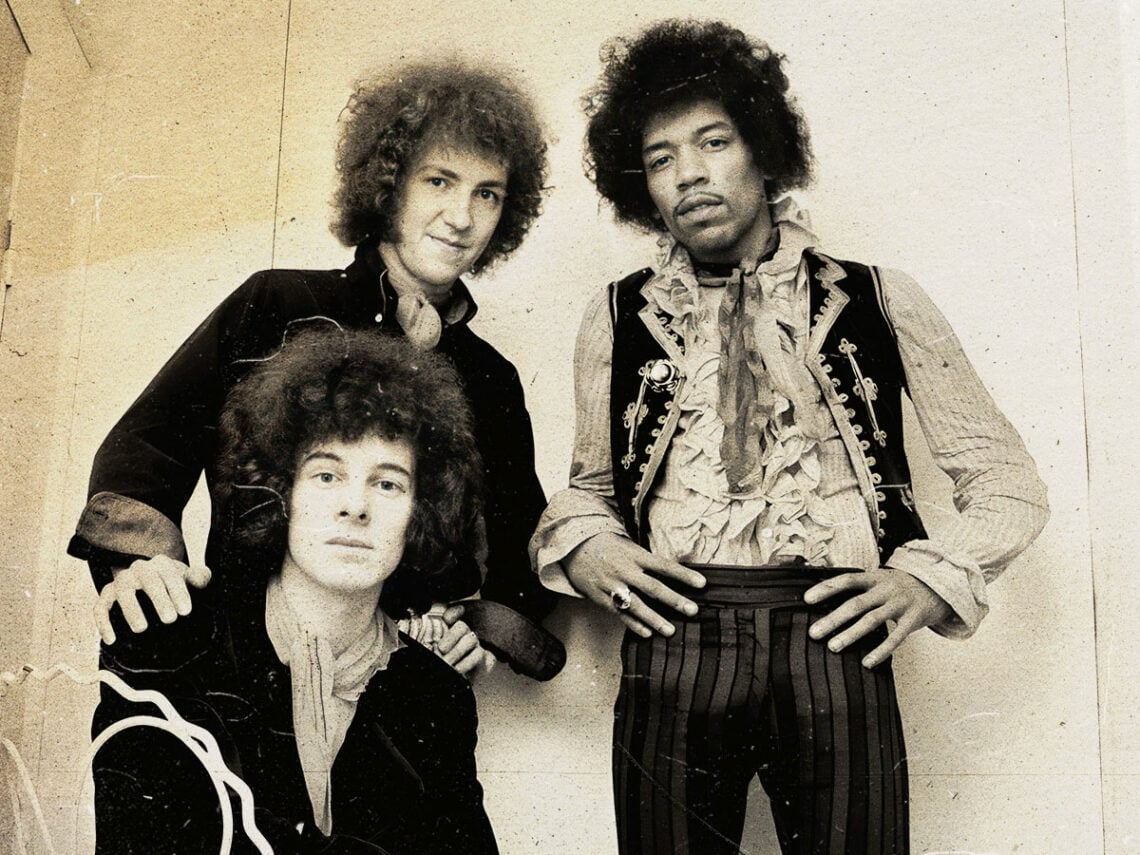
Hired guns, heavy amps, and “big clout”: How Jimi Hendrix assembled The Experience

It’s one of the great ‘fun facts’ of rock ‘n’ roll history that Jimi Hendrix not only went on tour with The Monkees, but did so as the second or sometimes third banana on the bill.
This was the ‘Summer of Love’, 1967, just before the Jimi Hendrix Experience’s debut album came out in America, so while Jimi might have already been the greatest guitarist on earth, he was still a clear tier below a cuddly slapstick pop group with their own TV show.
As anyone aside from Hendrix’s manager, Mike Jeffrey, might have predicted, The Monkees + Experience pairing went over like cod and cabernet. Young audiences desperate to see their new favourite mop-tops were not eager or willing to step into Hendrix’s groove, and in some cases, those who did observe that groove found it entirely inappropriate for their kids.
At one point, representatives from the conservative group known as the Daughters of the American Revolution organised a protest of Hendrix’s inclusion on The Monkees’ US tour, calling his music “too erotic”. Hendrix wasn’t exactly having a great time anyway, so when the mounting pressure led to the Experience getting jettisoned from the schedule, he took it in stride, telling the NME, “We decided it was just the wrong audience. I think they’re replacing me with Mickey Mouse”.
For all the comedic implications of an emerging musical genius finding himself stuck on the undercard beneath a manufactured pop band, it’s worth remembering that the Jimi Hendrix Experience didn’t exactly come together in the most organic of ways either. No, they weren’t cobbled together by television producers to create a fictional version of The Beatles, but they weren’t school buddies who earned their stripes in the clubs of Hamburg either.

In fact, before joining the Experience in 1966, Hendrix’s drummer had more acting credits than Micky Dolenz, having starred in the BBC series Jennings At School at age 11, and continuing to play various bit parts on shows like Redcap and Emergency Ward 10 right up into the mid 1960s. As a TV actor, he went by the name John Mitchell, but in his nighttime gig as a rock drummer, he was, of course, the legendary Mitch Mitchell.
Mitchell was a member of a few different London bands before ever meeting Jimi, including the Riot Squad and Georgie Fame and the Blue Flames, where he began developing his unique fusion of jazz drumming techniques with the new blues rock sound of the era. As it turned out, his path to joining the Experience wasn’t all that different from auditioning for a TV role. In 1966, around the same time Mitchell was on the outs with the Blue Flames, he got a phone call from Chas Chandler, the bassist for The Animals. He had decided to leave his band, as well, and had shifted his attention to management, with one very specific new client in mind.
“I’d seen Hendrix before the last Animals tour started, and I knew what I was going to do when the final tour ended,” Chandler told Guitar Player magazine in 1984, noting that Hendrix’s obscurity in America had boggled his mind, “When we finished the last show, I just flew right to New York, picked up Jimi Hendrix, went back to England and formed the Hendrix Experience.”
Several try-outs were held to build Hendrix’s new British backing band in 1966, and not unlike The Monkees, fashion and looks were very important recruitment factors, albeit complementary ones to actual musicianship. Chandler’s strategy was still borrowing from the old Brian Epstein playbook, as he felt like a group needed to have a uniform, marketable look, the same sort that had been required of The Animals when he was coming up.

“[Chandler’s] idea was to have a back-up band for Jimi, with patent-leather shoes, white jackets, and so on,” Mitch Mitchell recalled to Modern Drummer in 1981, adding that Hendrix was far less interested in such concepts. According to Mitchell, Chandler hadn’t envisioned the Jimi Hendrix Experience as a three-piece, either. During the audition and early rehearsal process, the natural chemistry between the initial trio had simply forced a change of plans.
Noel Redding had entered the fold almost accidentally. He showed up for an audition at the Birdland club in London with hopes of becoming the lead guitarist for a second iteration of Eric Burdon’s band, dubbed the ‘New Animals’. Instead, Burdon tipped off his old bandmate Chandler to Redding’s potential, and Noel was essentially pawned off onto him that same night, given an impromptu second audition for the Hendrix project. Chandler handed Redding a bass guitar, an instrument he didn’t even play at that point.
“[Noel] had the same haircut as Jimi, and it looked right, you know,” Chandler said, “So he borrowed my bass and did a little audition with Jimi, and that’s how he came to be in the band”.
“We went through three tunes with no vocals,” Redding said, as quoted in Sean Egan’s 2014 book, Jimi Hendrix and the Making of Are You Experienced, “As far as I can recall, it was ‘Have Mercy’, ‘Land of 1,000 Dances’ and ‘Hey Joe‘. We just played it through… [Jimi] wasn’t really playing lead. He was just playing rhythm, basically. I think he was trying to suss out people.”
Because of Hendrix’s restraint that night and the absence of Mitchell, Redding wasn’t even all that impressed or aware of what he was signing up for when he agreed to be a founding member of the Experience. It was only when proper rehearsals started that the band’s unique power became apparent, and any further searches for keyboardists or extra guitarists were deemed unnecessary.

“To give credit where it’s due,” Mitchell said, “[Chandler] went out and he got a couple of amplifiers. He brought in these little Burns 20 Watt amplifiers, and at the second rehearsal, we tried to break the bloody things by throwing them down flights of stairs, and they didn’t break! But we knew what we wanted, which was big clout, you know, big amplifiers, and to make it as dramatic as possible.”
Both Mitchell and Redding were only 21 years old. In a matter of a few months, they’d be finishing up the first Jimi Hendrix Experience album, Are You Experienced?, and playing soon-to-be canonised rock classics like ‘Purple Haze’, ‘Fire’, and ‘Foxy Lady’ to stunned audiences. For his part, Mitch Mitchell claimed to maintain a very workmanlike approach to the sudden superstardom. He saw himself as a hired gun and a collaborator with Hendrix, rather than as a member of a band under anyone’s specific leadership. If the Experience weren’t a tight trio of childhood friends with a shared goal, however, they still cast a mighty long shadow as a newly unified force.
Even on that ill-fated tour with The Monkees, most musically-minded people over the age of 14 realised they were in the presence of something special, including Monkee Mike Nesmith, who had a vivid memory or walking down a hotel hallway during the tour, and seeing a door suddenly open to reveal an “eerie blue-red light” created by a neon sign on the outside of the building. “Hendrix appeared in silhouette with this light behind him,” Nesmith said in a 1988 interview, “And of course his hair was out to here, and he had on what had become his famous ribbon shirt. And he took a step forward, and it was like it was choreographed.”
He expanded further on the aura of the moment as well as his awe, adding, “Noel and Mitch both came up on either side of him, and they made this perfect trio; it looked like the cover of Axis: Bold As Love… It was really pretty spectacular, wall-to-wall hair brushing against the pot bellies of these cops [on security]. Jimi was in absolute control. He had such a command of himself and his circumstances.”
