


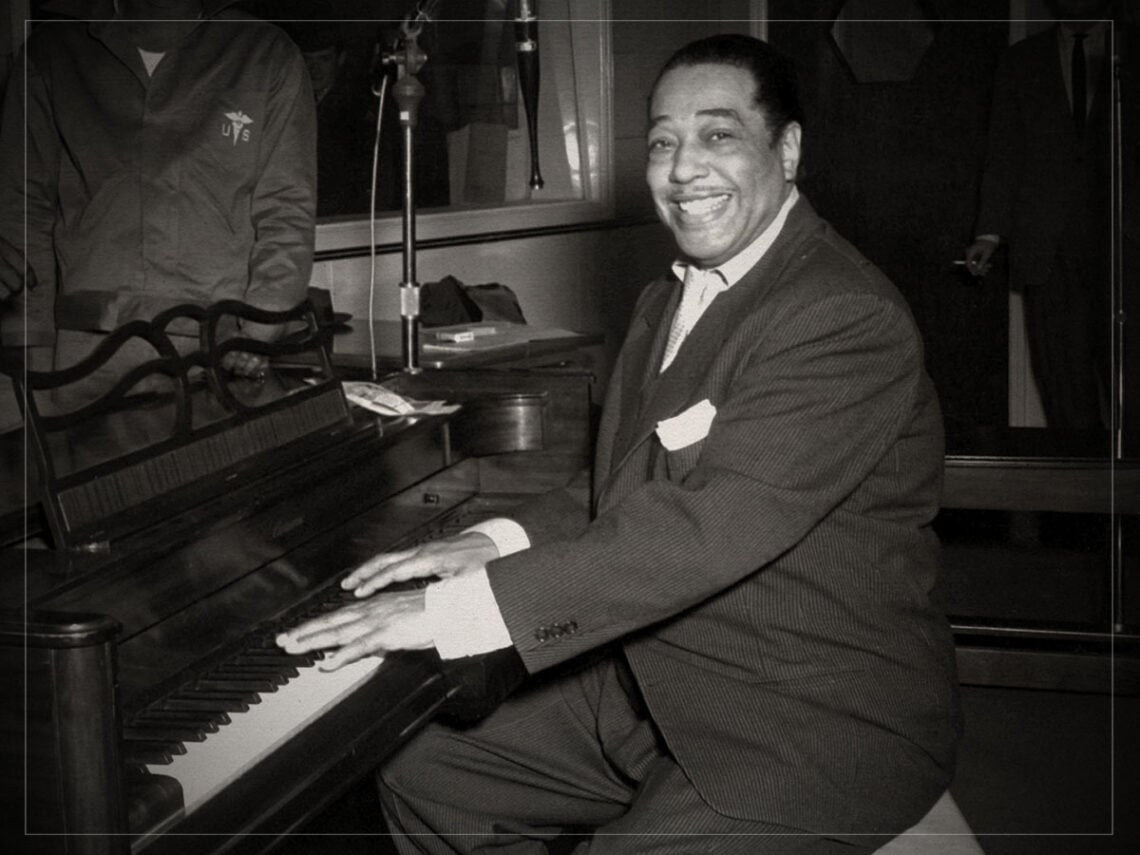
How Duke Ellington helped to inspire one of prog-rock’s greatest freakouts in 1969

While Duke Ellington is frequently regarded as one of the most significant composers in the history of jazz, without whom there wouldn’t have been quite as many advancements and innovations in the early 20th century, the man himself would tend to disagree with this level of high praise.
This isn’t to say that Ellington thought of himself as being considerably less talented than people gave him credit for, but it is more down to the fact that he thought of himself as being beyond a jazz musician and composer.
From his perspective, music was simply an opportunity for him to freely express himself without having to fall under the constraints of a particular genre, no matter how flexible the parameters applied to certain scenes can be. His mission in music was to create work that was challenging, and while it could often be squeezed under the umbrella of jazz music, he didn’t necessarily agree with being pigeonholed in such a fashion.
The breadth of what Ellington went on to inspire after his passing in the 1970s only further cements the idea that he transcended boundaries, and he’s far from just being beloved in the jazz circles where he was still most frequently active.
For example, Ellington has always had plenty of admirers in the world of progressive rock, and his virtuosic yet often unrestrained approach was a major inspiration for this freeform approach to creating rock music from the late 1960s onward. Progressive rock operated on an ethos very similar to that of Ellington’s, whereby music didn’t necessarily need to exist inside a box, and could incorporate anything from beyond their immediate surroundings in order to create something that is creatively intuitive.
In fact, one of the songs that is frequently cited as being a landmark in the early history of prog rock, King Crimson’s ‘21st Century Schizoid Man’, is said to have been inspired by Ellington’s madcap approach, especially in the latter section of the song.
While the instrumental middle section of the song, often referred to as its own separate composition called ‘Mirrors’, is frantic and jazzy and could be attributed to the influence of Ellington, it’s actually not until the closing moments of the song, after the main riff has played out one last time, that the true essence of Ellington comes in.
The gradual acceleration of the tempo at the end of the final repeat of the main riff ends up continuing to the point where it is moving so rapidly that none of the musicians are able to keep together, resulting in a completely chaotic barrage of noise that is reflective of the unbridled madness that Ellington and his various ensembles would create. Often associated with the big band style as well as the third stream, there was no specific point throughout his career where he chose to settle, and King Crimson can certainly be perceived in the same way.
It’s free-spirited and experimental, but is it jazz? Not exactly, but it’s certainly something that Ellington would have approved of, whether he was fortunate enough to have heard it before his passing or not.
