


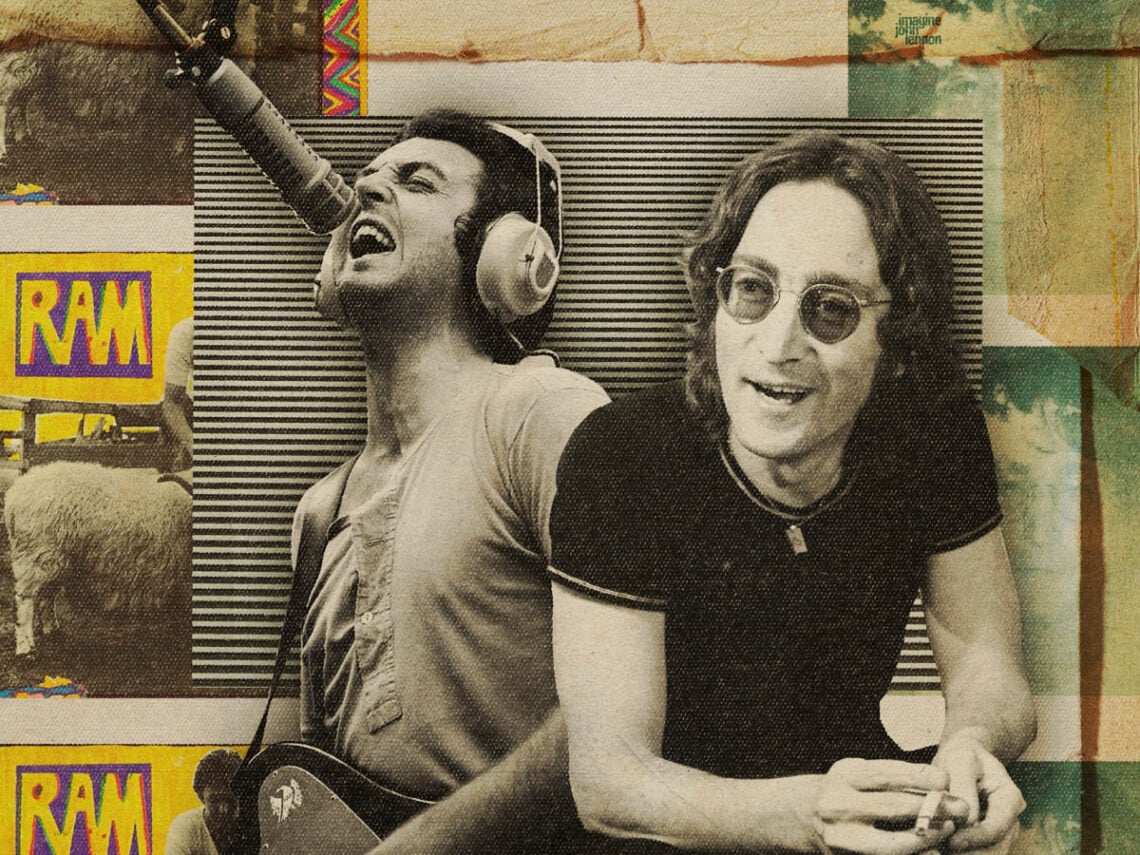
‘How Do You Sleep?’ vs ‘Too Many People’: What is the best song in the battle of John and Paul?

After the breakdown of The Beatles, all four members went off into their own corners, picked up their pens and vented their spleen in song. With years of friendship in tatters and a wild career to attempt to process, their debuts and first few albums each contained at least a few references to the band or to their ill feelings towards one another. However, in Paul McCartney’s ‘Too Many People’ and John Lennon’s ‘How Do You Sleep?’, the passive-aggressive messages hit a new level.
It’s not surprising. By 1971, when both these songs were released, things had gotten nasty. Not only had the band finally and officially split after a long process, arguably beginning way back in 1968 with The White Album or maybe even before, as tensions began to rise, but despite the inevitability, the split hadn’t been amicable.
It ended in flames when Paul McCartney turned around and sued his old bandmates. Filing for the legal end to the group, McCartney maintains that this was the only way to protect himself and his friends from their whole legacy falling into the questionable hands of Allen Klein. Later, the rest of the band would realise this and see his side. But in 1971, they did not.
There are many more songs that see the band dealing with the end of the Beatles. George Harrison navigated his annoyance towards them articulately on ‘Run Of The Mill’ or on the sad ‘Isn’t It A Pity’. Ringo Starr’s ‘Early 1970’ is a bittersweet depiction of his loneliness after the split. Both Lennon and McCartney mulled over the break up again and again on tracks like ‘Isolation’, ‘Man We Were Lonely’ and more. But in the summer of 1971, the two songwriters put the issue of their falling out into the charts.
First came McCartney’s offering, ‘Too Many People’. After recording his debut in complete isolation, Ram saw him return to a band setting with a lot more energy. He directed some of that energy right at the ‘Smart One’ in this veiled song about his feelings towards Lennon and Yoko Ono and the last days of the band.

“Too many people preaching practices,” he yells, later telling MOJO, “I felt John and Yoko were telling everyone what to do. And I felt we didn’t need to be told what to do.” The whole song seems to boil down to the idea that suddenly McCartney felt like there were too many people in the room, each pulling in their own direction and yelling over one another. Initially, the lyric “You took your lucky break and broke it in two” was even going to be “Yoko took your lucky break” as McCartney was bold enough to point right at Lennon’s wife and blame her for the split of the band. But, before recording, he took that line out and put the whole track over a charming, whimsical instrumental that gives the aggression a light-hearted disguise.
No disguise is present in Lennon’s response, which landed a few months later in September. “How do you sleep at night?” is the question at hand as the singer essentially spits at McCartney. While the Ram track goes some way to hide or dance around the subject, Lennon doesn’t as he loads the song up with references to the Sgt. Pepper’s album and even the Paul Is Dead theory, using it to essentially say that McCartney was dead to him as he sings, “Those freaks was right when they said you were dead”.
But without a doubt, the wildest and most savage line in the whole song is when Lennon brings McCartney’s dead mother into the mix. “Jump when your momma tell you anything,” he sings, seemingly referencing ‘Let It Be’ and ‘Yesterday’ and the way that McCartney believed his mother handed him songs in his dreams.
But which is better? If the marker here is drama, Lennon wins without a doubt. The initial release of ‘How Do You Sleep?’ had fans gasping at the lyrics as the singer lays their feud out with no attempt to hide anything through subtlety. However, if the question at hand is which is the better song, McCartney surely wins for exactly that fact.
While still musically great with a seductive instrumental, Lennon’s piece feels more like a historical artefact than a timeless song. By going some way to veil the topic at hand and make his lyricism more ambiguous and open, McCartney’s song feels more broadly enjoyable, still historically important within the fight, but also allowing itself to have a life and legacy beyond that as just a great song regardless of a friendship fallout.
But in Lennon’s eyes, the differences between the tracks reflect the differences that always existed between himself and his old collaborator. “The thing that made The Beatles what they were was the fact that I could do my rock ‘n roll, and Paul could do the pretty stuff,” he said, reflecting on the relationship of these two songs. “It’s all good, clean fun,” he concluded on the battle of the tracks. So, while the artists implored listeners not to pick a side between them, the two tracks and their different takes on the same situation were a fascinating early insight into what happens when you take two halves of a whole Lennon-McCartney and split them into two separate entities.

Never Miss A Beat
The Far Out Beatles Newsletter
All the latest stories about The Beatles from the independent voice of culture.
Straight to your inbox.