


Is Paul McCartney dead? Debunking the myth

“I am alive and well and concerned about the rumours of my death. But if I were dead, I would be the last to know.” – Paul McCartney
Before we dive into the multitude of mythology and musically warped intrigue, let us first simply state the fact: Paul McCartney is not dead. The Beatles’ legend has been the subject of near-constant headlines and unbridled scrutiny since they burst into the collective consciousness in the earliest embers of the fiery 1960s. Things kicked into overdrive a little later in the decade.
Ever since 1967, rumours of Paul’s death have been greatly exaggerated, and the singer has needed to deal with a continuous fascination with the conspiracy theory that The Beatles lost one of their principal songwriters during the band’s creative peak in a tragic car accident.
The theory claims that, rather than properly grieving the loss of a bandmate, The Beatles disappeared for a few days, reflected on the prospect of continuing without their beloved boy next door, and decided the only way forward was to replace him. Supposedly, the winner of a Paul McCartney lookalike contest, one that nobody can prove ever happened, a man named William Campbell, whom nobody can reliably trace, was hired to take his place permanently. As McCartney himself once said, “It is all bloody stupid”.
The ludicrous facets of the charade have never stopped the curiosity, though, and there is a slight enjoyment in pawing through the remarkable set of improbable clues to come to the conclusion that is blinking at anybody who meets Sir Paul in the face. Ever since The Beatles became the global superstars in 1965, Beatlemania had meant that every column inch that could be devoted to the band was done so with prolific effect. It’s something we still see to this day.
The facts are that the Beatles were and – still are – very big business, and conspiracy theorists around the world have pointed to this notion when surmising that the rumours are true, the clues are real, and Paul McCartney died on Wednesday, November 9th, 1966.

The ‘Paul Is Dead’ myth
The conspiracy theory claims that McCartney stormed out of a Beatles songwriting session during the making of Sgt Pepper’s Lonely Hearts Club Band, ironically the album many consider his masterpiece, before jumping into his Austin-Healey in a rage. According to the theory, he sped off into the night, crashed the car and was killed, with some versions even claiming he was gruesomely scalped in the accident. After all, a little blood and gore always seems to make these stories even more irresistible.
With the band floundering amid their pop peak, it is claimed that McCartney was then replaced by a lookalike called either William Shears Campbell (apparently referenced as Billy Shears on Sgt Pepper) or William Sheppard (supposedly referenced in ‘The Continuing Story of Bungalow Bill’). Luckily, he was a man who could not only look like Macca, but sing like him, play a whole heap of instruments like him, and write songs like him too – quite the find, and one that Simon Cowell would curse until his own dying day.
While McCartney was not in the country during this time, officially holidaying with then-girlfriend Jane Asher, there may have been some accidental muddying of facts that could have led to rumours starting to spread. McCartney was actually involved in two different car accidents, which bookend the proposed fatal incident. One saw the singer scar his lip, the reason why he grew a moustache in 1967, and the other involved his Mini Cooper, but he wasn’t driving, and he certainly wasn’t killed.
It did, however, prompt a Beatles newsletter, run by fans, to deny claims that Macca had died, written under the title heading ‘FALSE RUMOURS’, it reads: “The 7th January was very icy, with dangerous conditions on the M1 motorway, linking London with the Midlands, and towards the end of the day, a rumour swept London that Paul McCartney had been killed in a car crash on the M1. But, of course, there was absolutely no truth in it at all, as the Beatles’ Press Officer found out when he telephoned Paul’s St John’s Wood home and was answered by Paul himself.”
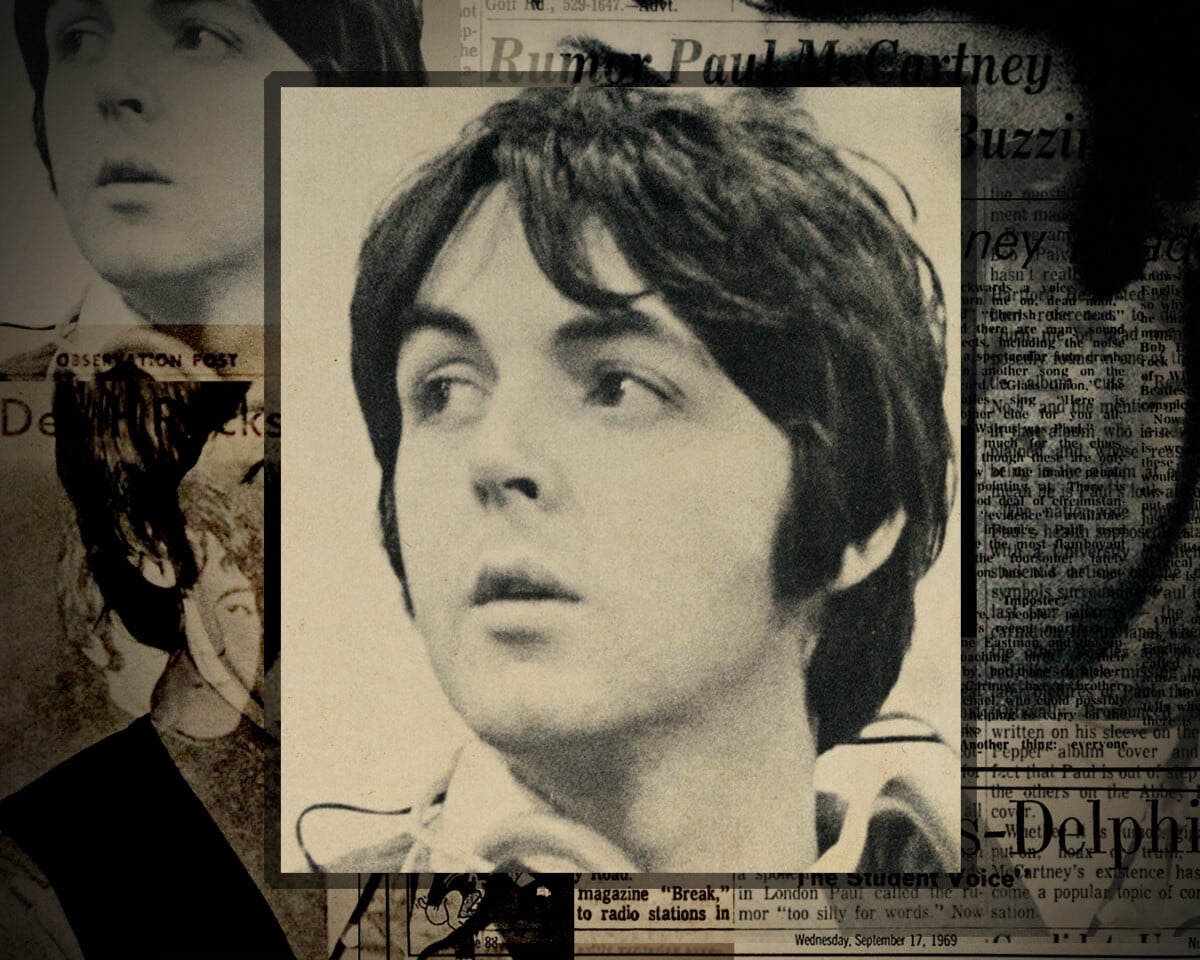
The moment the myth began
You might assume the newsletter was the spark that started the enormous rumour, but that is not quite true. At most, it provided the conditions for the theory to grow, while the real catalyst arrived two years later.
The first time the rumours of McCartney’s apparent death were given any real credibility in a public sphere was on September 17th, 1969, when Tim Harper wrote a piece referencing the tale in the Times-Delphic, a campus newspaper for Drake University in Des Moines, Iowa. Harper was quick to insist that the piece was purely for entertainment purposes and cited his source as a friend by the name of Dartanyan Brown. Brown himself was also more than happy to pass the buck along, later saying he had caught the word from a musician who had spent time on the West Coast.
The truth, therefore, was clearly already out there and being highly manipulated by a society that had very little ability to fact-check at source. If such a story came to you today, you would be able to dispel it with one, possibly two, clicks. But in 1969, things could grow unabated for some time.
Following the publication of the article, the rumour gained even more traction, reaching a far wider audience when a caller named ‘Tom’ telephoned Russ Gibb, a radio DJ on WKNR-FM in Michigan, to discuss the theory surrounding McCartney’s supposed death. The caller directed Gibb to The Beatles’ ‘Revolution 9’ and urged him to play it backwards. “I shoulda brushed the kid off,” Gibb later recalled. “He said, ‘Play the record backwards.’ I said, ‘What?!’”
Backmasking certainly wasn’t a very regular occurrence at the time, and this instance would push a whole generation to check every album they ever bought for satanic messages hidden in the backwards playing of the LP. The notion was a strange one at the time, but Gibb dutifully played the track backwards and heard the words “number nine, number nine” turn into something different:
“When I spun it backwards, it said, ‘turn me on dead man, turn me on dead man’. I freaked.”
One person tuning in was Fred LaBour, a writer for the Michigan Daily who turned the radio call into an article using both the ‘information’ given and using his own imagination, including the name William Campbell, the man who would supposedly replace McCartney:
“I made the guy up,” LaBour happily admitted.
“It was originally going to be Glenn Campbell, with two Ns,” he continued, with a more obvious nod and wink to the mischief, “and then I said ‘that’s too close, nobody’ll buy that’. So I made it William Campbell.” Later, the article ran under the headline ‘McCartney Dead; New Evidence Brought To Light’ on October 14th, 1969, as an obvious joke, but it still stoked the rumour mill into overdrive.
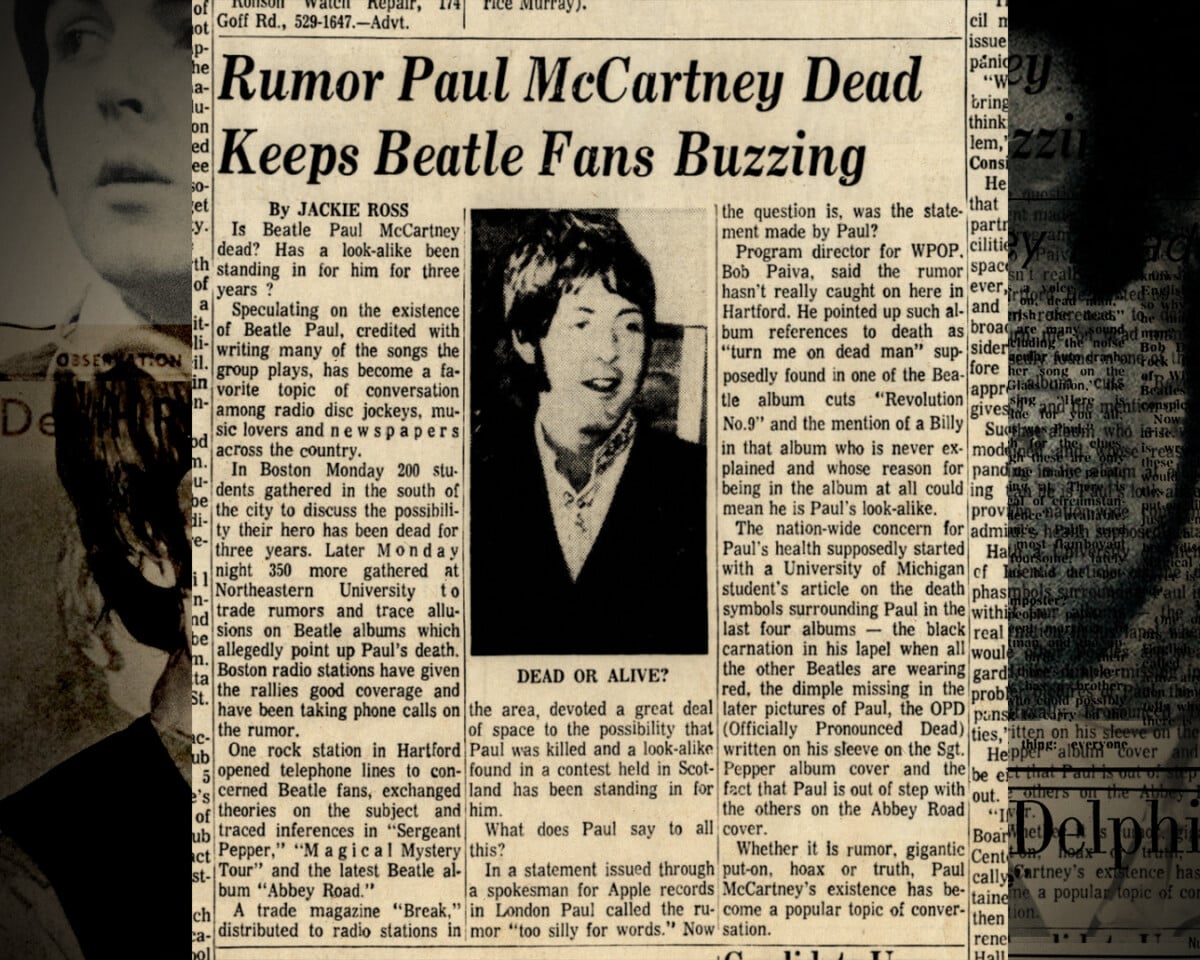
But why did a joke become a conspiracy?
So, how does a joke become a conspiracy? With every time the story was passed along, it was perhaps left unchecked just that little bit longer. The weight of perhaps one in ten people who actually believed it grew with every hundred who were notified. Soon enough, the 100 in 1,000 started to look like they were on to something. But it wasn’t just word of mouth that seemed to support this new, startling story; there was evidence, too. Apparently.
This is where most of the conspiracy theory’s sensationalism comes from: the supposed clues. The idea is that while The Beatles were willing to cover up the death of their friend and bandmate in order to protect the unstoppable success of the Fab Four, they also felt compelled to leave hints hidden throughout their music. As a result, almost every song the band released from 1966 onwards has been obsessively examined for evidence. Of course, as many people will tell you, if you go looking for connections long enough, you will usually find them.
The number of clues that the band supposedly left behind would suggest that if the rumour were to be true, they weren’t very concerned with keeping it concealed, as suggested. We’ll run through all of them.

The songs and the ‘clues’
Look, or rather, listen, for the clues, and they were easy enough to find. The Beatles, by this point, had written hundreds of songs, and it seemed like all of their lyrics were now pointing to something tragic befalling their leading man.
In the music, there are the opening words of ‘Got To Get You Into My Life’ which state: “I was alone, I took a ride, I didn’t know what I would find there”. Next up, the line “he didn’t notice that the lights had changed” from ‘A Day in the Life’ and, on top of that, the opening line of ‘She’s Leaving Home’ which supposedly highlighted the moment of the accident, “Wednesday morning at 5 o’clock as the day begins”. Meanwhile, ‘Lady Madonna’ reflects on the suppression of the media with the line, “Wednesday morning papers didn’t come”.
The ‘clues’, as some conspiracy theorists call them, keep coming and at the end of their classic song ‘Strawberry Fields Forever’, John Lennon can be heard muttering the words “cranberry sauce”, which were interpreted as “I buried Paul”.
A few more notes came with the phrases ”bury my body” and “oh untimely death”, which appeared at the end of ‘I Am The Walrus’, a snippet taken from a BBC production of King Lear, seemingly arriving completely randomly. The muttering continues, too. Near the end of their song ‘I’m So Tired’, Lennon is heard saying “monsieur, monsieur, monsieur, how about another one?” When the song was played backwards, it was quickly heard as the now-iconic line:
“Paul is dead, man, miss him, miss him”.
Of course, on ‘Revolution 9’, there is the aforementioned phrase “turn me on, dead man”, when played backwards, but it also includes the sound of a car crash and explosion. Other lines from songs outside of The Beatles have also added to the conspiracy, with Ringo’s song ‘Don’t Pass Me By’ apparently referring to the accident as well.
”I’m sorry that I doubted you, I was so unfair/ You were in a car crash, and you lost your hair,” the lyrics state.
The songs, it would seem, had stopped becoming pop-focused hits or deep explorations of love and livelihood in the world the band lived in, but platforms to, despite agreeing to carry on with their new replacements and apparently without the replacements’ prior knowledge, inform fans that McCartney had died.
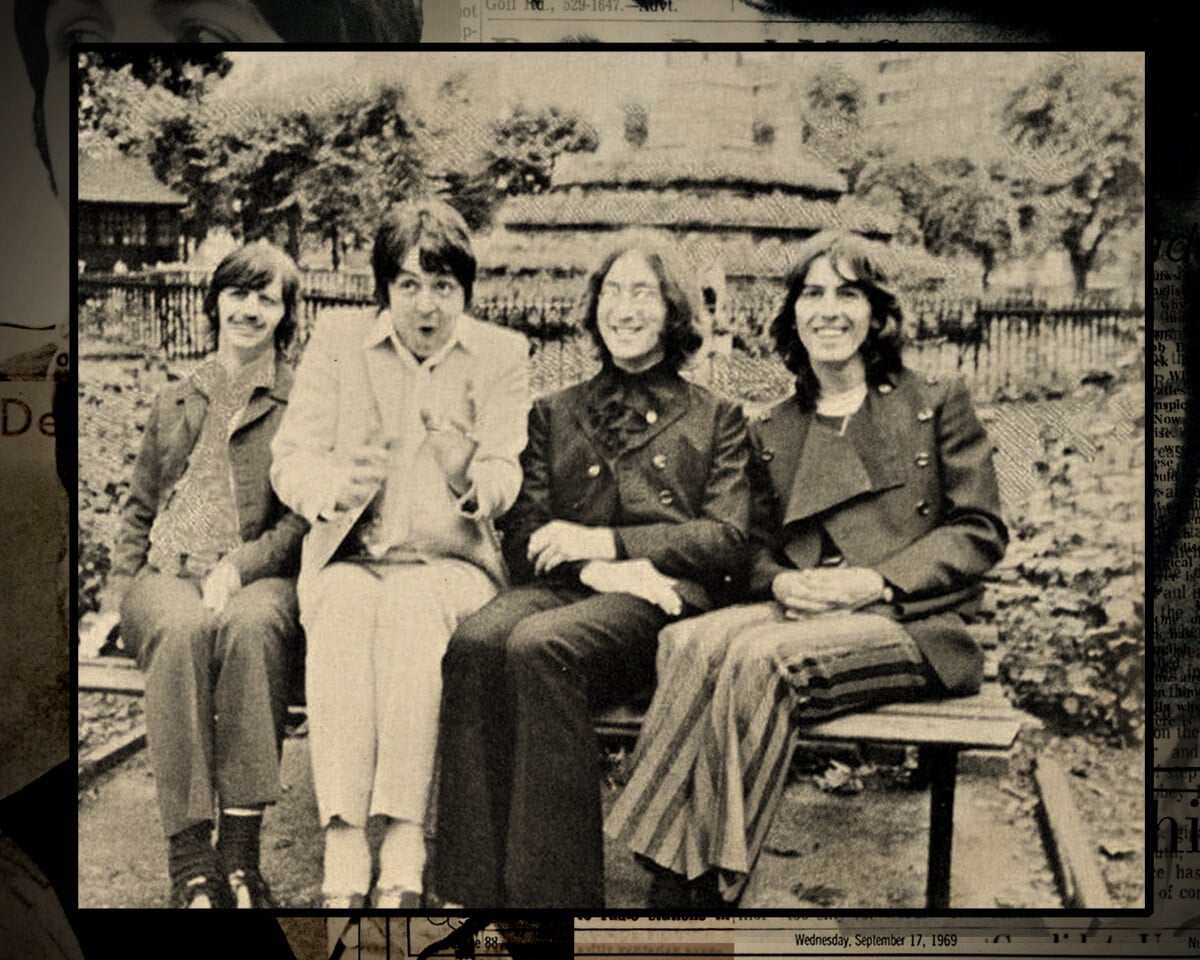
The album covers and other ‘clues’
Lyrics offered great comfort to fans seeking out the conspiracy. Having word from the Liverpudlians’ own mouths was gold-standard clues, even if half of them did arrive backwards. The clues weren’t just centred on the music.
Music offered some evidence, but it was what the band could say without saying anything at all that prompted the more hysterical assumptions to arise. Many people have speculated that McCartney’s ear shape has changed in countless images, with photographs from as late as 2009 being cited as evidence of the swap. If you stare at them for long enough, it can be quite an alluring assumption to jump to.
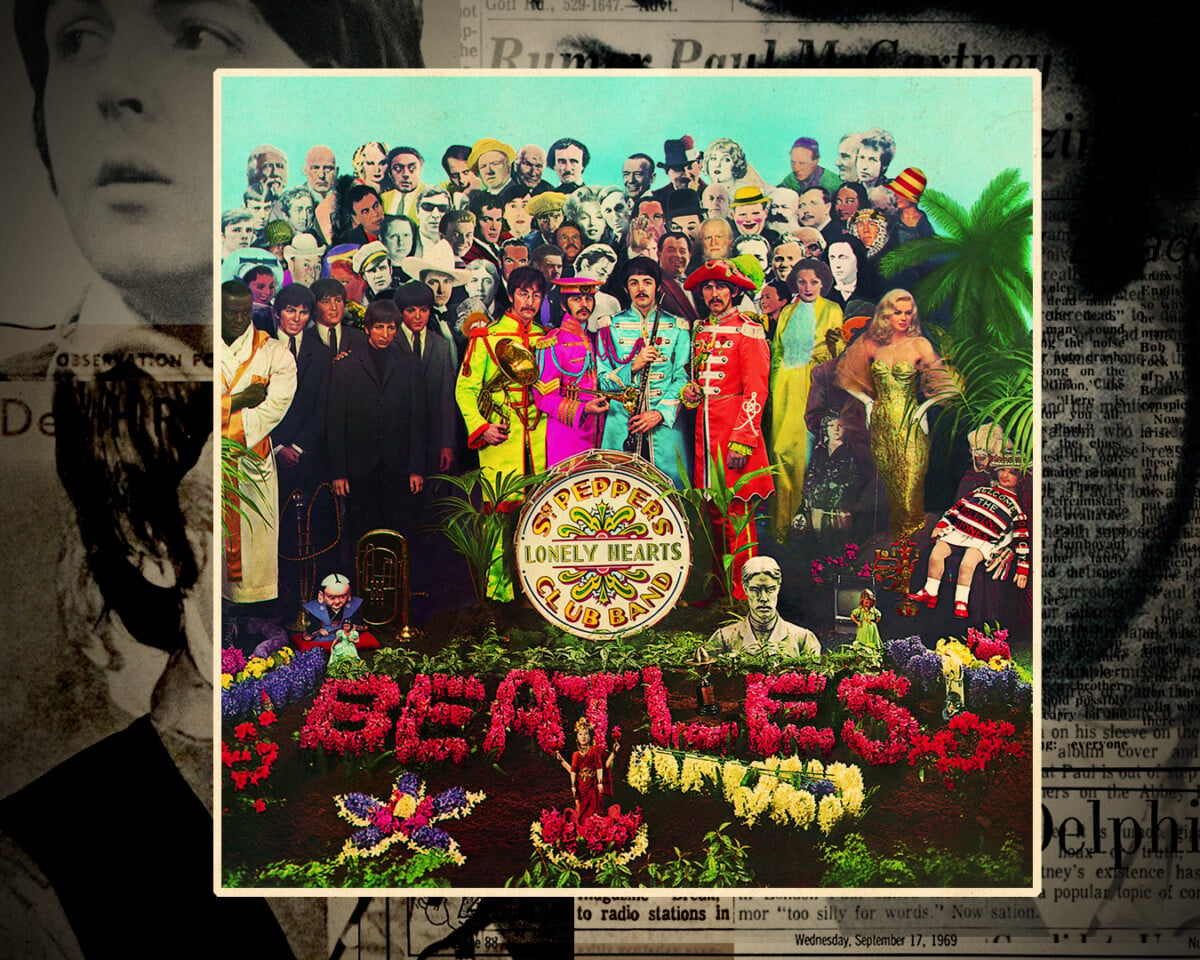
For a long time, the imagery of The Beatles had been just as vital as their music, and it appeared as though the Fab Four were keen to use their album covers to tell the story, too.
On Sgt. Pepper, the album cover consists of flowers which are supposed to symbolise McCartney’s left-handed bass; at the bottom of the image, the Hindu God Shiva, the destroyer, is pointing at Macca. Many thought the badge on McCartney’s arm read OPD, standing for “officially pronounced dead”, but, really, it came from the Ontario Provincial Police Department. There are also apparent references to the time and date of McCartney’s alleged death, with the original pressing featuring a picture of the band with Harrison apparently pointing towards the previously mentioned lyrics, “Wednesday morning at five o’clock”. Suppose you put a mirror down the centre of the Sgt Pepper bass drum, you will get the phrase ‘I ONE X IX HE DIE’, which many have interpreted as “11 9 HE DIE”, a reference to the date of the accident.
With conspiracy theorists building an arsenal of information, nuances continued over to the Magical Mystery Tour record, which showed the word ‘Beatles’ written in stars, which, if held up to a mirror, apparently gave you the number of a London mortuary. Many of the photos included in the booklet also show McCartney without any shoes on, a signifier of the dead in many cultures – but more on that later. It’s in a still from the ‘I Am The Walrus’ sequence that this record gave most of its clues.
The image shows Ringo Starr’s drum head, apparently saying “Love the 3 Beatles”, while next to the kit are McCartney’s boots covered in what appear to be bloodstains. Building on that, another image of McCartney with a black flower in his lapel and one with him bearing a crack in his head also added fuel to the fire. Admittedly, these are some serious coincidences.
The rumour mill clearly kicked up a notch after The Beatles’ album Abbey Road hit the shelves – and the album’s artwork didn’t disappoint. As well as the Volkswagen’s number plate in the image reading ‘LMW 28IF’, which somehow was turned into ‘Linda McCartney Weeps’ and references the age Macca would have been ‘IF’ he had lived, but he actually would have been 27.
For many, it’s bigger than that. For them, the shot represents a funeral procession, with John Lennon dressed all in white as the priest. Ringo Starr, in a black suit acting as an undertaker, McCartney barefoot, as many corpses would have been buried and still are, with George Harrison following behind as a gravedigger. Add to this that McCartney was also out of step with the group, walking with his eyes closed, and you can see how these things can get out of hand.
Debunking the ‘Paul Is Dead’ myth
Add it all together, and things can start to feel inescapable. Perhaps Apple Records simply was such a money-making behemoth that the idea of losing out on the cash purely because of a silly thing like mortality was incomprehensible. The clues certainly seemed to mount up. McCartney needed to address the elephant in the room. All of this culminated in a scene that one might expect to see on a comedy sketch programme.
McCartney was forced to give a press conference to deny that he was dead. Speaking with Chris Drake, he said: “If the conclusion you reach is that I’m dead, then you’re wrong,” he confirmed in a somewhat surreal fashion, “Because I’m alive and living in Scotland.”
Curious it may be, but an interview about the subject with Life magazine in November of 1969 did give Paul a chance to try his own spin on a classic Mark Twain quote when he replied to the rumours by saying:
“Do I look dead? I am fit as a fiddle. I am alive and well and concerned about the rumours of my death. But if I were dead, I would be the last to know.”
George Harrison was equally disparaging of the idea, later stating: “The rumours are too stupid to bother denying”. That didn’t stop Lennon, though, who clearly saw the funnier side of things. Replying in 1969, he said, “It’s a lot of nonsense. Paul McCartney couldn’t die without the world knowing it. The same as he couldn’t get married without the world knowing it. It’s impossible, he can’t go on holiday without the world knowing it. It’s just insanity. But it’s a great plug for Abbey Road.“
During Lennon’s 1970 interview with Rolling Stone, the bespectacled Beatle was more firm when he beat down the rumours in his usual manner: “I don’t know where that started, that was barmy,” he said. “I don’t know, you know as much about it as me… No, that was bullshit, the whole thing was made up. We never went for anything like that. We put tit-tit-tit in ‘Girl’. It would be things like a beat missing or something like that, see if anyone noticed – I know we used to have a few things, but nothing that could be interpreted like that.”
More than five decades later, the idea that anyone could have secretly replaced McCartney at that stage of The Beatles’ career feels impossible to believe. Not only would it have been incredibly difficult to keep quiet, given the sheer number of people who would have needed to be involved, but it would also have been morally outrageous. And besides, if Paul McCartney really did die in 1966 and was replaced by William Campbell, then Campbell turned out to be an extraordinarily talented musician.
If, and that is a huge, massive, ginormous if, he was replaced, Campbell as McCartney presided over perhaps the band’s greatest period of musical creativity, acting as the artistic lynchpin for a group who only excelled from then onwards. Surely, by now, he would have earned the right to call himself whatever he wanted?
We needn’t worry. The rumours may be fun to throw around, the ‘clues’ in lyrics and LP covers are a piece of pop fandom always worth discussing, and the idea that the band would do such a thing provides a sense of danger to the group. But underneath it all, we all know that they aren’t true.
Paul is most certainly alive and well.

Never Miss A Beat
The Far Out Beatles Newsletter
All the latest stories about The Beatles from the independent voice of culture.
Straight to your inbox.