


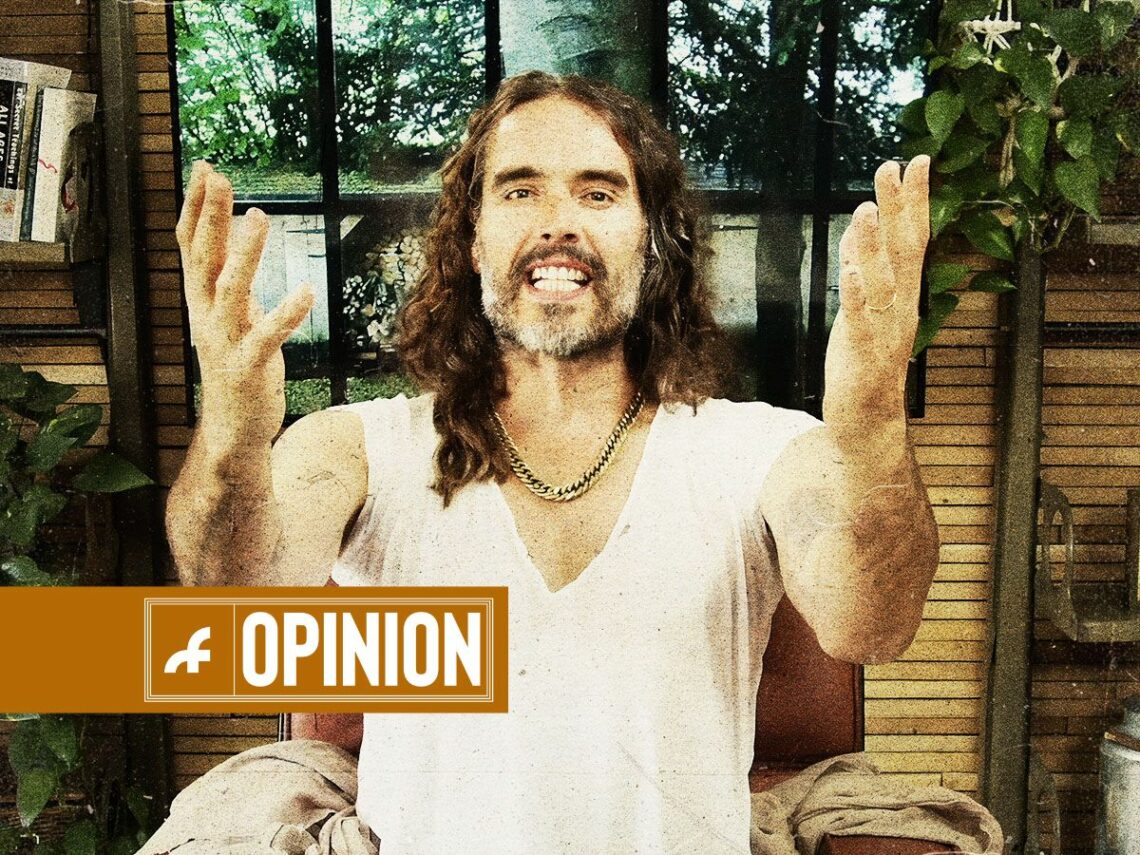
How did Russell Brand go from edgy comedian to provocative political commentator?

There was no better person to illustrate the frenetic excitement of the new millennium in British media than the bumbling arrival of Russell Brand, a daring and bizarre comedian who sported distinctive black eyeliner and wild unkempt black hair, kind of like a rambunctious Medusa. Embodying and conducting the cultural zeitgeist at one point in the late 2000s, Brand went from being a national icon you would see every night on Channel 4 to one that resides in the shadows of the internet, spewing conspiracy politics on YouTube.
Brand was never the kind of vanilla and vetted TV personality you see on modern-day screens, with the comedian comparing the concept of his fame as “like ashes” in his mouth, battling throughout his life with ADHD and bipolar disorder. But this was exactly the reason why he resonated so much with younger millennials, with Brand bringing a new, subversive attitude that looked to upend generations of stiff TV material.
Rising to fame as a stand-up comedian and a presenter for MTV, Brand became known as an iconic face of Channel 4, representing the youth with such shows as Big Brother’s Big Mouth, Russell Brand’s Ponderland and regular appearances on the fan-favourite Big Fat Quiz of the Year. Predictably, his mammoth success in the UK soon spilt over across the pond, with Brand taking roles in successful Hollywood comedies like Forgetting Sarah Marshall and Get Him to the Greek. But, truthfully, his journey to international fame would mark the beginning of his downfall.
Indeed, Brand was the perfect product of time and place, with his mystifying hair and unapologetic idiosyncrasies reflecting a contemporary culture that was having an identity crisis of its own. The rise of internet culture and reality TV invited a whole new world of infinite possibilities that the media wasn’t too sure how to react to. In this era of uninhibited new media, Russell Brand became an intoxicating ringmaster.
Though Brand was erratic and troublesome, carrying the rebellious streak of a young teenager all the way into his 30s, where his persona began to clash with the ever-changing politics of the modern world.
In September 2013, for example, Brand was ejected from the GQ Awards show after he mentioned the sponsor, Hugo Boss, in relation to their former business working for the Nazis making uniforms during WWII. “They did look fucking fantastic, let’s face it,” Brand announced before goose-stepping across the stage and, eventually, getting kicked out. He was indeed no longer living in a world of limited accountability.
Taking time to reflect on the incident, the comedian later rambled in The Guardian: “It was a daft joke by a daft comic at a daft event. It makes me wonder, though, how the relationships and power dynamics I witnessed on this relatively inconsequential context are replicated on a more significant scale…We all know it, we already know all the important stuff, like: don’t trust politicians, don’t trust big business and don’t trust the media,” spouting exactly the kind of suspicious cynicism that would fuel his later career in pseudo-politics.
Mere months after his debacle at the GQ awards, Brand launched his YouTube series The Trews: True News with Russell Brand, itself a reaction to his own fears of mainstream media. Presenting himself as some sort of modern-day saint, putting himself through considerable affliction, he described the show as a platform where he “analyses the news, truthfully, spontaneously and with great risk to his personal freedom”.
Just like in his early days, when Brand was left to his own devices on British television, YouTube became the commentator’s latest platform for personal expression, away from the control of the mainstream media and the censorship of careful TV channels. Brand’s echo chamber was unsurprisingly a lot more enticing than the silver screen, too, taking a step back from his movie appearances to focus on his loyal legion of fans.
These days, his legion has swelled to an impressive 6.45 million subscribers, helping to legitimise Brand’s concerns when he discussed Covid-19 conspiracy theories from 2020 and, more recently, amplified pro-Russian propaganda in relation to the Russo-Ukrainian War. When YouTube moved to take down one of his videos that cited medical misinformation in September 2022, Brand searched for new pastures, following in the footsteps of the likes of Donald Trump, Sean Hannity, Alex Jones and Andrew Tate, transitioning his political ramblings to the alternative streaming platform Rumble, where he launched Stay Free with Russell Brand among newfound tin-hat-wearing supporters.
You can’t help but feel that the Rusell Brand of the 2000s would mock the one we see before us today, but the truth is that the comedian’s tragic downfall isn’t all that dissimilar from the path of other aforementioned right-wingers. Having been given the soap box to perform in his youth, Brand has long continued his search for a new place to voice his curious opinions and conspiracies, jumping from platform to platform like some sort of nomad, keeping himself busy with the sound of his own voice.
