


The disappearance of the viral meme 10 years after the ‘Harlem Shake’

Culture has always changed quickly, with political movements and the rise of technological innovation in the late 20th century leading to a significant shift in how people lived, communicated and interacted. The rise of the internet age has heightened the transparency of such cultural changes. However, taste, fashion and comedy fluctuate with rapid vacillation, reflecting the ever-shortening modern attention span.
There’s no better way to study this shift than in the realm of online comedy, with the internet meme, proposed by Richard Dawkins in 1972 to describe an idea that spreads by means of imitation from person to person, metamorphosing since its practical inception in the early 1990s. The first of its kind was arguably Michael Girard and Robert Lurye’s ‘Dancing Baby’, a 3D render of a boogying tot that became a GIF and was made famous via message boards, Usenet groups, and email during the infancy of the internet era.
‘Hamster Dance’, by Canadian art student Deidre LaCarte, later emerged in 1998, with images of funny felines donned ‘Lolcats’ becoming a viral trend soon after they found a home on the imageboard website 4chan. As the internet grew in popularity, this type of meme featuring an image overlaid by large text became the bread and butter of online comedy, making way for the rise of the popular rage comics in 2008.
It was with the popularisation of YouTube that such static memes became louder and more dynamic, with ‘random’ juvenile skits thriving on the platform. Not yet a platform to be exploited for personal profit, YouTube was a space curated by young people creating content for their peers with boyish immaturity and clamorous comedy that largely involved silly dancing and public pranks. Through this platform, the viral meme would go public, spilling out of the contained boundaries of the internet and into the physical world.
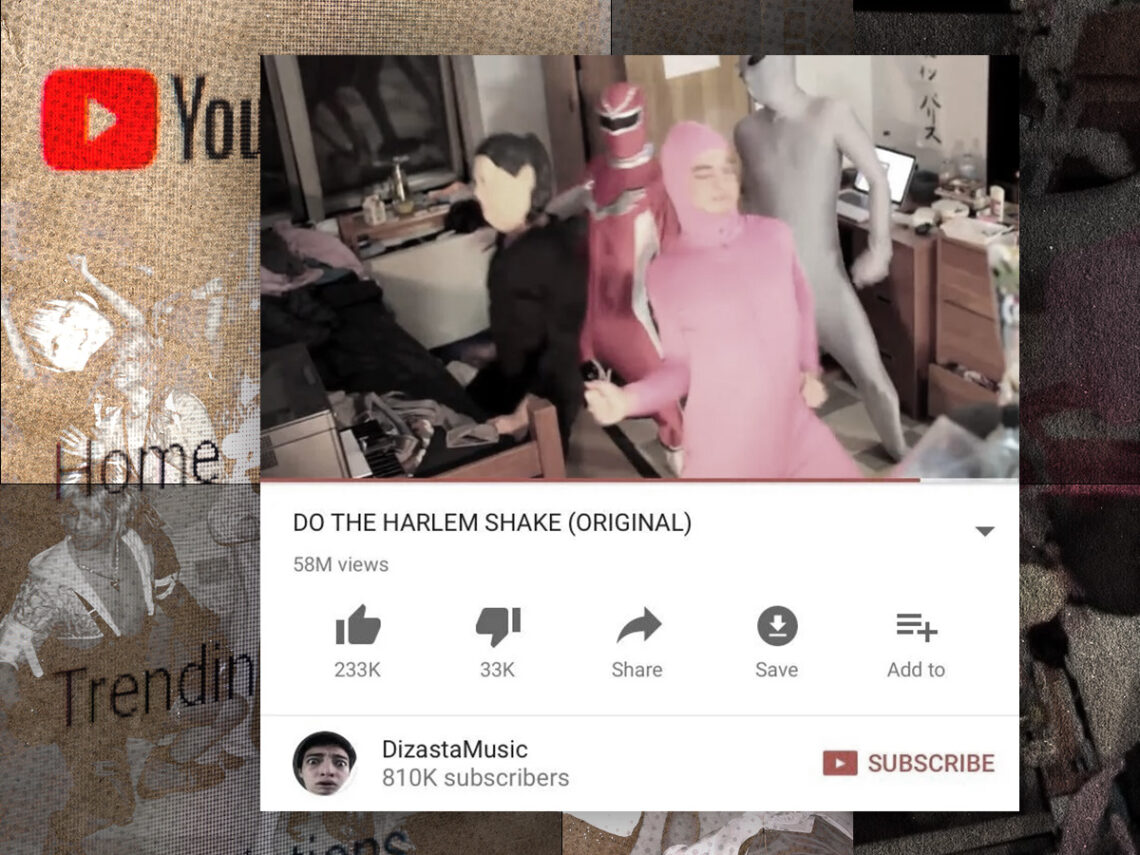
George Miller, a Japanese-American college student, would be one of the most pivotal figures in the evolution of this viral meme. Miller posted an inane three-and-a-half-minute skit show under the alias ‘Filthy Frank’, which began with an absurd dance featuring him in a pink morph suit. Unimaginatively named ‘Pink Guy’, Miller’s character led a small group of friends in a dance to the EDM song ‘Harlem Shake’ by Baauer.
The small clip was pounced on by Miller’s subscribers, with one cutting the 19-second sequence as a singular video where it has today amassed over 65 million views. Immediately becoming an online sensation, an endless stream of other creatives copied the video format, prompting young people from across the globe to try and one-up previous iterations by performing the Harlem Shake dance on buses, planes and at sports events.
Since young people were heading up the online movement, it was almost inevitable that the trend would spill out into colleges and universities, with schools worldwide adding to the online community. Having no malicious or commercial undertones, the Harlem Shake was a pure reflection of the innocence of the early internet, particularly compared to the bitterness that exists in 2023.
Leaving as quickly as it had arrived on the scene, the Harlem Shake was shifted out of popularity by young people who quickly became bored of the trend, especially after they’d seen the older generation jump on the bandwagon. But now, the thirst for a public embrace of online culture had been fostered, with PSY’s ‘Gangnam Style’ prompting a similar level of mania when it was released in the summer of 2013.
Existing both online and in real life, such viral memes were something of a celebration of the internet’s all-encompassing global popularity. Back then, it was still something of a novelty to see the teachers and pupils of your school featured on YouTube, dancing the Harlem Shake in grainy footage, or indeed watch a whole TV studio or army division boogie down, but in the modern world, such basic thrills seem outdated.
Mass trends like the Harlem Shake, Gangnam Style or the Ice Bucket Challenge have indeed disappeared, lost in the ether of early internet romanticism, replaced by more cynical, commercial efforts to gain popularity. Though such viral memes may have been lost, the essence of their popularity remains, with similar dance trends popping up on the short-form content platform TikTok.
Claiming all responsibility for online viral content, TikTok now hoards the contemporary meme, with Facebook being a place for ‘boomers’ to converse, Twitter being a trading floor of screaming voices, and Instagram being a vain echo of one’s own interests. Social media is no longer quite as community-focused, the thrill of connecting with somebody halfway across the world has dissipated. The Harlem Shake is merely an eerie EDM echo of a romantic bygone era where the internet’s moral potential was still up in the air.
