


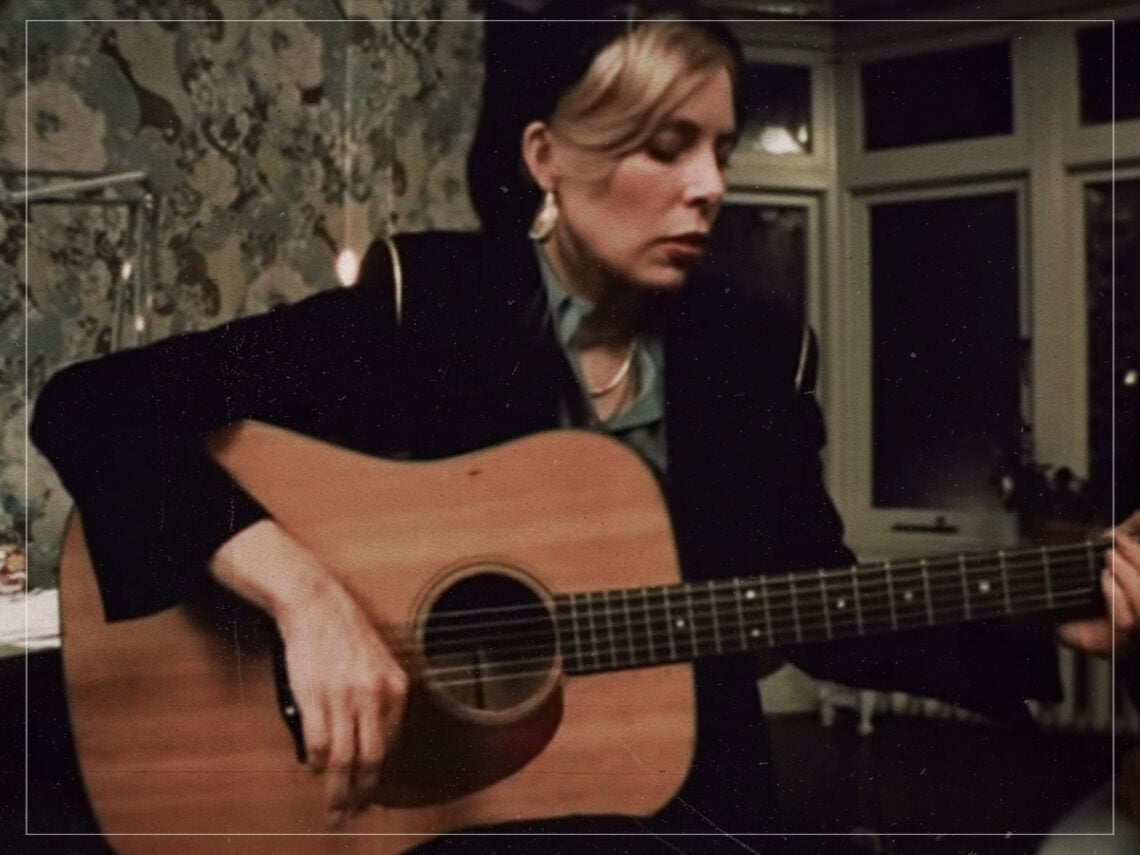
How defiance prompted Joni Mitchell to pick up a guitar: “My mother was a real hillbilly”

“I thrive on change. That’s probably why my chord changes are weird, because chords depict emotions,” Joni Mitchell once said, “They’ll be going along on one key, and I’ll drop off a cliff, and suddenly they will go into a whole other key signature. That will drive some people crazy, but that’s how my life is.”
By her account, Mitchell was encouraged by her mum, Myrtle, to pursue music from childhood; the expectation was a given, considering that Mitchell’s father, William, was a musician himself. A Royal Canadian Air Force flight lieutenant by day, he took up playing in marching bands and local groups by night, when his daughter was young.
Music weaved through Mitchell’s life from its beginning, even when she rejected her father’s trumpet playing and chose painting and visual art as her chosen medium, to get through her struggles in school. Still, poetry was a constant, and like many artists in the years before and after her, there was a certain folk singer who radicalised the ways that music was composed.
“I wrote poetry, and I painted all my life,” Mitchell told Rolling Stone in 1979, “I always wanted to play music and dabbled with it, but I never thought of putting them all together. It never occurred to me. It wasn’t until [Bob] Dylan began to write poetic songs that it occurred to me you could actually sing those poems.”
Mitchell was somewhat secretly intrigued by the guitar from an early age, teaching herself how to play from reading Pete Seeger’s How to Play Folk-Style Guitar instruction book. “I went straight to the cotten picking,” Mitchell explained to Acoustic Guitar in 1996, “Your thumb went from the sixth string, fifth string, sixth string, fifth string… I couldn’t do that, so I ended up playing mostly the sixth string but banging into the fifth string.”

As she got older and broadened her artistic palette, she moved away from home to attend the Alberta College of Art in the early 1960s. With her summers spent taking trips to the lake with her friends, singing around a campfire, she one time decided to change course, instead travelling to a coffeehouse to introduce herself to live jazz music. Mitchell was influenced by her friends, who took a liking to jazz, while she “was a rock and roller, teeny-bop go-to-dances-on-Saturday-night type,” as she described to Broadside in 1968.
As fate had it, the night she ventured into the coffeehouse, there were no jazz performers, but there was “this terrible folk singer,” she remembered, “I didn’t enjoy it at all, but I kept on going down there. And I found out there were some things I liked”. She became a fan of an unnamed local band whom she’d compared to The Kingston Trio, who introduced her to comedy in music.


“I wanted the leader of the group to teach me how to play the guitar, and he wouldn’t,” Mitchell recalled. For the burgeoning musician, this was an act of rebellion. Not only had her parents encouraged her to pursue music, but her mother, conversely, did not favour the guitar.
When the band’s leader rejected Mitchell’s request, she went out and bought her own ukulele, instead, in defiance, “Because my mother thought that guitar…she sort of associated guitar music with country and western, which was sort of hillbillyish there”. She clarified, “It’s like in the South. If you ask, people are afraid to admit to you that they like country music…some of the people who are really hillbillies think it’s unhip. You know, my mother was a real hillbilly, so she thought it was unhip, so she said no guitar and banned the guitar.”
Of course, Mitchell found a way to work around her mother’s ban, learning from Seeger’s chords and imagining the ways that she could make music by fusing writing and painting. By the time she was in college, armed with her trusted ukulele (and later, her favourite guitar), she truly made the instrument her own.
From when she began to play guitar, she adopted what became open or ‘nonstandard’ tuning, which she affectionately referred to as “Joni’s weird chords”, and this allowed her to reach a broader spectrum of sounds. She utilised right-hand picking and strumming techniques, growing as she evolved into a more rhythmic flow. Over the course of her career, Mitchell used over 50 different tunings, and this was a result, in part, of her childhood illness of polio. The disease left her left hand weak, and as such, out of necessity more than anything, she had to re-teach herself how to play the guitar while adapting to leaning on her right hand.
“I plunked my way through most of the summer,” Mitchell recalled of her travels across Canada, performing at venues from nightclubs to Y clubs, to churches, with her ukulele as her sidekick. Once she left Canada and made her way to the states with her first husband, Chuck Mitchell, she’d perform across the country: Detroit, Philadelphia, Boston and North and South Carolina, before finding a fan in David Crosby in Florida.
Mitchell asserted of her growth as a songwriter from her beginnings, “My mother and a lot of my relatives will think I’m more ambiguous. I think I’m a better poet now, and my melodies are much more complex”.
Considering where a young Mitchell began, interested in music but not letting the dream become fully realised until later in early adulthood, it is intriguing how she effectively needed to pursue music entirely on her own terms, not on the path set out for her, in order to become the artist she was. All it took, really, was some defiance (and Pete Seeger) to place her on the right path.
