


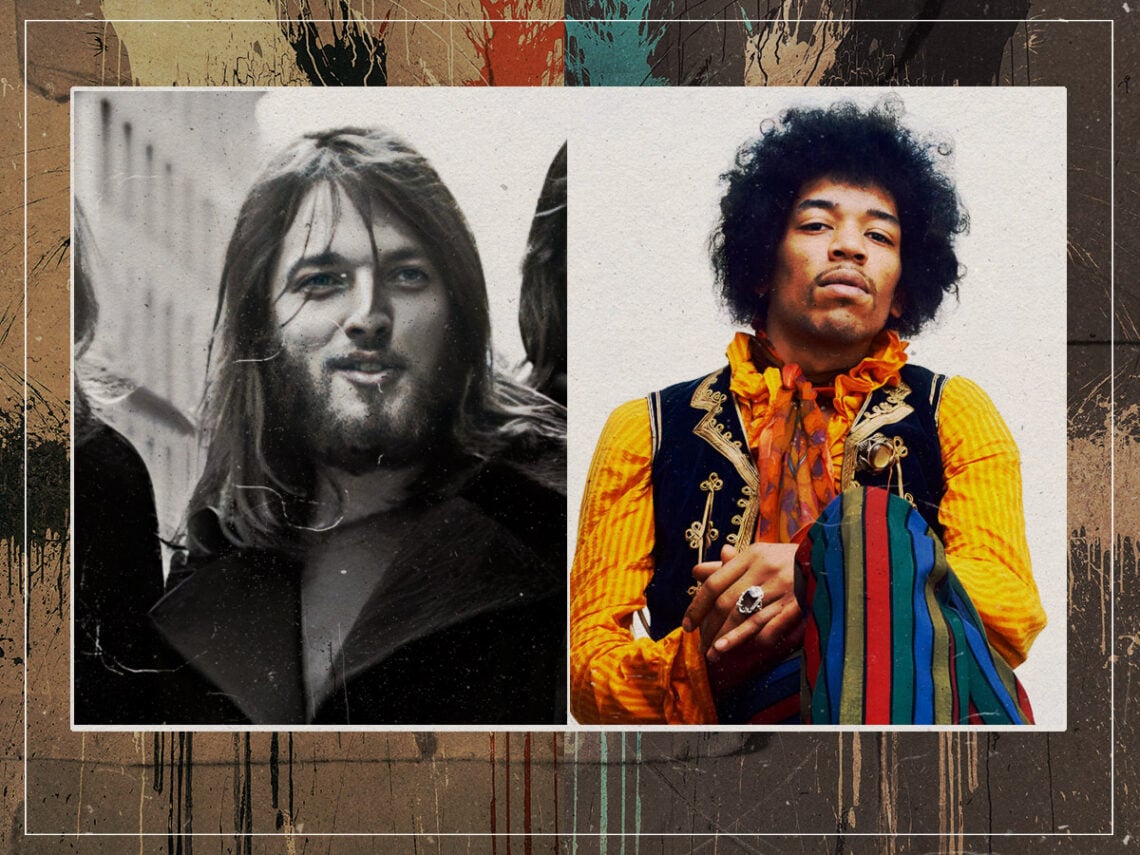
How David Gilmour saved Jimi Hendrix’s biggest concert

The life and career of Jimi Hendrix is perhaps the most mythologised in music. While he was a distinctive personality, the elemental and groundbreaking nature of the American’s musical efforts saw him rise fast after being discovered by Chas Chandler. From ‘Purple Haze’ to his cover of Bob Dylan’s ‘All Along the Watchtower’, many moments convey his deeply innovative essence.
Although Hendrix is unquestionably one of the most influential artists of all time, his story was tragically cut short in September 1970. During this period, the dangers of drug abuse were becoming increasingly apparent to Hendrix’s generation, primarily due to their widespread use during the counterculture movement. Before this time, the pitfalls of narcotics were largely unknown. Hendrix, at just 27 years old, tragically joined a list of icons from his era who succumbed to the perils of hellraising.
However, in his short time in the limelight, Hendrix left a tremendous legacy and would deliver iconic shows to affirm his status in this final chapter. Of course, the most famous was Woodstock 1969, which featured his timeless reworking of ‘The Star Spangled Banner’, but a year after that, at The Isle of Wight Festival in 1970, he would deliver a resounding follow-up to another mass of hundreds of thousands of revellers. However, it very nearly wasn’t the success we know it as today.
The festival lineup boasted many notable acts, including The Moody Blues, Miles Davis, The Doors, Jethro Tull and The Who. Yet, Hendrix had the prime slot, playing late on the final day of the bonanza, playing until the early hours. The crowd is estimated to have exceeded 600,000, the most expansive concert of his career. Ironically, though, the show was saved by none other than Pink Floyd’s David Gilmour, who was not the household name he is today.
Although Pink Floyd were a successful outfit, 1970 was a transitional time for the group as they cultivated their booming prog-rock sound following the departure of original frontman Syd Barrett in 1968. Accordingly, Gilmour was at the festival as a fan and was there to see one of his heroes, Hendrix, take to the stage.
Hendrix followed Jethro Tull onto the stage, and as both acts had such different sonics, the sound engineers had issues setting up for the American’s performance. It was this issue that saw Gilmour, who had some prior experience with mixing boards due to producing Barrett’s two solo albums, The Madcap Laughs and Barrett, drafted in to save the day.
Gilmour recalled to Prog: “I went down to go to [the Isle of Wight], and I was camping in a tent, just being a punter. I went backstage where our main roadie guy, Peter Watts, was trying to deal with all the mayhem with Charlie Watkins of [Watkins Electric Music]. They were very nervous; they were going to have to mix Hendrix’s sound. I did some mixing stuff in those days and they said, ‘Help! Help!’ So I did.”
Watch Hendrix’s performance at the Isle of Wight below.
