


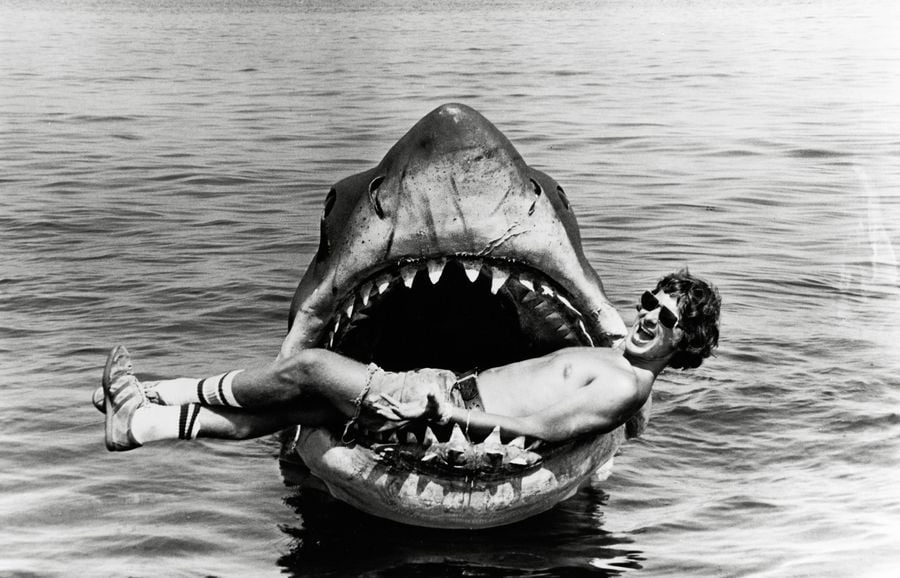
How a technical fault led to the huge success of ‘Jaws’

Nearly everyone involved in the production of the classic 1975 suspense blockbuster Jaws thought that the movie was going to fail. Helmed by then-relatively untested director Steven Spielberg, the production of Jaws was legendarily fraught, with technical problems and extended shooting schedules surrounding the project. Spielberg was over budget and was losing the trust of the actors he was directing, but most importantly, he had a shark that didn’t work.
“It was very tiresome and very tedious,” producer David Brown recalled in a 2012 oral history with Empire. “There were all kinds of mechanical problems with electrical polarisation in salt water. Richard Zanuck and I more than once saw our careers going to the bottom of the Atlantic while the sharks sank and frogmen were sent down to rescue them.”
Shooting in the actual Atlantic Ocean meant that the mechanics of the artificial shark were wonky at best. Movement was limited from the outset, and once the salt water got into the gears, “Bruce” looked less like a menacing predator and more like a malfunctioning toy.
“I never would have guessed that so many people would have gone to see Jaws. In my mind, the shark looked dumb,” Spielberg admitted to W Magazine in 2023. “When I went to the first preview, in Dallas, and people were screaming and popcorn was flying at the screen, my first feeling was—’Oh my god! I didn’t think any of this was going to work.’ The truth is, you never ever know.”
The initial screenings were where Jaws was going to either sink or swim. Peter Benchley, the author of the original novel and co-screenwriter for the film, was tasked with showing the finished product to a group of actual marine biologists and aquatic experts to judge whether the effects were believable enough.
“The first time I saw the whole film was in a screening room at Universal, where I was asked to assemble shark experts and divers to look at it to see whether it was laughable,” Benchley told Empire. “All the great names in the shark business were there to look at it from a technical, shark point of view. I had been concerned about the ending of the movie all along. We had argued long and hard about the fact that a shark would not bite down on a scuba tank and explode like an oil refinery. Steven’s response was, ‘I don’t care: if I’ve got them for two hours, they will believe anything in the last three minutes.'”
Ultimately, Jaws became a runaway success. The massive box office receipts went against the then-accepted mindset that summer was the time of year when films did the least amount of business. Jaws helped pioneer the idea of the summer blockbuster, as audiences kept returning to the theatre to see a shark that barely worked. By hiding the flaws, Spielberg inadvertently ramped up the tension. “The film went from a Japanese Saturday matinee horror flick to more of a Hitchcock, the less-you-see-the-more-you-get thriller,” he told The Roanoke Times in 2005.
