


How a giant inflatable pig made Pink Floyd enemy number one in 1977

Does anything capture the distinct oeuvre of Pink Floyd more clearly than the iconic cover art for Animals?
The purplish sky swirls with the hues of a two-day-old bruise. The stark industrial scenery seems to comment on the brutalist modern age without even saying a word. The whimsy of a floating pig, and the distinct hint of a setting sun, casting a golden glow over more classical architecture, all seem to combine to capture the story of Pink Floyd in all their odd glory.
From its cover to its mysterious sound, Animals remains a part of the iconography of one of the most important bands in rock history. Roger Waters, David Gilmour, Nick Mason and Richard Wright had already asserted themselves on the musical landscape by the time they came to record their George Orwell-inspired LP, but one incident would make the production utterly unforgettable for all the wrong reasons.
By 1976, Pink Floyd were in full artistic flow. Not only was their growing musical majesty accruing yet more steam, but their artistry had spread out from the studio and found itself nestled into every facet of their being. From stage set-ups to album artwork, everything had to be perfect.
In the case of Animals, it would comic flourish on their LP sleeve that would land the band on the front page of the news, all thanks to a giant, flying, inflatable pig.
The incident arose when the 40-foot inflatable broke loose from its moorings. It began to float above England’s capital, London, and make its way out of the city and seemingly on to pastures new. It would see the band make a big splash on the tabloids and garner a huge amount of publicity for Pink Floyd’s tenth studio album.
Which has us thinking, was it all a part of the plan?
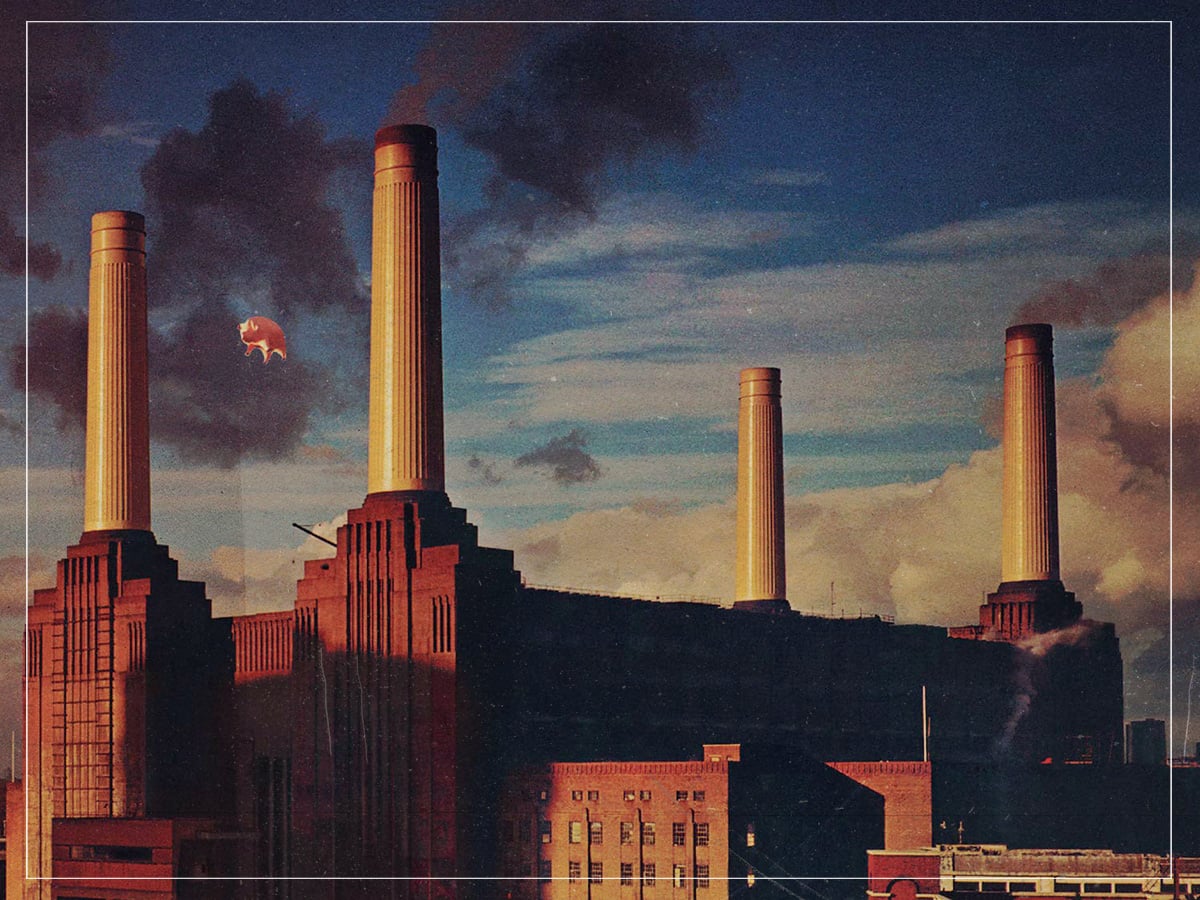
The pig, nicknamed ‘Algie’ by the group, was being photographed for the forthcoming Animals release and would be a focal point of the album artwork, neatly placed between the towers of an iconic piece of the London skyline. During the heyday of the 1970s rock scene, album artwork was, at times, as important as the music inside it.
After all, in the age before streaming and everything being available at a click, it was one of the few forms of marketing available to bands. Artists took this stuff seriously and applied both their creative energy and budget to make sure the artwork was simply perfect. As you might expect, Pink Floyd were pioneers of this production and even encouraged their own design department.
So, when Roger Waters sat down with Aubrey Powell and came up with the idea to send Algie the inflatable pig up above the London landmark Battersea Power Station, people really took them seriously. “I’d always loved Battersea Power Station, just as a piece of architecture,” Waters later told Rolling Stone of the album’s conceptual artwork.
The building rests in a previously undeveloped area of the capital, though now it has been given a billion-pound makeover. But for Waters, the towering station resonated with what he and the group were trying to achieve: “I thought it had some good symbolic connections with Pink Floyd as it was at that point,” he said.
Continuing, “One, I thought it was a power station, that’s pretty obvious. And two, that it had four legs. If you inverted it, it was like a table. And there were four bits to it, representing the four members of the band.” You could maybe throw in a few further touchstones: it was, for instance, a symbol of London’s industrial past on the brink of reinvention, not unlike Pink Floyd’s own transition from the 1960s to a new dawn.
So, the symbolism was rife, but where did it all go wrong?
Things went wrong pretty quickly after they snapped a few shots. With a heavy breeze snapping the ropes holding the ginormous inflatable pig in place, the gigantic rubber swine would rise high into the sky and beyond their control, even finding its way into Heathrow’s flight path. It was becoming incredibly dangerous.
Crossing into the flight path of an international airport does, as you might imagine, attract some unwanted attention, and the Civil Aviation Authority issued a warning to all pilots to be on the lookout for flying pigs. It wasn’t even April 1st. Disruption was afoot.
After all the flights were forced to be grounded, Powell, the co-founder of art group Hipgnosis who worked closely with Pink Floyd on a lot of their designs, was arrested. It would see Police helicopters and even the Royal Air Force hot in pursuit to chase down the floating oinker and try to bring it down. The chase would finally come to an end when the pig eventually came down and crashed into a barn on a dairy farm in Godmersham in Kent for some bacon-sized irony.

“At 9:30PM, a man rang up,” Powell told Time Out. “He said, ‘Are you the guy looking for a pig? It’s scaring my cows to death in my field.’ It was front-page news. Pink Floyd couldn’t have got better publicity if they tried.” However, the tricky issue of a cover shoot was still to be traversed. What’s more, a few thousands irate people stranded in airports for a moment were far from pleased with the ‘playful proggers’.
The team returned to re-shoot the image, this time armed not only with a 40ft inflatable pig balloon and stronger ropes, but a sharpshooter to bring down the balloon should it break free again. While Powell laments “the most incredible, Turner-esque sky” they had for the first shoot, which was subsequently lost on the second, the final result is still marvellous.
Powell admits, though, that the final result was a manipulated image: “It’s actually a completely faked photograph”.
Still, the album, perhaps buoyed by the extra publicity one gets when a 40ft inflatable pig breaks free across London’s skies, would smash into the top ten on both sides of the pond and cement Pink Floyd as an unstoppable force. With its long-form style and loose Animal Farm concept, the record would be another step toward the Floyd’s growing iconography.
Algie, the pig, would become a symbol of the London band’s ludicrous creativity and their powerful follow-through as a part of the band’s live set, too.
Back in 2011, a replica of the pig was again floated between the chimneys of Battersea Power Station to celebrate a reissue of the classic 1977 record. More than three decades later, Algie still hangs over Pink Floyd’s story as a reminder that their wildest ideas were never confined to the grooves of a vinyl record. In fact, evidently, they often weren’t tethered to anything.

Never Miss A Tale
The Far Out Classic Rock Newsletter
All the latest Classic Rock content from the independent voice of culture.
Straight to your inbox.