


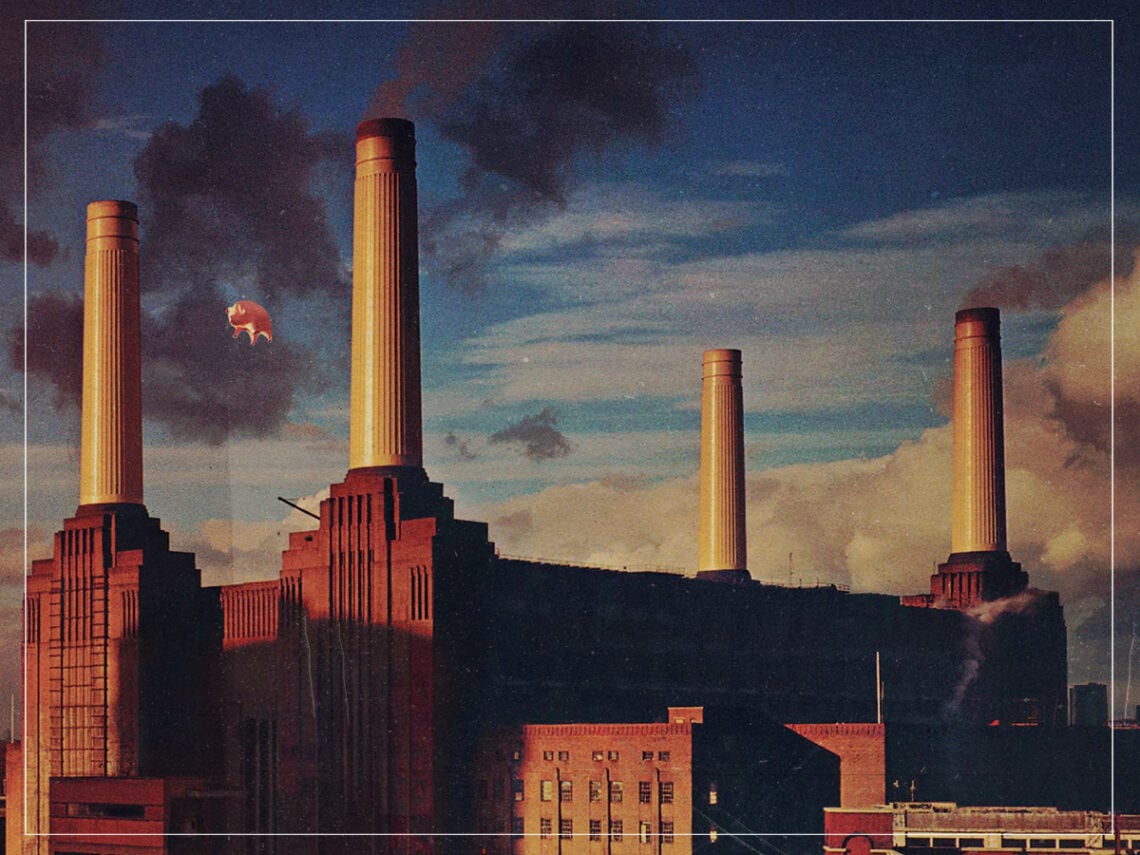
What is the hidden meaning behind Pink Floyd’s ‘Animals’ cover art?

Many bands hit a crisis of confidence once punk’s rug pull arrived, but Pink Floyd took the late 1970s’ rock upend in their stride.
There wasn’t much difference. While dwelling in the same proggy arcs as their pointy-hatted peers across the decade, Pink Floyd’s jazzy darkness and Roger Waters’ emerging conceptual captaincy would steer the art-rock outfit closer to punk’s social alienation and seethe at political failure. By 1977, Waters was feeling just as insurrectionary as the Year Zero generation, soaking up all the day’s cynicism and angst for their tenth LP effort.
Borrowing Animal Farm’s allegorical farmyard but swapping Stalinist satire with a hatchet to capitalist greed, Animals depicts the dying days of the post-war big state as stratified by the lowly and docile sheep trapped in their obedient herd mentality, the vicious muscle of the dogs that ruthlessly safeguard the social order, and the gluttonous pigs that revel in their financial swill above.
On the nose, but a pertinent fable that grows ever sharper half a century into the neoliberal rot Waters was anticipating back when the Conservative opposition was planning their comeback.
Recruiting the same Hipgnosis design team responsible for The Dark Side of the Moon and Wish You Were Here, the team dreamed up one of Pink Floyd’s most iconic covers. Hovering above London’s Battersea Power Station, the faint pink dot of a floating pig is spotted in between its mammoth concrete chimneys, prompting intrigue among fans as to the surreal image’s exact meaning.
So, what is the Animals cover all about?
As ever, a Pink Floyd cover isn’t supposed to be shaped by any explicit, definitive message. However, Animals’ excoriation of greed and the systemic fortifications that uphold the top-level avarice at society’s ruin will offer a clear lens to view the pig’s coast through the UK’s smoggy sky.
Deindustrialisation was already well underway across the country before Margaret Thatcher entered Number Ten. Fuelling the socio-economic ennui that would plague the next decade in earnest, Battersea’s prominent power generator had already half-closed by the time Hipgnosis had planted its porcine helium balloon. In 1983, the entire site was totally decommissioned and left abandoned for 30-odd years.
The pigs of big finance looming over the symbol of the UK’s industrial decay present a stark and unambiguous illustration of Waters’ disgust with the political trajectories hinted at from Westminster. Prime Minister James Callaghan was heading an exhausted Labour Party, and Thatcher was waiting in the wings, ready to spark the unregulated frenzy of market forces for the upcoming 1980s. The Pink Floyd bassist knew that the social democracy he was so sentimentally attached to was stumbling toward its political bonfire.
Nearly 50 years later, the old Battersea site is now hijacked by retail stores and luxury apartments that no one can afford. Animals’ pig, however, has lived on as a staple of Pink Floyd shows and Waters’ solo gigs, still floating symbolically across the British skies and casting its eye across the ghoulishly marketised landscape its villainous trotters helped shape all those years ago.
