


Hell’s Devils: The manic formation of Czechoslovakia’s first underground band in 1961

Hell’s Devils are remembered as the Czech Republic‘s first ‘underground’ band, from their formation in 1961.
Guitarists Zdeněk ‘Kelly’ Macháček and Jiří ‘Satan’ Sigmund wanted to form a rock ‘n’ roll band, and they recruited another guitarist, Mirek Lyncl, and a drummer, Emil Gröschell (soon-to-be replaced by Miroslav Schwartz, known as Tony Black), to join them, before finding their singer in Miloš Vokurka.
They found a backbone in their sound engineer, Zbyněk Lán, known as Binny Laney, who held a reputation in Prague’s rock ‘n’ roll circuit for building his own tech: amplifiers, tape recorders and the like. He recorded music programmes from the AFN Munich radio station in West Germany, which was broadcast for the US Army, and Radio Luxembourg, and was even subject to investigation by the police for broadcasting the programmes across the then-named Czechoslovakian radio.
When Binny Laney joined the Hell’s Devils in 1962, they also found Eugen ‘Toscani’ Fiala and Evžen Fiala, a father-and-son duo who became their managers and producers. The Hell’s Devils, then, properly emerged within the big-beat scene of the decade, finding a horror-inspired niche among the rock, jazz and twist bands that existed alongside them. With the Fialas, they honed their image, wearing a strict uniform of shiny red shirts paired with black trousers, while their stage was shrouded in red light and smoke-infused pyrotechnics, to establish a “devilish” tone and immerse their audience in the fantastical element of their shows.
Each of the Hell’s Devils shared the goal of wanting to become one with the audience, not to establish any boundaries between them. At every show, “Hell’s Devils” flashed in red light on panels on either side of the stage, an unforgettable signature. In contrast to their image, which shocked at the time, their setlists were filled with familiar favourites from the likes of Elvis Presley, Little Richard, Eddie Cochran and Cliff Richard, alongside surf rock instrumentals from Richard’s backing band, The Shadows, and The Ventures. The Hell’s Devils put their own spin on the classics, however, performing their own riotous renditions that, while not their original songs, became associated with the band’s image as a progressive, provocative force in Czechoslovakia’s underground scene.
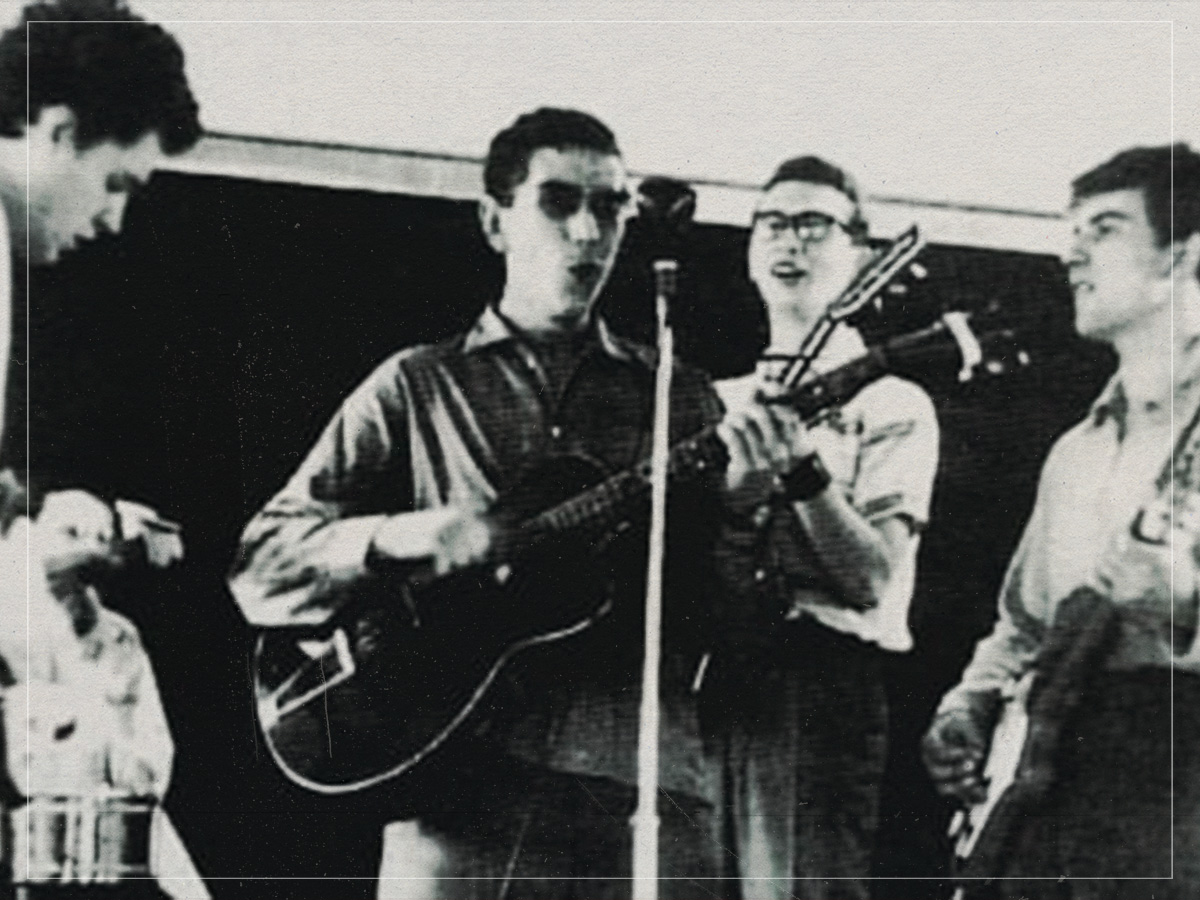
Reaching their peak at the end of 1963, they found a cult following in Prague’s ‘long-hairs’, the younger generation who were against living under the totalitarianism of Communist rule. Rock ‘n’ roll had always existed in some way, shape or form in Czechoslovakia, from the genre’s emergence in the 1950s, continuing into the ’60s with a heavy Americana influence that began to shift with the British invasion. Things began to shift, however, once rock music began to be regarded as ‘decadent’ by the country’s regime.
Decades of geo-political turmoil had transpired by the time that the Hell’s Devils formed, which was just after the declaration of Czechoslovakia as a socialist state, and a few years before the invasion by the Soviet Union in 1968, and in this interim, the band caught the attention of the regime. Their concerts were deemed overly provocative, and Evžen Fiala was arrested in May 1964, while the press followed suit with articles that disparaged the collective and described them as enemies of the state. As a result of their constant persecution, the band’s members were in constant flux, as they assumed various new band members in the coming years, including guitarist Karel Kahovec and bassist-guitarist Zdeněk Rytíř.
After years of ongoing tensions between the Hell’s Devils and the police, their final show would take place on April 3rd, 1965, in the town of Brandýs nad Labem-Stará Boleslav. Promoted within their underground scene, the show was a success until the police arrived and cut the night short. The Hell’s Devils, in turn, were officially prohibited from future performances. Some of the former and final members of the band continued to play music, with a few joining The Matadors, another big-beat band that, while also short-lived, saw the likes of Miloš Vokurka, Karel Kahovec and Miroslav Schwartz join their lineup. Vokurka later changed his name to Reddy Kirken, assuming the role of frontman of the jazz-progressive rock band Emergency.
Once Czechoslovakia was invaded in 1968, the music scene was heavily surveilled and dismantled from what it once was. During this ‘normalisation’ period, alternative music was completely suppressed, while many professional and emerging musicians emigrated due to their failure to requalify exams, which would not allow them to play in the country legally. Musicians were discouraged from singing in English, while the ‘long hairs’ and unannounced concerts were both forbidden, and censorship began to take hold. The Hell’s Devils’ impact endured, however, and in just four years, despite being stifled far too soon, the band managed to make an impact on their country’s rock ‘n’ roll underground.
