


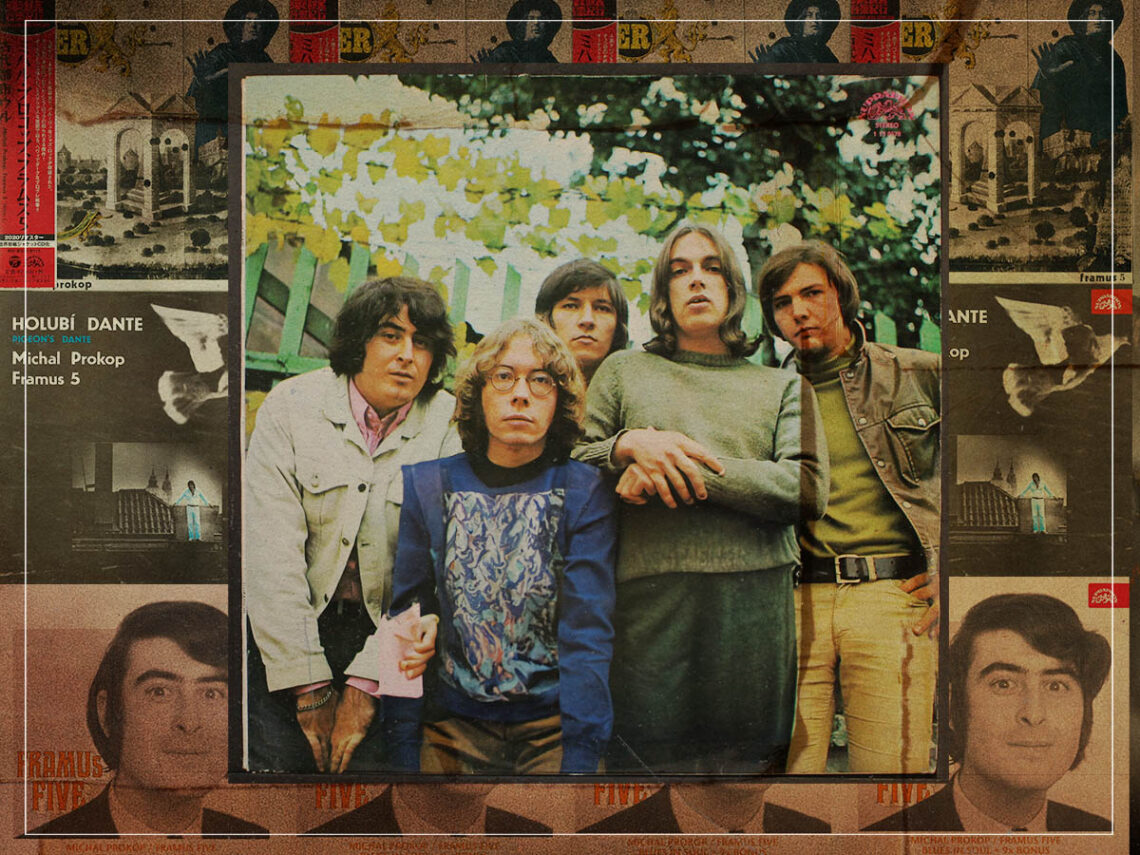
Framus Five: Czechoslovakia’s forgotten answer to The Rolling Stones

A cultural explosion occurred during the 1960s, and although the discourse surrounding this revolutionary period in music is often limited to the United States and the United Kingdom, the shockwaves spread far and wide across the globe. It was not necessarily that British or American groups were more talented than others; it was simply that the music industry of the time was inseparably rooted in America and the English-speaking world. This blinkered view of music in the 1960s allowed some truly groundbreaking groups to slip through the cracks, like Framus Five, hailing from Czechoslovakia.
Much like The Rolling Stones, Framus Five first came together, united by a mutual adoration for American blues music. Founded by Michal Prokop in Prague in 1963 and including some of modern-day Czechia’s most notable musicians, including Luboš Andršt and Jan Hrubý, Framus Five recorded a plethora of tracks during the early 1960s, the vast majority of which were English language blues songs.
Covering tracks by the likes of Muddy Waters, Chuck Berry, and Ray Charles, as well as composing their own original material, Framus Five combined their love of blues, jazz, and soul music with the modern sounds of 1960s Czechoslovakia, defining the youth culture of the period in the process. In contrast to The Stones in the UK, or groups like The Beach Boys across the Atlantic, however, Framus Five were forced to reckon with a tumultuous political period in their home nation rather than recording rock records.
More so than most European nations, modern-day Czechia has a fractured and chaotic history. Following the Second World War, Czechoslovakia—as it was then called—experienced a succession of conflicts and revolutions that led to the establishment of the Czechoslovak Socialist Republic, a satellite state of the Soviet Union. For the most part, therefore, the nation did not experience quite the same authoritarian regime that those under direct control of the USSR did.
That all changed, however, in 1968 when a mass protest movement erupted in Prague, lasting from January until August of that year. Inspired by various reforms proposed by politician Alexander Dubček, the period known as the ‘Prague Spring’ provided hope to many who were unhappy with the state of affairs under satellite control of the USSR. However, these celebrations were short-lived when the USSR, along with other Warsaw Pact nations, invaded the country and ushered in a regressive period of ‘normalisation’.
Amid this complex and, ultimately, frightening backdrop, Framus Five continued to exercise their all-encompassing love for American blues music. In fact, their debut album, Framus Five + Michal Prokop (later reissued under the title Blues in Soul), was released in 1968 while the period of Prague Spring was still ongoing.
The period following this social unrest and subsequent invasion by the USSR saw Czechoslovakia adopt some regressive, authoritarian, and, at times, pretty bizarre new laws and conventions. Among them, artists and musicians were placed under the watchful eye of the state, just as they had been in East Germany, Yugoslavia, and the USSR. Most notably, English-language music was heavily discouraged, which spelt disaster for Framus Five.
In fact, this new period for Czechoslovakia meant that the band’s sophomore record, 1972’s Město ER, was pulled from the shelves on the orders of the Czech state. Inevitably, this restriction and persecution soon caused Framus Five to split up in favour of something less dangerous than recording rock music.
Speaking to the enduring influence and power of rock music, however, Framus Five returned to the airwaves in 1978, when state rules surrounding Western music styles became a little more relaxed. During this time, the group adopted a more up-to-date style of mainstream rock, with various folk influences coming into play, too. Even today, the group still performs sporadically to audiences in Prague and further afield.
The fact that this adolescent beat rock outfit from the 1960s was able to outlive the Czechoslovak Socialist Republic, which had tried to subdue their output, will forever be an indicator of the unstoppable power of rock and roll.
