


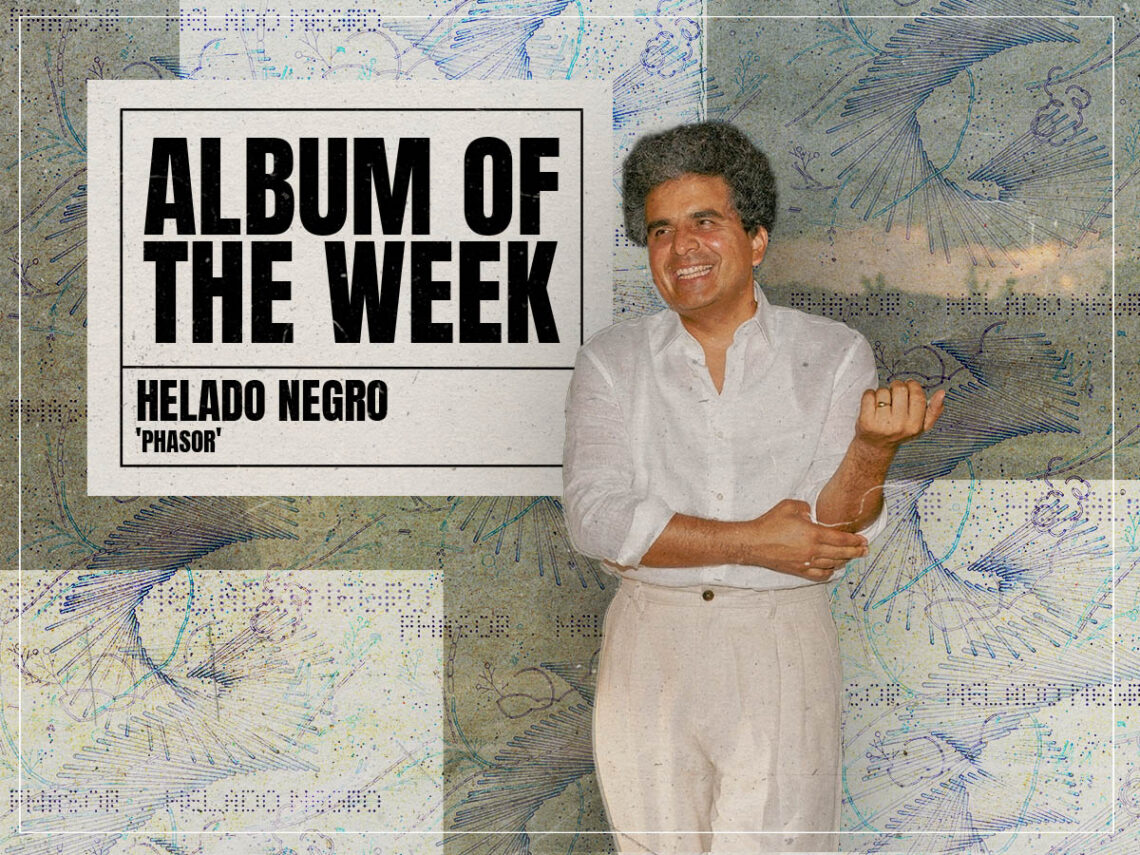
Helado Negro – ‘Phasor’ album review: a sumptuous slice of avant-pop

THE SKINNY: Helado Negro translates from Spanish to English as “Black Ice Cream”. This name becomes less arbitrary upon listening to the Florida-born artist’s brand-new album, Phasor. Sweet and moreish at the outset, it prevails with opulent electronic textures and shady, late-night intoxication. Bright danceability is warped throughout by the avant-garde production quirks essential to Helado Negro’s sonic identity.
The successful experimental pop project of Roberto Carlos Lange, Helado Negro has prevailed for over 15 years. Since his 2009 debut album, Awe Owe, Lange has deftly straddled the fine line between experimentalism and accessibility, adorning an eclectic oeuvre with Latin tones to reflect his Ecuadorian heritage.
As a high school student in the 1990s, Lange’s fascination with music was markedly pictorial. The tech-savvy teen would stay up late at night watching Liquid Television on MTV, transfixed by the audiovisual vanguard. Although his associative medium is sound, Lange channels his Computer Art and Sound Design degree in cinematic dreamscapes.
Phasor arrives as the eighth album attributed to the Helado Negro moniker. As a follow-up to 2021’s Far In, Phasor brings a nuance to Lange’s distinctive catalogue, but its conception can be dated back to 2019. On Lange’s 39th birthday, he visited the University of Illinois to acquaint himself with Salvatore Matirano’s SAL MAR machine, a complex synthesiser that generates music with vintage analogue oscillators. “I was enthralled by it,” Lange reflected in press materials while discussing the inspiration for Phasor.
Contrary to Far In, a rumination on lockdown claustrophobia, Phasor hears Lange return to the big wide world. Instrumentally optimistic, this heady bundle presents a kaleidoscopic image of decadent dance halls and bustling beach parties. But not so fast; Lange will burrow under your skin with oblique flourishes and transportive lyrics demanding undivided attention.
For fans of: Static dancing on a Chesterfield after an exhausting night of cocktails and social interaction.
A concluding comment from Tom’s mother: “Blissful and just a little bit fruity too, like a holiday in Malaga.”
Phasor track by track:
Release Date: February 9th | Producer: Roberto Carlos Lange | Label: 4AD
‘LFO (Lupe Finds Oliveros)’: A tumbling instrumental sets the scene for a rather curious narrative. “Yesterday, on my way to your home / I was lost in a garden of uncertainty / The police knocked me down, left me for dead / And I shouted, ‘Who are you?” the first verse reads, setting the scene for a monologue bemoaning a series of unfortunate events. By the song’s end, “the sun is gone,” but the narrator has found peace in a “zen”-like state. [4/5]
‘I Just Want To Wake Up With You’: Although it sits near the album’s beginning, this should find a comfortable spot near the end of the dizzying night out Phasor embodies. Languid and seductive, ‘I Just Want To Wake Up With You’ soundtracks a homebound taxi journey bristling with anticipation and excitement. Sound effects throughout seem to mimic mobile phone tones and ice rolling in empty glasses. [3.5/5]
‘Best For You and Me’: This one mobilises the neck muscles with a sultry synth rhythm. One of the album’s more danceable and, hence, instantly accessible moments ‘Best For You and Me’ is a true “Black Ice Cream” moment: the instrumentals are saccharine, but something’s afoot under the moonlight in Lange’s laconic and nebulous lyrics. [5/5]
‘Colores Del Mar’: Like the sea it evokes, this one is blue-tinted. The beat moves gingerly with echo-treated lyrics and instrumentals, adding a slightly ominous tone to proceedings. “And I don’t want to be found / I only want to disappear / And I don’t want to be visited / Im only looking for love,” the translated lyrics read, suggesting the narrator is lovelorn – perhaps rejected in the taxi. [4/5]
‘Echo Tricks Me’: Like the previous track, ‘Echo Tricks Me’ pierces the album’s illusion of optimism. Oscillating strings bring vibrant Latin jazz tones to life, but the lyrics are dejected and ruminative. A pattern of unrequited love seems to be developing, but Lange finds courage in the closing line: “Teach yourself to arrive / Grace and mercy will restore you”. [4/5]
‘Out There’: This dynamic little number is ethereal yet propulsive. Wordless vocals follow the instrumentals through a surreal dreamscape, with Lange’s voice intermittently cutting the fog. A sense of apprehension is palpable, but the ominous tones are vanquished in a hopeful liaison: “Out there you won’t know / Follow me to see”. [4/5]
‘Flores’: Get your yoga mat out for the album’s most sedate moment. In the absence of a beat or bassline, an ambient introduction encourages a zen-like state. The narrator seems to have found peace with his lover. Spanish lyrics read, “Resting my voice in your arms / I’ll escape my only agony”. Towards the end, a relative climax introduces a soft guitar progression and rhythm section. [3.5/5]
‘Wish You Could Be Here’: Stimulating and fresh, ‘Wish You Could Be Here’ is very dissimilar to its Pink Floyd-created cousin. A conga-style rhythm propels the song through waves of intensity guided by masterful synth textures and sound effects reminiscent of a rainforest setting. The lyric, “Trees begin to hold us still / Living wounds won’t heal themselves,” seems to comply. [5/5]
‘Es Una Fantasia’: Lange closes Phasor with a Spanish lead vocal. At five minutes, this is the album’s longest track. It skips along on a subtly energetic beat while slow croons and spacious acoustic strums place a pillow under the head. Whatever romantic struggles have occurred on this bizarre, tropical night, we arrive home to yielding leather furniture. Lange bookends his latest triumph as classy as ever. [4/5]

Never Miss A Beat
The Far Out New Music Newsletter
All the latest New Music from the independent voice of culture.
Straight to your inbox.