


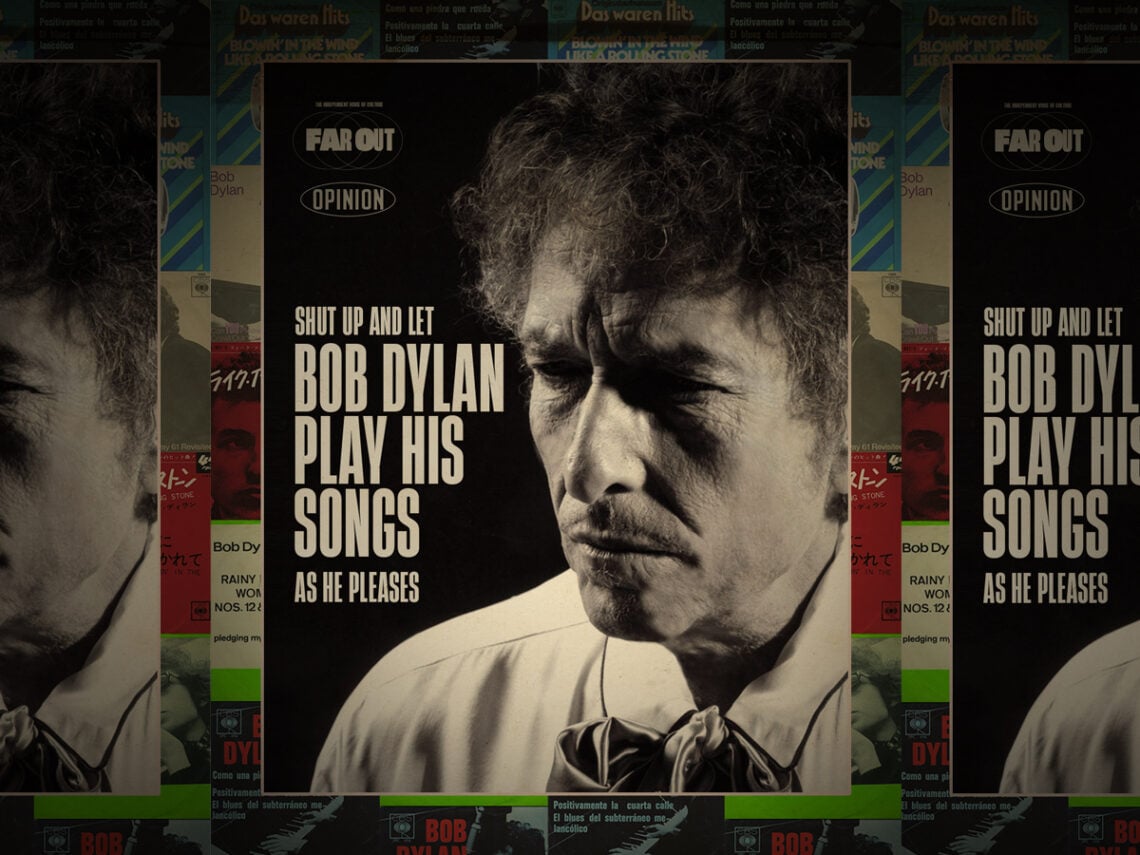
Hear Me Out: If you think Bob Dylan should play the hits as they were, you’re not only wrong but also a grotesque freak

”The highest purpose of art is to inspire. What else can you do? What else can you do for anyone but inspire them?” – Bob Dylan
I strive to be a woke, little egalitarian of the highest order, but try as I might, there are three prejudices that I can’t overcome. When presented with the following opinions I can’t help but think at least 1% less of the person proclaiming them: people who believe Christiano Ronaldo was better than Lionel Messi, people who prefer a Chinese takeaway to an Indian, and people who think Bob Dylan should stop messing around and play the hits just as he recorded them 50 years ago.
The latter will be the focus of today’s holier-than-thou sermon. You see, Bob Dylan might just be one of the greatest artists in human history. He changed pop culture as we know it, expanding our understanding of modern song. Along the way, he inspired the likes of The Beatles, Lou Reed, Nina Simone, David Bowie, Joni Mitchell, and Marvin Gaye. Each of these esteemed artists would happily admit that they are indebted to Dylan.
In fact, I think you could trace a line of inspiration from any given modern artist directly back to Dylan in some capacity. Such was the seismic shift he initiated, his influence is all-pervading. In this regard, it simply feels fundamentally wrong for any accountant who has never even fingered the fret of a guitar in anger to sit in sweatpants and demand, well, anything at all from the folk luminary.
Yet, every time the ‘Jokerman’ singer has toured for the last decade or so, there has been a chorus of resentful scrutiny over the fact that he doesn’t play the old hits. Or rather, that when he does play them, you can’t recognise them anyway because he has completely overhauled the arrangements to the whims of his recent jazzy wont. I think a genius is entitled to do that.
But that’s not why the constant calls to the contrary peeve me. That’s not why the concept of saying, ‘Shut up and recreate the hits’ rattles my usually calm core with an internal earthquake of acerbic prejudice. The issue uneasily stirs something on a much deeper level than that surface perturbation. A lack of respect for a great artist is a factor that barely registers on the Richter scale of my ire.
I’d be happy to accept complaints that he’s not quite as good as he once was, or hear out any grievances voiced over the sound and chemistry of the band. But that’s not what people typically say. Instead, it’s a chorus of confrontational clamour about how he’s playing them rather than considered complaints about the quality.
It’s only when you break down the disgruntled demands of that sweatpants-wearing accountant, to analyse what they’re actually asking for when they rubbish Dylan’s new arrangements, that the depths of their depravity really come to light: they are, in effect, asking someone who they often consider a genius even themselves, to perform karaoke.
That’s like going to a magnificent farmhouse restaurant, where the produce is locally reared with pride, passion and artistry, sweated over with love in a kitchen rich with tradition, and asking them to order you in a Big Mac.
Here’s the thing: Dylan’s songs aren’t all that difficult. They are not something that an accountant who thinks a timpani roll is a type of Vietnamese sandwich could not replicate with a few years of practice. But they changed the world because of how they engaged with society. That’s what separates an artist, in the truest sense, from a Grade 8 piano player who never tinkles a key outside of their own spare room.
As the quote at the top of this piece proclaims, inspiration is the highest purpose of art, exulting us from the humdrum workaday reality and elucidating something new in a great shake-up that spiritually touches our souls and society alike. Dylan did that in a manner that irrevocably changed the world in the 1960s, and he did that with a sense of newness, invention, progress and liberty in mind, not playing to the gallery in a stagnant recital of what was once popular.
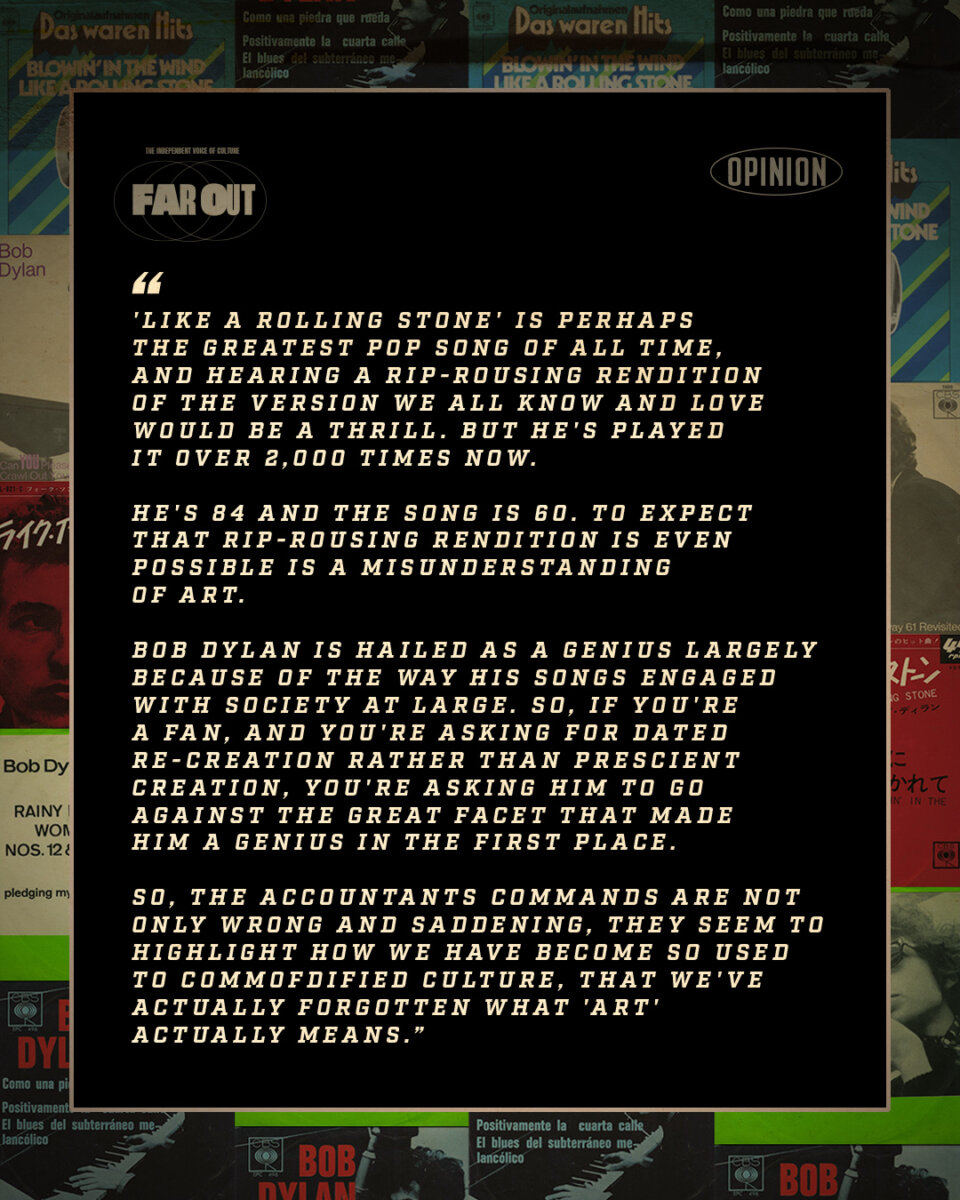
So, if you’re a fan of the icon and you’re asking him to play the hits, then you’re unknowingly asking him to turn against the thing that made you a fan in the first place. That doesn’t mean that it isn’t an understandable demand. For instance, ‘Like a Rolling Stone’ might be the greatest pop song ever written, so to see a knowable, rip-rousing rendition of that performed live would be an undoubted thrill.
But the thing is, he’s played it over 2,000 times now. It’s a song approaching pensionable age. So, as thrilling as it is to envision him ripping through it, I’m just not sure the passion would be there for him to play it like that effectively.
The hardest thing about being Bob Dylan on tour in the 21st century is the weight of expectation that comes with it. He’s such a legend that night after night, people attend expecting something religious, expecting one of the greatest concerts of their lives. Now, imagine that expectation coupled with an ethos of just rolling through the same setlist of the same songs played in the same way for fucking 50 draining years. It would be pretty much impossible to remain impassioned.
Dylan has kept going passionately, and he’s kept delivering magic because he’s never lost sight of what art truly is. It is not a one-time recording pressed to acetate for posterity to be repeated on a loop for eternity, even in a live setting. That thinking is a mishap of the analogue and digital modern age. Art is the thrill of what happens in the moment.
Kiboshing that sense of live creation in favour of live re-creation is a fundamental misunderstanding of art itself. It’s like going to a football match and demanding a play-by-play re-enactment of a 3-0 win from 1993 rather than an actual live game where something even more magical could unfold.
Dylan is obviously still an artist in the purest sense who still sees the magic in aiming to surpass his former 3-0 wins, and he has the passion to pursue a figurative fourth goal. Those calling for recreations have evidently lost that wonder and crave artless routine instead.
That’s why, after the initial quake, my hate for this hypothetical accountant with his crooked demands subsides, and I grow to pity them. But then I tremble in a different way, I tremble for the sorry state of society. You see, the accountant’s claim does not merely reflect badly upon the world in the context of Dylan, but I actually think, in its own deeply tangential way, it taps into where we’re going wrong. So, in the briefest way possible…
Here’s how I think the demand for Bob Dylan to play the hits represents the demise of society…
About 75 years ago, culture was cheap. If you were lucky enough to live in Harlem, you could pop into a bar and watch an in-house piano player of the magnitude of Thelonious Monk perform for free, provided you bought a drink. The next night, you could be watching a more established hero in a swankier venue like the Carnegie Hall for a fee akin to an hour’s overtime.
This meant people were constantly interacting with art and the world around them, mixing with the masses in a buoyant and celebratory fashion. Thudly, culture created a greater sense of cohesion and civility. You were rubbing shoulders with thy neighbour rather than at war with them. Social spaces were valued and cared for. They were seen as a vital part of a functioning civilisation. Then vinyl came along.
Initially, the sound quality was crap so if you were used to seeing Billie Holiday from 15 paces, the appeal of a recording was pleasant, but largely novel (think playing a song off your phone without a speaker – you’d probably still do it the day after a concert, but you wouldn’t see it as a replacement for the real McCoy that you saw just last night). Then, Enoch Light invented stereo sound, and vinyl suddenly sounded even better than the real thing.
So, the on-demand, at-home quality of vinyl steadily began to eclipse the real thing. The problem is, it isn’t the real thing. It sounds similar, but it’s a facsimile to be enjoyed in isolation. It was, and is, devoid of the chinwag with a co-worker at the ticket office. Devoid of the pint with an old pal in the Dog & Dare afterwards. Devoid, in short, of human connection. That’s a sorry loss. That communal connection is why you have the best night of your life at a concert, not sat at home, alone with a record.
That’s why we all want the dour and divided modern world to change, but change is the last thing we expect, it seems impossible to the point that it is imperceptible. Culture once brought people together, and when people come together, they can get things done. They can also accept each other and develop greater empathy.
As we have become increasingly isolated through the commodification of culture, we have lost that connection and the notion of positive change being possible. We have lost our understanding of the purpose of culture. Hence, an accountant sat at home, eager for change, but change is so far beyond comprehension that they even demand Dylan remains the same, without considering the extent of what they are truly missing out on in doing so.
They are saying: ‘No, Bob Dylan, you irreplaceable genius drawing upon the wealth of your wisdom and passion to create a unique and magical experience before us so that we might spill out onto the streets inspired and revel in the jangle-jangle evening knowing we have just witnessed something never to be seen again – don’t do that. Play them how you once did in a studio when you were 23 years old, because that’s how they sound on my headphones when I listen alone’.

Never Miss A Tale
The Far Out Bob Dylan Newsletter
All the latest stories about Bob Dylan from the independent voice of culture.
Straight to your inbox.