


Have we all misunderstood the album Bob Dylan called his best work?

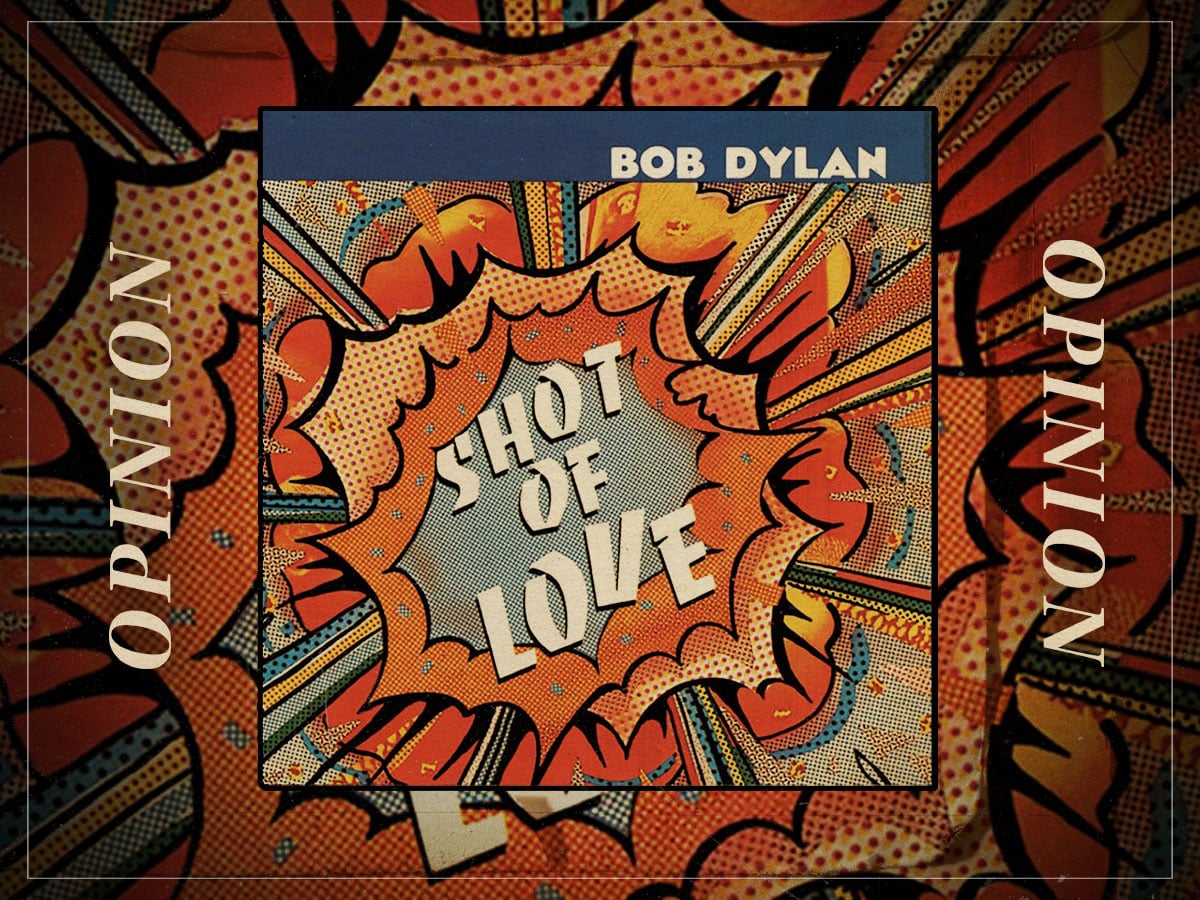
“I think this one, for its time right now, will be perceived in the same way. I may be totally wrong in saying that, but I feel that same way about this album,” Bob Dylan said about Shot of Love, the record he deemed his favourite at the time of its release.
While Dylan had full faith in Shot of Love and ranked it as his very best work, as he predicted, the public perception went another way.
The 1981 album didn’t necessarily flop (it hit number six in the UK charts), but in America, it only sold about 200,000 copies. It was a sign that the singer was still in decline, and his commercial performance had been continuously dipping for an increasingly depressing amount of time.
There could be many reasons why his drop off was moving at an alarming rate, and a lot of them were attached to Dylan’s hope pinned to Shot of Love. Of course, many people will point to the strange phase he’d fallen into at the time, given that this record sits as the third in his religious trilogy, beginning in 1979 with Slow Train Coming. To ask his fans, many of whom might have got on board during his liberal protest days, to now engage with three years’ worth of hyper-religious and gospel inspired music is a lot.
Though Dylan might have fallen into an intense period of evangelicalism, suddenly becoming a vocal critic of his peers through this new spiritual lens as he condemned rock bands to hell, his audiences certainly hadn’t.
But of that trilogy, Shot of Love was the weakest link when it comes to the strength of Dylan’s god obsession. Given that there’s a song on there called ‘Property of Jesus’, it’s obviously still very present. But in the album’s finest moments, it is subtle and nuanced, like the beautiful hymn-like track, ‘Every Grain of Sand’, which seems to go beyond religion and exists simply as a piece of beautiful melody.
I think when trying to understand the issues of Dylan around this point, it would be mad not to recognise that something started happening to his voice. We know he never had a truly angelic timbre, but suddenly the singer’s voice was ten times gruffer, as if he was smoking pack upon pack upon pack a day. For fans who got into Dylan’s music during the lighter folk days, it was the late 1970s and early ’80s period when most jumped ship, no matter how good Dylan believed Shot of Love was.
And he thought it was great. He thought it was his best work. “It sounds old, but it’s new. I think this new album we did, for me, is the most explosive album I’ve ever done. Even going back to Blonde on Blonde or [The] Freewheelin’ [Bob Dylan] or any of those. Bringing It All Back Home or Highway 61 or wherever they were,” he said, putting it above any of his earlier records that were already classics.
That seems to be the kicker. While Shot of Love can be revisited with kinder ears now and appreciated for its good moments, Dylan was delusional to really think that this album, caught in the strange turn of the decade where his brand of folk-rock Christian edge was already past it in the pivot towards heavier rock and pop, was his best.
New acts had popped up and taken his spot as the mouthpiece of a generation, especially as his spirituality and rejection of protest music made him even less connected to his crowd. He was isolated and stuck in a no-man’s land where he was falling out of fashion, and so his belief that Shot of Love would beat his earlier folk records, which were so tethered and representative of their times, is foolish.
“It was like the breakthrough point. It’s the kind of music I’ve been striving to make, and I believe that in time, people will see that,” Dylan said, but the people didn’t, and when his songs about Jesus are pitted against his songs about social injustice or even his earlier love songs, they didn’t stand a chance.

Never Miss A Tale
The Far Out Bob Dylan Newsletter
All the latest stories about Bob Dylan from the independent voice of culture.
Straight to your inbox.