


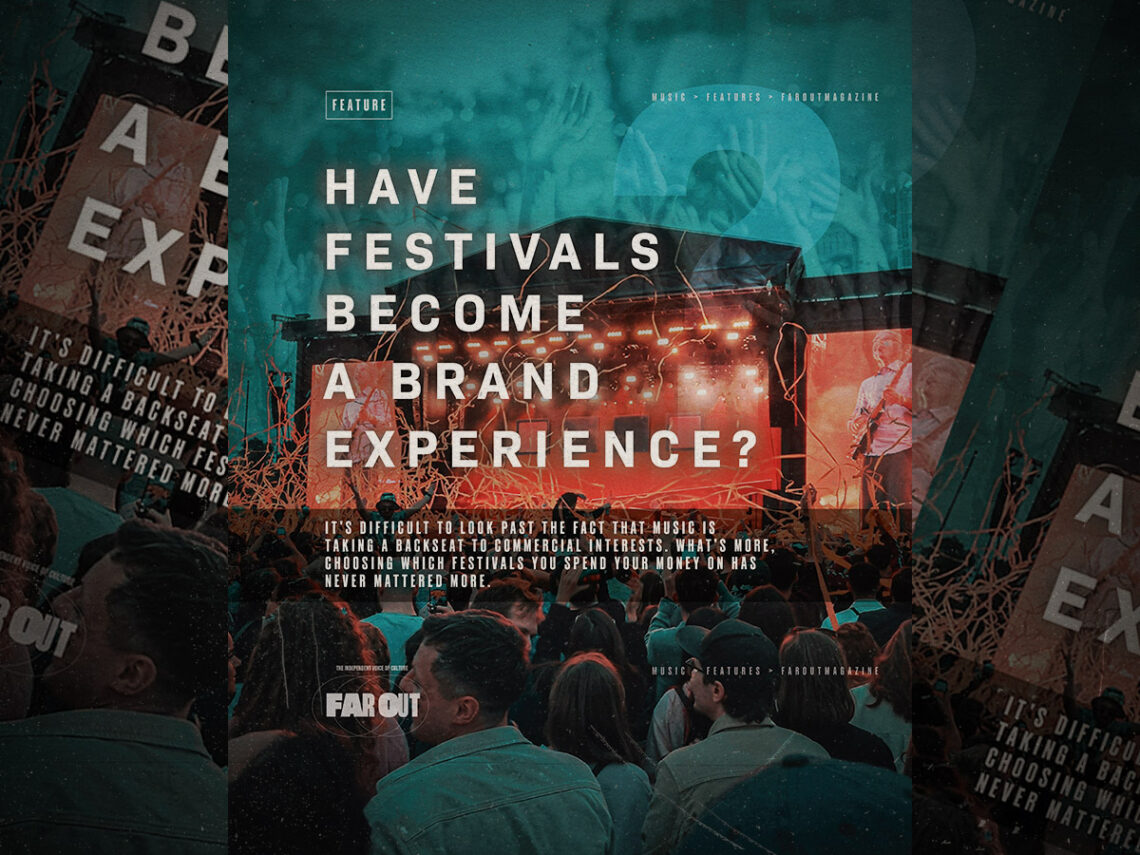
Have music festivals become a brand experience?

In 2004, writers Crispin Aubrey and John Shearlaw put together a book called Glastonbury Festival Tales, an interesting oral history of Britain’s biggest music festival from its 1970 inception through to the turn of the millennium. In that 264-page book, the word “brand” appears exactly two times; once in reference to a “brand new” Pyramid Stage, and secondly to mention a performance in the year 2000 by a band called the Brand New Heavies.
To be fair, Glastonbury has always famously upheld a policy against overt commercial branding on festival grounds, reducing the need for the authors to discuss the topic in much historical detail. Though 20 years later, a “brand” is now no longer just a corporate concept. Thanks to social media and influencer culture, an event and every individual who attends it is a potential brand in and of themselves, and this has gradually overturned many of the old ideas of what a supposedly communal festival-going experience even means.
For a long time, the primary and most important selling point of any music festival was—surprisingly enough—the music. For the ambitious and always cash-strapped festival organiser, this meant living and dying with your bookings. Can you convince The Who to swing over to your mud-soaked field in the middle of their summer tour? Any chance The Police want to reunite again for one day?
These were the key discussions, followed closely, of course, by endless negotiations over leases, permits, noise ordinances, security clearances, yada, yada. Aside from signing deals with a few advertisers for sponsorship for big stages, there wasn’t much time left to consider the bigger marketing potential of your event. The festival was the product, and your attendees were getting what they paid for: music. If there was enough water available to keep them all hydrated, that was considered a bonus.
As for the independent festival merchants who came to sell all those water bottles, sausage rolls, or handmade hacky sacks, for many years, they were basically spending a weekend in the lawless Old West. As former Glasto stallholder Dick Jones recalls in Glastonbury Festival Tales, working at the event back in the 1980s was a game of survival.
Explaining, “I remember we pulled up next to a guy selling cakes—proper cakes, not wacky baccy ones—and when someone tried to rob him, which did happen occasionally, I looked up and there he was running down the road with a shotgun. Whether it was loaded. I don’t know, but that’s how much anarchy there was at the time… You had to be streetwise. In the early days, when you couldn’t get out to bank [your stall earnings], everybody would be out there with a spade secretly digging a hole in the ground to bury it. Then, of course, you had to find it afterwards.”
Even in those Mad Max days, of course, corporations and advertisers were already intrigued by the potential value of the enormous, captive audiences standing around aimlessly between sets. It just took a bit longer for the festivals to fully become aware of their own inherent brand status; that Glastonbury, like Woodstock, was a loaded word with a lot of romantic connotations—a marketable commodity with or without any A-list bands attached to it.
The slightly younger Gen Z batch of big annual music festivals, from Coachella in the US to Primavera Sound in Spain, were born with this self-awareness already built in. They immediately began focusing on giving their attendees an experience that would properly promote and reinforce their brands, with the musical performances as just one piece of that overall experiential pie.
How are festival organisers preparing for this new vision?
To help them out, festival organisers can now choose from countless marketing and PR companies specialising in brand management. These firms, in turn, use surveys and analytics to profile a festival’s would-be attendees, and suggest modes of appeasing that demographic’s every desire, or at least, any desire that can distract them from just being present and watching the bands play. “The impermanence of the music festival,” as one of these brand-boosting firms explains it on their own site, “signifies how Millennials and Gen Z value experiences over things, which provides an exciting opportunity for brands”.
Another PR firm, noting that young people today are far less interested in drinking or taking drugs at festivals (or at least in trusting a survey taker with such information), suggests to clients that “events are a great platform for brands to embed themselves in Gen Z popular culture. From driving UGC to building relationships with IRL shoppers, they present multiple opportunities for brands to engage with young people.”
There’s nothing Gen Z festival goers hate more than “cringe” and “inauthenticity”; however, if you’re going to distract them away from the Pyramid Stage with fun interactive product demos, contests, give-aways, and some such, make sure you keep it chill and subtle. On the contrary, this is less important with Millennials. Nearly half, which is 48%, of those 30-somethings and 40-somethings freely admit that “they attend events so they have something to share on their social channels,” according to Sense Marketing, “so providing them with the tools and inspiration to act as creators on their social platforms is a no brainer.”
That’s certainly one way of looking at it. But is catering to the self-absorbed wishes of half your audience always the best move, even if it continues to draw their attention away from the performers and stages that actually make your music festival, you know, a ‘music’ festival? Isn’t there a chance that a festival goer could find themselves joyously liberated from their smartphone for a weekend if they weren’t led toward a branding experience that kept requiring its use?
The recent backlash against the well-documented social media obsessions of the Coachella crowd, best exemplified by Damon Albarn yelling at their screen-lit faces like a frustrated boomer dad in 2024, only makes the brand-loaded model feel all the more misguided. Rather than thousands of people coming together for a shared experience, for better or worse, festivals may become something more akin to 500 buskers in a corn maze, posing for IG shots with a dozen half-listeners at a time. It’s still a nice time in the sunshine, but individually curated and boxed off like everything else, and easily forgettable.
