


Has £1 got what it takes? The future of the grassroots music industry explained

These days, everything, from the price of a standard food shop, filling up the car with fuel, and keeping a roof over your head, has skyrocketed. For many, quite understandably, the luxury of going to a gig is out of the question.
Unfortunately, it’s this uncomfortable truth that discussions about art in the modern world will all too happily overlook. The consumption of music, theatre, dance, or anything else on a live scale is a hobby generally reserved for a privileged few. For the vast majority, popping out to a gig for an evening isn’t a normal done deal; culture comes at a cost.
It goes without saying that there is an entirely separate conversation to be had about the elitist role of class and social mobility within this, but the issue then becomes twofold: if audiences can’t pay to see a show, then venues can’t keep their doors open, and artists can’t perform. It’s an extremely sorry state of affairs for everyone involved. This is, of course, something that we have all heard many times before. The current festival circuit is being obliterated because of it, and the condition of the grassroots sector has been dismal for a long time. You could give up every last hope for the future, in this sense, but that would be the easy way out.
Regardless, there are many people fighting back, and the solutions might seem obvious: champion small artists, and get down to your local grassroots venues as much as possible, which is undeniably helpful, but the system is actually telling you to take your power and money elsewhere. It’s time to join the masses and save grassroots through a stadium gig.
Those might seem like two ends of a totally polarising extreme, but it is exactly what the Live Trust are counting on with their £1 ticket levy on arena and stadium shows. For all the tens of thousands of fans who are still guaranteed to turn out for their favourite huge artists, they’ve cracked the pipe into a sizable cash flow, which they can channel back into the grassroots sector.
Since launching in January 2025 with government approval, the first £500,000 from the scheme has been distributed to more than 12 grassroots live music organisations across the UK, with a further £6million also already pledged. Funding has been generated via huge shows by the likes of Mumford and Sons, Olivia Dean, Lorde, Florence and the Machine, My Chemical Romance and many besides, fostering a sense of connection in the music industry that every artist can come together as one.
But the levy has been in place for 18 months now, and the picture is still far from rosy. The 2025 annual report from the Music Venue Trust, one of the main beneficiaries of the Live Trust’s funding, reported 6,000 job losses in the sector and 53 per cent of venues failing to make a profit in that time. So the question stands: will £1 really be enough?
Jon Collins, the CEO of the Live Trust, is adamant that it is a step in the right direction. “No single initiative will solve decades of structural pressures on its own,” he tells Far Out.
However, he adds, “We have already secured more than £6 million in pledges and are now preparing to make our second round of funding awards. The Trust was never intended to be a silver bullet. It is a long-term commitment by the live music industry to reinvest in its own future. As more tours, festivals and events come on board, the Trust will grow year on year, allowing us to support more organisations and reach more parts of the live music ecosystem.”
Clearly, there are still plenty of mountains to move, whether between politicians or the general public, to increase understanding and support of what the scheme is actually setting out to do, and in turn, achieving. One of the most common misconceptions, from a fan’s point of view, is that the £1 levy is adding an extra cost to their ticket price, which Collins is keen to address.
“Ticket sales are the lifeblood of our industry. It is fans who buy those tickets, and it is fans who make Live Trust possible,” he says, “They understand that global artists are not made overnight; they are developed through a thriving grassroots ecosystem of venues, festivals, promoters and touring opportunities. By supporting Live Trust, audiences become part of protecting that future pipeline of talent. In fact, a Music Fans Voice survey found that 93 per cent of fans support the £1 donation. Importantly, this is not an additional charge, it is incorporated within the existing ticket price.”
Some might suggest that a donation scheme, like one used by Coldplay on their Music of the Spheres Tour, where they donated ten per cent of their total profits to the Music Venue Trust, might be more effective.
“While artist donations are incredibly valuable, they ultimately need to be funded from within a tour budget, making them more likely to result in higher costs being absorbed elsewhere, including through ticket prices,” Collins notes in rebuttal.
As much as the scheme has undoubtedly made great strides, there are many challenges which still stand in its path. Currently, one of the most prominent is the Westminster government’s refusal to remove Vat from the levy, which means that “for every £500,000 received, £125,000 will have been taken in Vat,” according to Collins.
The government has acted in regard to schemes with similar intentions before, such as the Tampon Tax, where the £86million generated in tax revenue was channelled back into organisations supporting women and girls. But when you look at cases like Harry Styles, who participated in the levy for the ticket sales of his recent record-breaking 12-night residency at Wembley Stadium, that means that although there would have been around £1m in donations, approximately £200,000 would have been stripped from the Live Trust, according to a report from The Telegraph.
For Collins, this situation cannot continue. “That is money stripped directly from grassroots venues, festivals, promoters and artists and crew. It also means that the biggest single beneficiary of the fundraising is not the grassroots organisations who desperately need it, but the government that asked us to put the scheme in place and is challenging us to go further, faster. This situation undermines the government’s own objectives to improve the grassroots live music sector,” he says. Far Out put forth these claims to HM Treasury, but they did not respond.
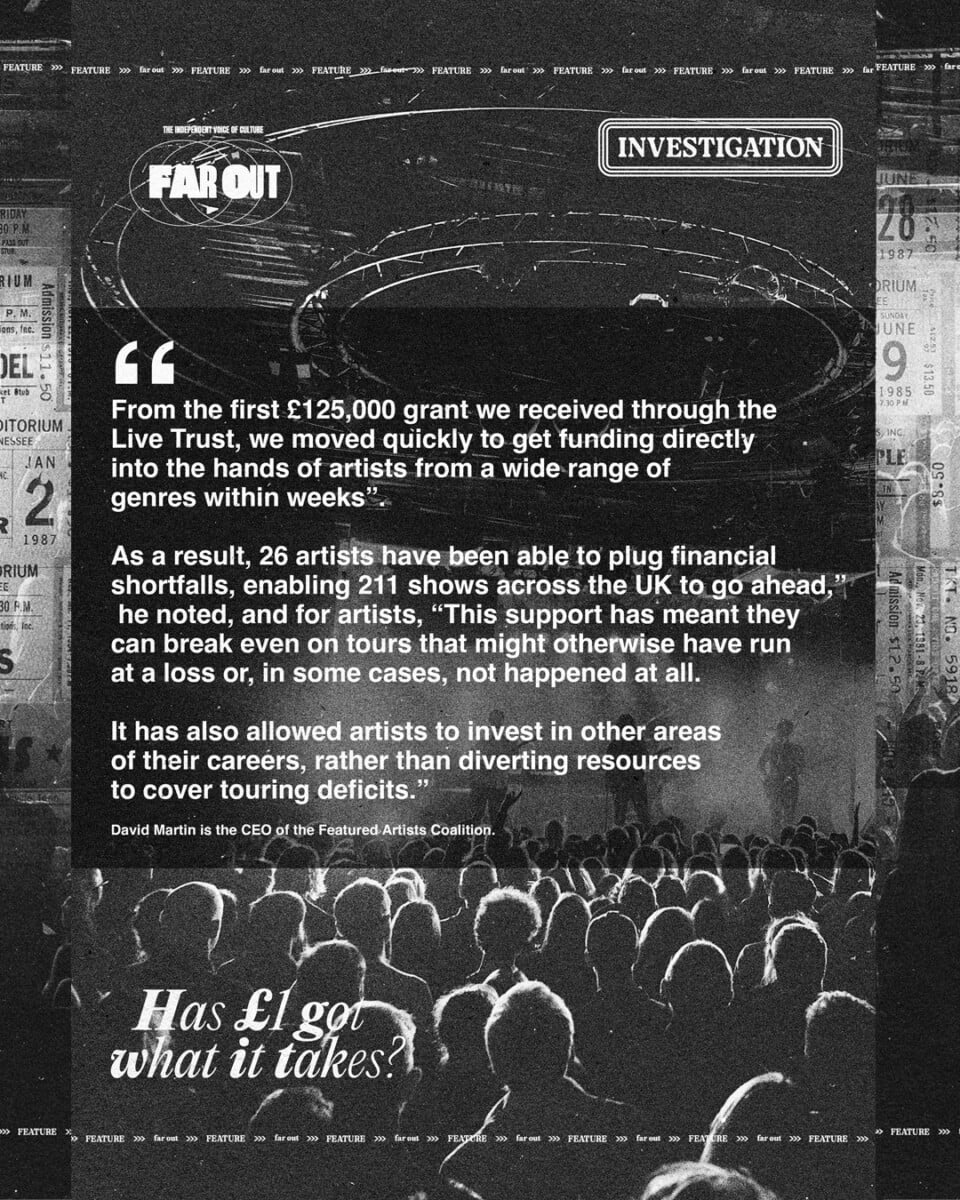
Despite the roadblocks in the way, for those that the funding is directly benefiting, there is no denying its very tangible impact. David Martin is the CEO of the Featured Artists Coalition, one of the organisations receiving grants from the Live Trust. They established the UK Artist Touring Fund, and subsequently, as Martin told Far Out, “From the first £125,000 grant we received through the Live Trust, we moved quickly to get funding directly into the hands of artists from a wide range of genres within weeks”.
“As a result, 26 artists have been able to plug financial shortfalls, enabling 211 shows across the UK to go ahead,” he noted, and for artists, “This support has meant they can break even on tours that might otherwise have run at a loss or, in some cases, not happened at all. It has also allowed artists to invest in other areas of their careers, rather than diverting resources to cover touring deficits.”
It is helpful, in this context, to see the real-world impact that the money generated through the levy is having, rather than just looking at pound signs all the time. Yet ultimately, there is no escaping the fact that every facet of this issue does boil down to financials. As such, Martin echoes Collins’ comments about the government’s handling of Vat from the scheme, saying that from their side of the bargain, “The industry has shown that it is willing to come together and create practical solutions to support grassroots live music”.
In these types of discussions, we hear a lot about “silver bullets” and ultimate solutions. Both the CEOs, from the Live Trust and the Featured Artists Coalition, are firm that the £1 levy is not that. “My view is that the greatest impact will come from a unified and collaborative approach that is adopted across the sector and becomes part of the fabric of how live music operates in the UK,” Martin says.
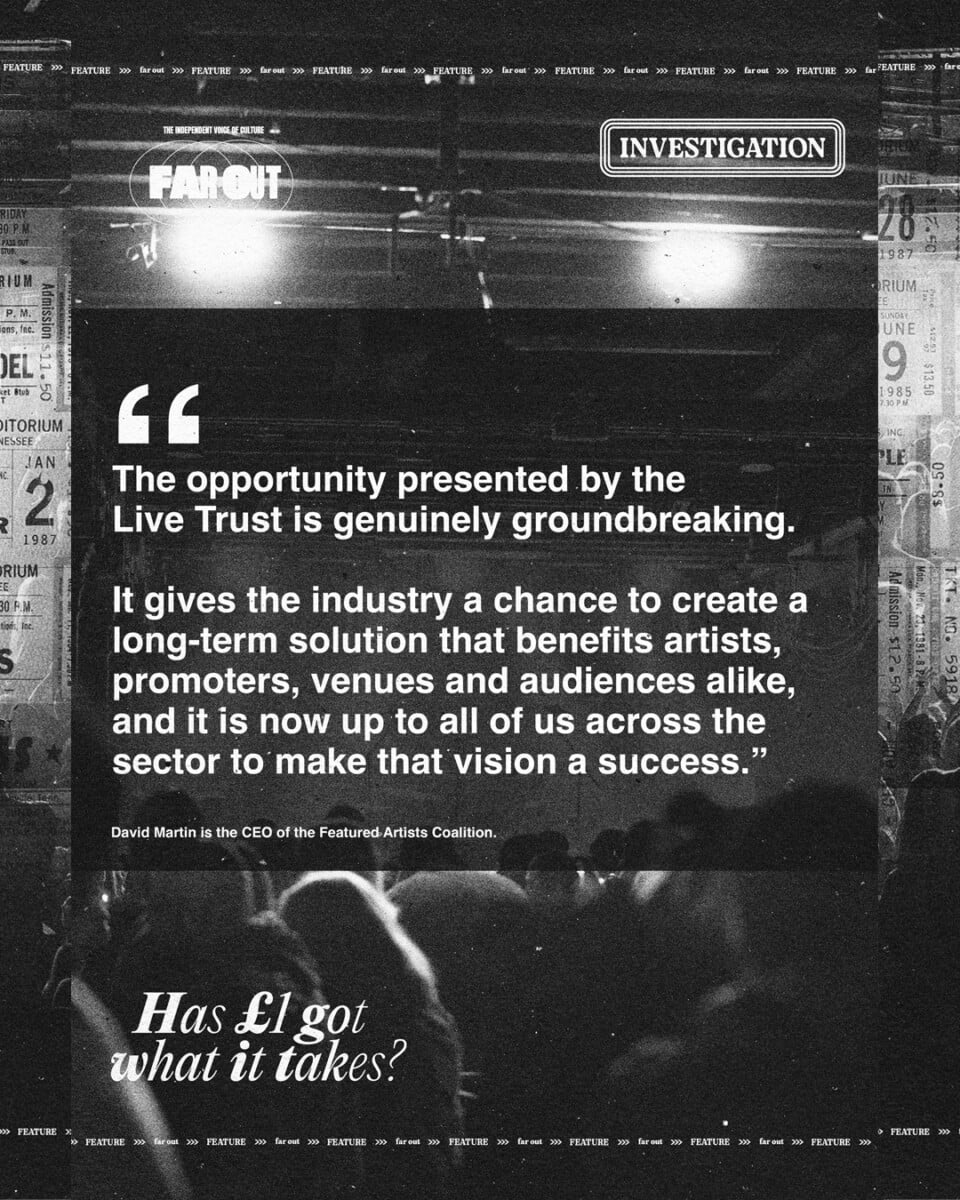
He adds, “The opportunity presented by the Live Trust is genuinely groundbreaking. It gives the industry a chance to create a long-term solution that benefits artists, promoters, venues and audiences alike, and it is now up to all of us across the sector to make that vision a success.”
Of course, it is easy to listen to the heads of these organisations and become slightly detached from it all. At the end of the day, the average gig-goer is not expected to be inclined to the whims of bureaucracy, politics, and Vat. But Imogen Williams, one of the beneficiaries of the funding via the Featured Artists Coalition with her rising alternative rock outfit, Imogen and the Knife, is one of the best-placed people to explain how the rewards can be reaped.
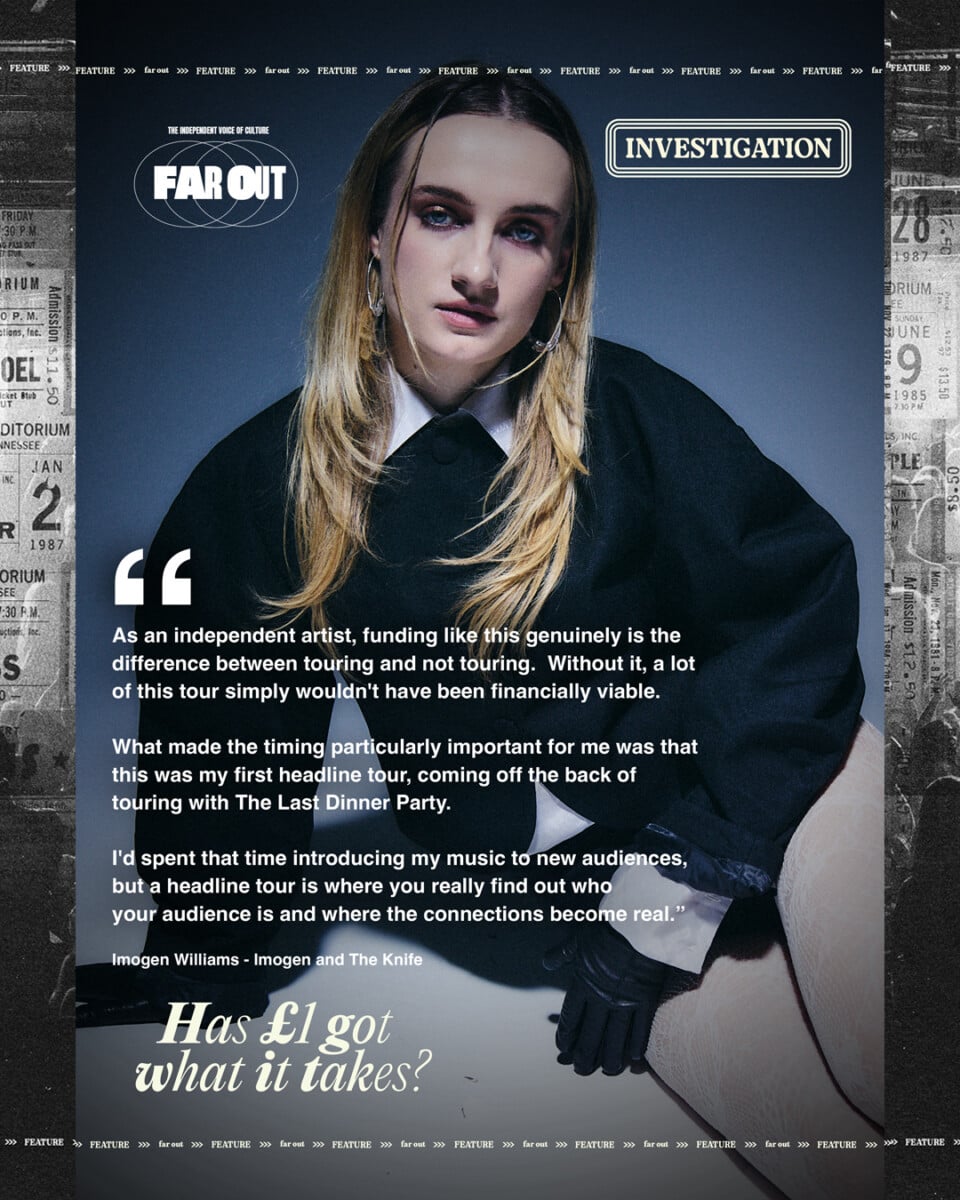
“As an independent artist, funding like this genuinely is the difference between touring and not touring,” she says. Having just had a taste of what that feels like, Williams adds, “Without it, a lot of this tour simply wouldn’t have been financially viable. What made the timing particularly important for me was that this was my first headline tour, coming off the back of touring with The Last Dinner Party. I’d spent that time introducing my music to new audiences, but a headline tour is where you really find out who your audience is and where the connections become real.”
On a personal level, there have also been benefits from the funding for the singer that the audience wouldn’t typically see. “As an artist who deals with chronic pain and fluctuating mobility issues, the funding also enabled the tour to be more comfortable and sustainable. Touring can be physically demanding at the best of times, and having the ability to pace things more carefully and pay for support where needed was a real game-changer. It meant I could focus on giving the best possible performances rather than simply trying to get through the logistics,” Williams explains.
Although the shows she is playing may be at the smaller end of the scale for now, she can see the potential and immediate benefits that bigger artists contributing to the grassroots scene are already having. She says, “I think it creates a sense that we’re all part of the same musical ecosystem rather than existing in completely separate worlds. Sometimes it can feel like there’s a huge disconnect between those ends of the industry, but initiatives like this recognise that the success of large-scale live music depends on a healthy grassroots scene beneath it.”
Despite this, “It’s encouraging to see bigger artists and tours contributing back, but I don’t think we should solely depend on the artists themselves to help,” Williams notes, “The next generation of artists needs places to learn their craft, make mistakes, build audiences and develop. The government, ticket agencies, and monopolising promoters need to understand this. If grassroots spaces and tours disappear, the entire industry loses its talent pipeline and the country, a huge part of its culture.”
Even with all this in mind, she inherently understands the pressure that is being put on audiences, noting, “People are perhaps more likely to invest in one or two massive concert experiences a year for a few hundred quid, like a holiday, than £15 a week on taking a punt on a new artist. I get it, no one has cash to spare, and no one wants to take a risk with their money. We’re in a situation where everyone in the chain is under pressure.”
Ultimately, the £1 levy has only been in existence for a year and a half. It’s unrealistic to think that it could ever solve the issue of the declining state of the grassroots live music scene on its own. “The industry has shown in just one year that the Live Trust £1 contribution initiative can have a massive, real-world impact,” Collins says, to this effect, “To go from nothing to £6million in pledges in just over a year is remarkable. We need to now keep up the momentum and grow the number of pledges each year to maximise the impact we can have.”
Martin agrees with this from the perspective of the Featured Artists Coalition, saying that if the levy is adopted “at scale”, and not just via the Live Trust, the opportunity could “provide a significant and consistent injection of investment into small and mid-level artists and live infrastructure”, which would be “truly transformational” to the industry.
“We all have a responsibility to make that happen for the good of the sector,” he states.
Above all else, Williams is the one who has seen all of these effects, good and bad, manifested right before her. She has travelled up and down the country, got ready in cramped dressing rooms, played shows big and small, and yet made real human connections with the fans who come out to see the gig that night. “We don’t question as much the value of libraries, museums or theatres, and grassroots music venues deserve to be viewed in the same way,” she points out, but there also needs to be an acknowledgement that “music isn’t just entertainment; it’s a vital part of our culture, our communities and our national identity.”
Williams says she is “incredibly passionate about this because I’ve seen first-hand what grassroots venues, particularly outside of London, do for people. They give artists a place to grow, they create jobs, they bring communities together, and they provide spaces where people can experience something meaningful and human. The £1 levy is an incredible start, but it has to be the beginning of the conversation, not the end of it.”
Every part of live music comes at a cost, but the next time you’re considering a night out or taking on the Ticketmaster war, you should know this: £1, as part of your ticket price, is giving more hope to the grassroots music sector right now than most.
