


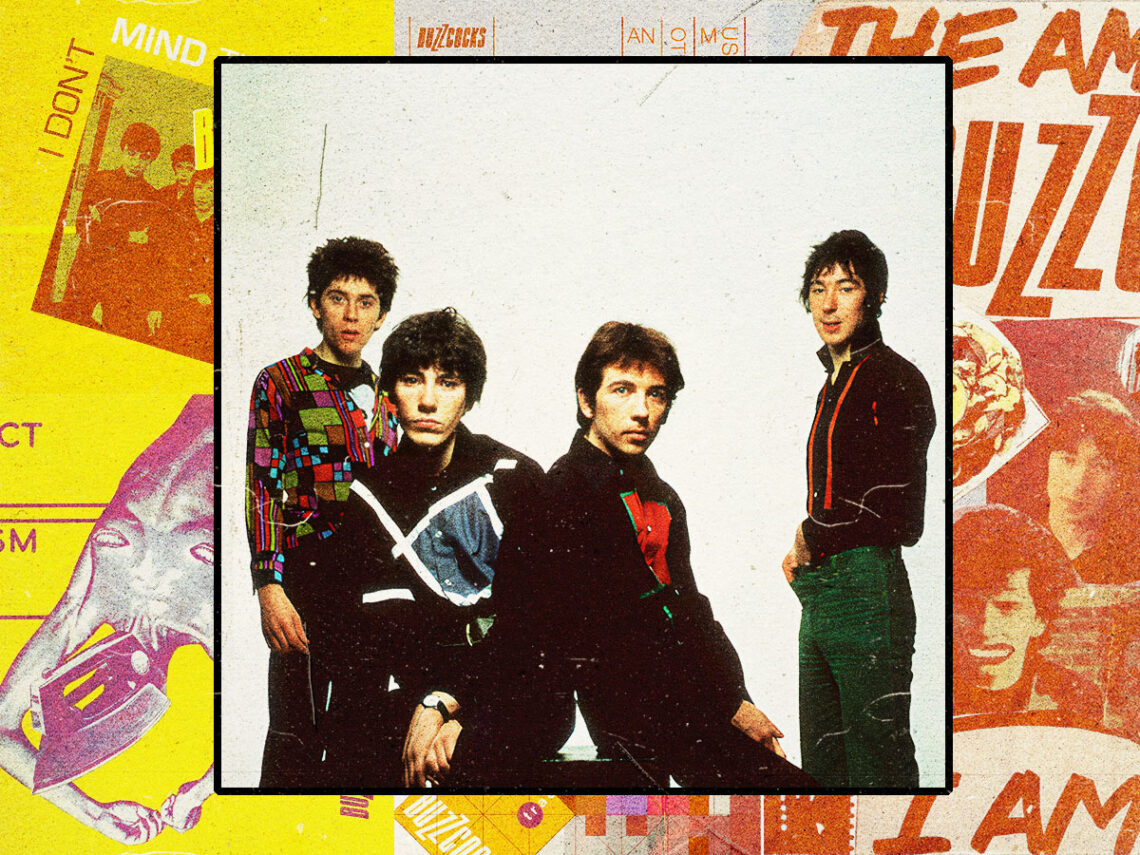
‘Harmony In My Head’: punk’s postmodernist moment

When taking a step back and casting an eye on UK’s grand musical tapestry, it’s typically Sex Pistols which is stamped onto the punk chapter, scoring requisite stock footage of piled-up rubbish in the streets, “three-day week” folklore and generally everybody having a miserable time in the latter part of the 1970s.
Little has changed—except we’re working twice as hard to be even more malaise-stricken. But while ‘Anarchy in the UK’ may stand as the archetypal British punk single, alongside The Clash—Rolling Stones‘ eternal favourite—Manchester’s Buzzcocks’ slyly enmeshed itself in pop’s collective canon with a sharp knack for hooks and infectious songcraft.
They started strong. Originally fronted by Howard Devoto for 1977’s debut Spiral Scratch EP, his departure that year to form Magazine resulted in a reshuffle of band duties. It saw Steve Diggle swap bass for rhythm guitar and Pete Shelly step up to lead and vocals. Following their debut single ‘Orgasm Addict’, ‘What Do I Get?’ was the first piece solely written by Shelley that demonstrated the Buzzcocks’ serious pop chops.
The following year’s ‘Ever Fallen in Love (With Someone You Shouldn’t’ve)’ would stand as a classic of the era, demonstrating that punk could be vulnerable, venerate classic songwriting, and still keep its bite.
Diggle, too, formed a significant part of Buzzcocks’ dizzying pace of singles across their initial tenure. Never overtly praised for tackling political subject matter, Diggle would bury subtle critiques of the country’s class oppression into his pieces, from ‘Why She’s the Girl from the Chain Store’s’ veneration of the everyday cashier girl to the ‘language barriers’ that shut working-class people out of academia on ‘Autonomy’. Then, taking stock of Manchester’s rapidly shifting regeneration and America’s commercial threat to the area’s cultural fabric, Diggle dreamed up one of Buzzcocks’ finest cuts.
“I was reading James Joyce‘s Ulysses, which is a heavy book,” he told Uncut in 2021, “but it had a lot of cinematic imagery—so ‘Harmony’ wasn’t a linear story like pop songs are. The Arndale Centre had just been built, and it gave me a real sense of alienation. I wanted to walk down the street and hear the percolation of the crowds—that was the ‘harmony.’ Life was never going to be sweet and nice and it’s not always doom and gloom. The ‘Harmony In My Head’ was the sound of the crowd. That’s how real life is.”
Manchester’s flashy Arndale Centre was one of the first American-style malls to hit the UK, and naturally, a fierce backlash erupted over its threat to the city’s organic heritage and identity. Exploring its effect on the Market Street area via the Joyces’ postmodern lens is a literarily pertinent prism through which to view the world’s sacred ebb and gnawing disillusionment, capturing the nation’s political pivot that would dominate the next decade.
It also was a hit, spending six weeks on the UK Singles Chart and peaking at number 32. Still bristling with introspective snarl neatly 50 years later, Buzzcocks’ ‘Harmony In My Head’ may well stand as their most subversive cut.
