


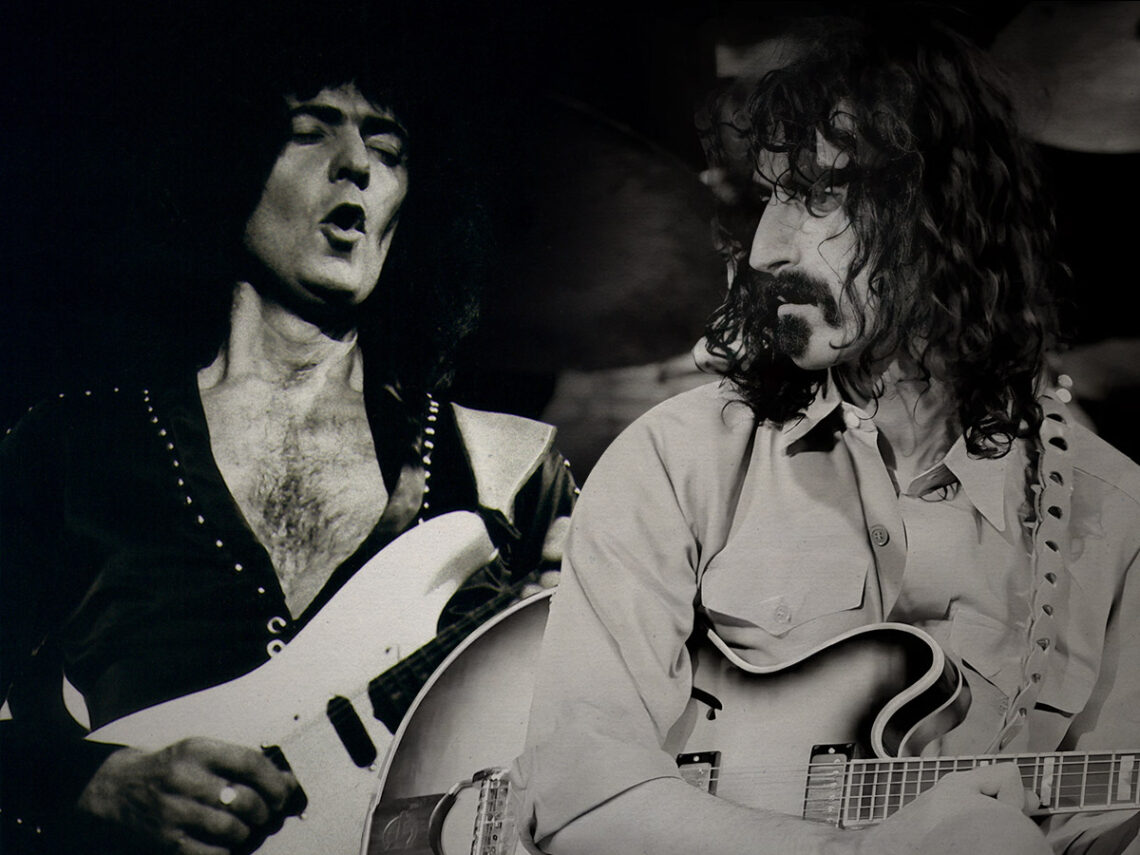
The guitarist Frank Zappa and Ritchie Blackmore both agreed reinvented the instrument

While dwelling in disparate musical realms, Ritchie Blackmore and Frank Zappa both shared a similar loose tongue when it came to dissing the bands they didn’t feel cut the mustard.
The former was the lauded guitarist for Deep Purple, the hefty organ groove band that helped pioneer heavy metal in the early 1970s, the latter the Mothers of Invention captain corralling a dense sprawl of arch-satirical and freakish avant-garde, standing as a virtual genre unto its own. Both held high standards for their artistry, be it Blackmore’s jump to Baroque fancies or Zappa’s forever keeping abreast of rock’s evolving trends until his death in 1993.
But many of rock’s biggest names found themselves in Ritchmore and Zappa’s critical target. The Deep Purple guitarist and Rainbow guitarist spoke candidly on his displeasure with David Bowie’s perceived theatre supplanting substance, and Eric Clapton’s supposed lapses into tired old blues rehashes.
Zappa was more than happy to attack rock’s sacred cows, making virtual enemies of The Velvet Underground during their Factory pomp, and desecrating the entire hippy movement with the cover of 1968’s We’re Only in It for the Money’s Sgt Pepper’s nightmarish inverse.
Yet, one guitarist united the two picky artists in mutual veneration. A titan in the heavy metal world, Blackmore was effusive with praise when issuing a statement after his death, highlighting Zappa’s statement years back in his reflective message.
“Eddie Van Halen was a brilliant guitarist who started a technique of guitar playing which was emulated by a whole generation of guitarists, Blackmore stated in 2020. “He was one of the nicest musicians I ever met in the music business. (He was) very shy and not at all conceited about his ability as a guitar player. Frank Zappa said (Eddie) reinvented the guitar. I agree. He will be sadly missed but his brilliant legacy will always be remembered, the ultimate guitar hero.”
Perhaps it’s the complexity that stuck its hook into the two. While fatiguing some in rock, Van Halen’s famous two-hand tapping, novel whammy bar use, and frenetic melodies created a richly dramatic sound to their namesake band’s pop rock appeal, piquing the interest of Blackmore’s classical background and pursuit of symphonic arrangements for Rainbow, and Zappa’s well-known hectic compositional style, seeing a kindred spirit in the Pasadena metal outfit.
Blackmore’s assessment of Van Halen’s was a little cooler back in 1991, however. Speaking to Guitar World, he was no less praising of Eddie’s guitar technique, if tired by his tremolo customisations on his famed Charvel guitars. “He is probably the most influential player in the last 15 years, Blackmore asserted. “Because everybody’s gone out and bought one of those [locking nuts]”.
“So everyone’s gone hammer-on crazy!” Black more concluded with some exasperation. “So he’s obviously done something, he’s a great guitar player. But I’m more impressed by his recent songwriting and keyboard work.” Admitting to his pleasure of seeing the back of the ‘tapping’ era, Blackmore made an unlikely comparison to one of Hollywood’s most celebrated songsmiths and piano players. “I think he’s going to be remembered, he could be the next Cole Porter.”
