


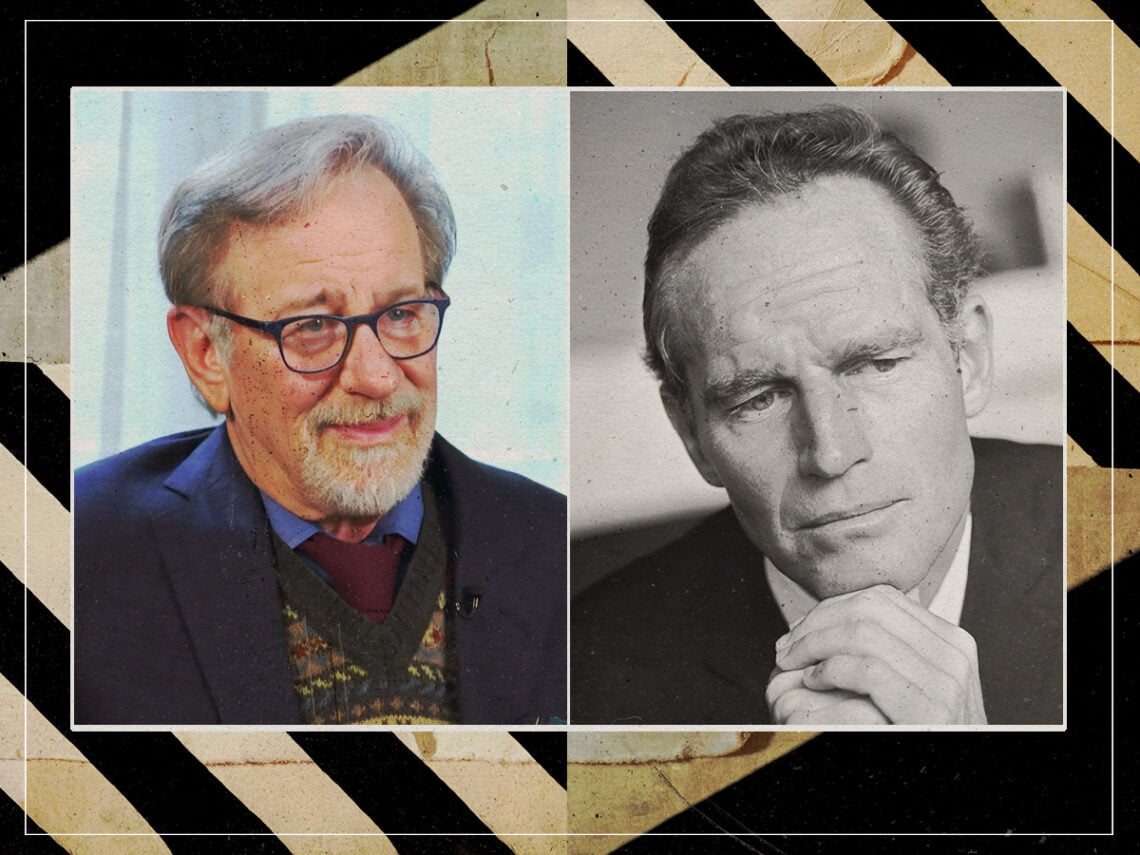
The cold grudge between Steven Spielberg and Charlton Heston

Steven Spielberg‘s first major success came in 1975 with Jaws, a film that not only pioneered the concept of the summer blockbuster but also tapped into the primal fear of the unknown lurking in the ocean. Humans instinctively fear what they cannot see or understand, much like children are terrified of the dark and what might be hidden in the closet. With Jaws, Spielberg found his grain of sand—a simple yet deeply unsettling idea—on which to build a cinematic pearl that gripped audiences worldwide.
Spielberg knew, after all, that adults aren’t that much different. When people do hit the beach during the summer, there is always a small nagging thought in the back of their minds: ‘What if I go out swimming and get eaten by a shark?’ Sometimes, this notion is a little irrational, founded purely on the inability to see exactly what is coming, or not, toward them. The unknown is both a terrifying and alluring prospect, one which we try to avoid in our everyday lives but seek out in our art, with movies, literature and more being flooded with the notion.
One of the things that made Jaws an instantaneous classic and still referenced by modern-day filmmakers is its use of suspense. If you think about it, the great white shark—affectionately referred to as ‘Bruce’ by the film crew on set, named after Spielberg’s lawyer—doesn’t appear until one hour into the film. Even after that, we don’t actually see the shark even though it’s there. How do we know about the shark’s imminent entrance? John Williams’ classic soundtrack theme plays every time the shark is nearby. Whether or not this suspense was a happy mistake due to the film’s budget, it doesn’t matter; the film probably would not have worked as well if the shark had been overused.
Spielberg and his crew created three gigantic prosthetic mechanical sharks that malfunctioned a lot of the time, which would explain why the movie took a lot of time to finish. For Spielberg, his first major hit film was very much like shooting in the dark. “I could have shot the movie in the tank or even in a protected lake somewhere, but it would not have looked the same,” he said.
It would say a lot about the filmmaker that even though he was comparatively unprepared, the movie would become a cult classic and a blockbuster hit. He spent a lot of time on the details, and the two biggest challenges lay in the location for the shoot and the casting. “I was naive about the ocean, basically,” Spielberg said. “I was pretty naive about mother nature and the hubris of a filmmaker who thinks he can conquer the elements was foolhardy, but I was too young to know I was being foolhardy when I demanded that we shoot the film in the Atlantic Ocean and not in a North Hollywood tank”.

As to who would play his three main characters, Chief Brody, Hooper and Quint, there were a lot of toss-ups, firstly with Quint. The author of Jaws, Peter Benchley, had recommended major star names to play the three roles. Benchley gave Robert Redford, Paul Newman, and Steve McQueen the nod. But the director had his own ideas.
Spielberg had offered the role of Quint to Lee Marvin, who politely turned it down. Next, Steven Sterling was a potential candidate for the role of professional shark hunter. It would turn out that Sterling was in trouble with the IRS at the time, so that came to a halt. Eventually, Spielberg settled with Robert Shaw to play Quint, although, bizarrely enough, Shaw also had troubles with the IRS.
While it could not have been known whether Jaws would become the smash hit that it was, everyone surrounding the movie seemed to have a sense that this film would be the talk of the year. Actor Robert Duvall had a good relationship with Spielberg and encouraged the young filmmaker to make the movie to begin with. In turn, Duvall favoured taking on one of the central roles of Chief Brody. Duvall would ultimately decline because of the same reason that Charlton Heston wanted the same part so badly.
Duvall believed that the shark-oriented phenomenon would be a hit but declined because, unlike the majority of his contemporaries, he didn’t want to become that famous. On the other hand, major star and future NRA President Charlton Heston wanted the part of Chief Brody to fling his anime back into the stratosphere.
Having become a hero of multiple epics in the 1950s, with The Ten Commandments and Ben Hur among his finest, Heston was hoping to continue his heroic ascension. The actor was often seen embodying heroes, warriors and historical figures, allowing him a prestige that was hard to shake. Planet of the Apes and Soylent Green had kept those hopes high, but Spielberg had different ideas.
Spielberg turned Heston down because of how hot his name was then. If this actor, who always played the winning hero in other films, had starred in Jaws, the audience would subconsciously associate Heston with the shark eventually losing the battle – the film’s end would be obvious, destroying any sense of suspension. Spielberg knew that the very essence of the movie lay in the unknown; to cast Heston would be to end the movie as soon as the opening credits rolled. Heston was simply too obvious in the hero’s role.
It is unclear who first moved to distance themselves from one another, but it would seem that Heston did not appreciate Spielberg’s sense of storytelling. After hearing of the director’s intentions, the veteran actor moved away from the role of Chief Brody and vowed he would never work with Spielberg even if the opportunity arose.
Surely enough, when Spielberg was making his 1979 film 1941, a period comedy about World War Two, the filmmaker asked Heston to star as General Stilwell—Heston gladly declined. The actor, much like John Wayne, labelled the movie unpatriotic and once again moved away from the project.
