



“Completey on the brink”: Gretel on ‘Squish’ and the glee of hitting rock bottom

When west London indie singer-songwriter Gretel met producer, songwriter, and Grammy-winner Mura Masa for the first time, she decided to smoke a cigarette.
She wanted to come off carefree and chic, despite her teenage years. But Gretel, who wasn’t a smoker at the time, learnt the hard way that pretending to be somebody you’re not won’t get you very far: excusing herself, she ended up almost immediately with her head in the toilet, moved to sickness from the nicotine.
Though she recalls this story with a wide grin over a picnic bench in Dalston, east London, I know the tale is one that has stayed with her. It’s something she had to learn all over again in the process of making her debut album, Squish, finding out, despite industry pressures, to stay true to herself.
Gretel and long-time friend Mura Masa, also known as Alex Crossan, collaborated on a first attempt at the debut, but something wasn’t right. They both felt it. To smoke, or not to smoke, the metaphorical cigarette?

At a crossroads
“Sometimes you get into a creative space where you can’t quite tell where you can grow,” she mused, absent-mindedly fingering the packet of tobacco lying between us, “I just got a little bit lost. You know, the name Gretel really, really came into its own meaning there.”
Her musical moniker disguises her real name, a choice combining her love of fairytales with her penchant for so innocuously and consistently losing her way.
When Gretel approached Crossan about bringing Seth Evans, ex-Black Midi musician who hadn’t ever produced an album, on board, Crossan granted Gretel “the biggest blessing” and insisted that the pair break off and start from scratch.
“He just waived all the fees for the work that he did,” her eyes widen, insisting that I understand how rare this is in a usually cut-throat industry.
“Sometimes you’ve got to kiss a few creative frogs, right?”
Gretel’s earlier work, 2022’s debut EP Slugeye and 2023’s Head of the Love Club, both had titterings of electronic leanings. Take ‘Apple Juice’, which opens with a siren-like distortion introducing Gretel’s deep, husky voice. In front of me, Gretel takes a sip of her apple juice. “The house demos are still sick,” she reassures me, “I’ll share what we did at some point, because it’s so good”.
For Gretel, who adores playing live, it wasn’t about distancing herself from the medium but about staying true to her earliest influences, 1990s grunge and real, visceral band music, that she could perform so truthfully.
Distancing herself from such a huge name on a debut is a bold choice from the star, who has spent five years already learning the hard way that the industry demands connections and names, teasing success only when it exists in proximity to the rich and famous. But for her, it’s always about the music: “I was definitely at a crossroads, and I was flirting with two different things. The live thing was a huge risk for me, and was a huge learning experience, but I’ve earned the rite of passage.”
On Squish, Gretel doesn’t cut any corners: “From scrapping the first draft of the album to re-recording it, it’s been a long, long process. Sometimes you’ve got to kiss a few creative frogs, right?”

Thrashing around in the mess
Gretel’s move away from electronic influences seems at odds with an industry that appears to be moving towards the glitchy specificities of computer music. Locally, London band The Itch are on the rise with their electro-fused pop, while globally, Harry Styles’ latest album features a Eurorack modular synthesiser set, but Squish is very evidently a band record.
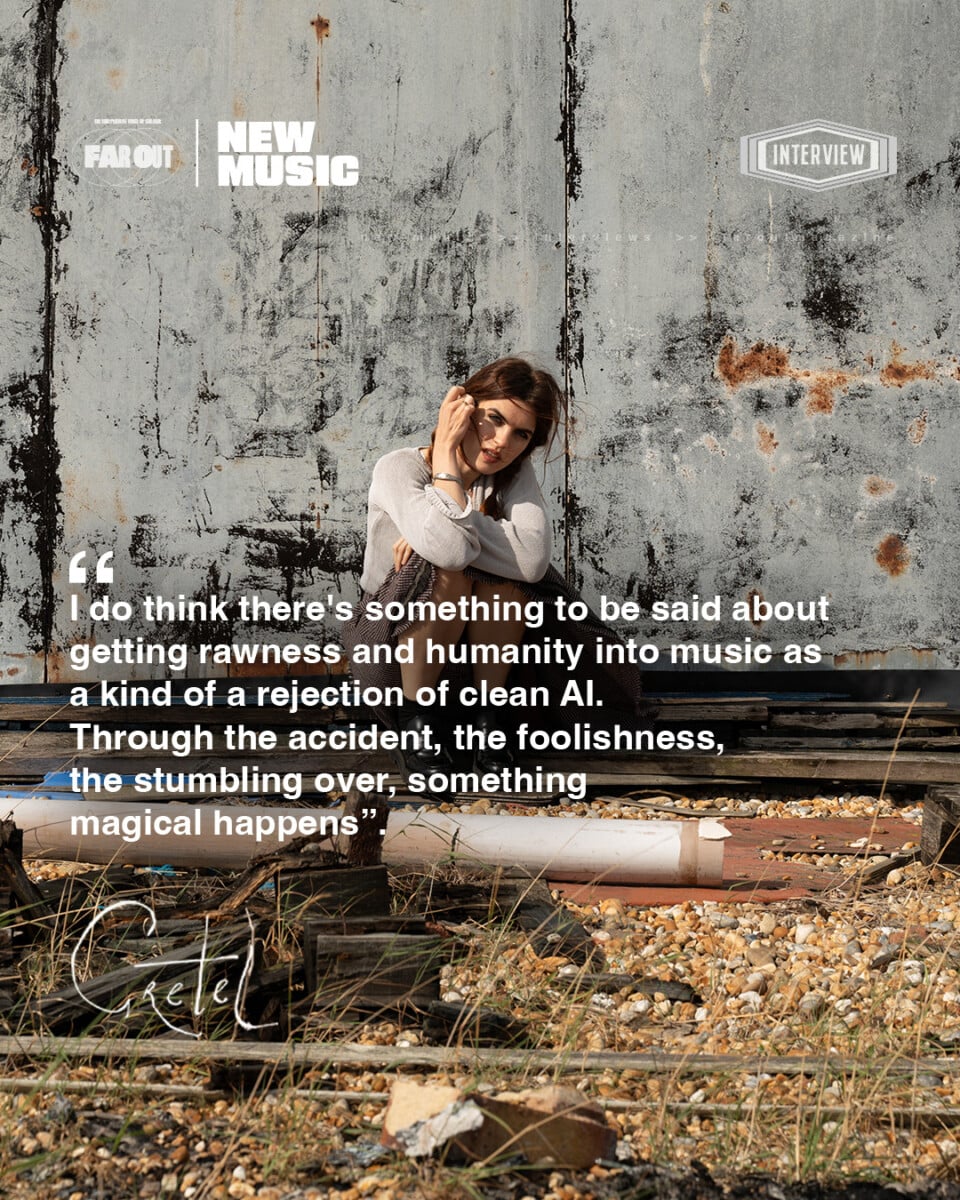
For Gretel, the difference is in the emotion: “I do think there’s something to be said about getting rawness and humanity into music as a kind of a rejection of clean AI”. Over a five-day recording process, Gretel strived to keep as much unpredictability as possible in the project, which she continues to refer to as “keeping the cough in”.
She elaborates, “Through the accident, the foolishness, the stumbling over, something magical happens”.
In some way, this is also a resistance to the speed at which today’s culture moves. Gretel, who struggles to name any contemporaries beyond alt-rock Brooklynites Geese, has actively avoided the capitalist trappings of algorithmic dissemination of the latest passions and hobbies on the ‘cool’ list, and thereby the cutthroat speed at which things expire into ‘so last week’.
She explains, “I’m a little terrified of allowing culture to make me fall out of love with something”. The uncontrolled and unpredictable nature of a live recording means it can be rediscovered again and again. A live recording is something that’ll always unfurl, and has its own world, its own palette in the room where it happened, a piece of staunch human history.
Crying on the track
Gretel has been building up to this release for as long as she’s been in the music industry. She explains, incredibly, that the title track, “Was written four or five years ago, and it was the only song that stuck around”. Instead, heading into the intense recording period at London’s iconic RAK Studios (she recalls seeing James Blake heading into the studio one day), she turned up, doe-eyed, with 40 or 50 demos to choose from.
Even in the avalanche of options, she wasn’t convinced she’d “said her piece”. Ironically, as she stressed about this exact issue two days before pre-production, Gretel, alongside two friends, wrote ‘Laurali’, a wilting, reflective epic filled with drum brushes and guitar arpeggios. “Press your face to the pavement, play with your accent, this ain’t you,” she sings, before admitting, “Everywhere you move, I’ll shelter you”. The meta moment epitomises Gretel reaching out to her own mirage, “following the feeling”, and taking a leap of faith in her career.
Gretel whittled the critical mass of demos down to a clean dozen that made up the album. Most were taken from that intense five-day recording period, like ‘Unbloom’, which shows a songwriter graduating into a new stratosphere. “That’s the favourite guitar riff I’ve ever written,” she reveals.
She goes on, “I was feeling crazy, and I was in my room, and I wanted to write a song that blended the Billy Corgan guitar style and riff with Cocteau Twins’ Elizabeth Fraser vocals”. I nod toward the obvious Nirvana influence on the project when she admits that the grunge band often “leaks in as a byproduct, but it’s not as a direct influence. But I’m always happy to take that compliment”.

However, she defies the expectations of the genre buffet throughout the album and instead opts for a tear-jerking close with ‘Perfect Body’, a song that initially gave Gretel cold feet for being “too sincere, too sad, too intense”. But after the finalised recording, the star still thought something was missing: “How dare I take that off?”
She recollects the song that tackles body dysmorphia, eating disorders, and, as she put it so eloquently, “learning to realise that, at some point in your life, happiness is more thrilling than anything else that shit can give you”.
Gretel sips on her juice and looks off to the side, but is firm in her reasoning, her chin facing upwards in a well-earned display of pride. So they added the song back in, the song which reaches out to make a connection with a friend, the listener, rather than diving deeper down into the self. “I’ve wrecked my body tryna be happy,” Gretel confesses on the track, singing, “And I want to have children, that is if I still can”. Amazingly, the vocal line is taken from the original demo because she laughs exasperatedly, “I was crying while I sang”.
“Squish is a witnessing of yourself in society, learning all the things about yourself until you pop. You become realer out of sheer exasperation”.
Explode, unfurl, unbloom, repeat
This excessive emotional episodia is at the heart of Squish, written over half a decade by an artist who admits to me that she is “always one sentence away from crying my whole life, in a really nice way”. We share a look, one only recognisable to two young women caught in the rampant waves of a metropolis sharpening its pitchforks against the creative industry on a daily basis.
In this way, Gretel has written the album for me, or for the idea of me, as much as she has written it for herself. The ‘Drive’ singer admits that she writes from a “protective place”, as she tries to summate her experience for “young women navigating setting boundaries in their lives and finding themselves”.
While I admit that the capricious female experience is retold with anger and fury in much of my own writing, she instead writes from a hopeful, realistic yet optimistic perspective: “I feel like there’s the angriest part of me would be exasperation toward establishments, toward the world,” she says quietly, after a charged pause. “I know you tried to make it the perfect night, but you’re drunk, drunk on the ballroom floor,” Gretel laments in this way on the album’s sixth track, ‘Drunk on the Ballroom Floor’.
We’ve come ceremoniously to the final point: What is Squish, then? An avalanche inward? An embrace that lingers? Both, neither: “Squish is a witnessing of yourself in society, learning all the things about yourself until you pop. You become realer out of sheer exasperation”.
From heartbreak to haunting fairytales, from darkness to depression and everything in between, Gretel has brought everything to the floor on Squish. If Squish represents all of the forces crippling the female psyche, the album is the idea of a woman in active free-fall: “Instead of being more put together, [it is about] being less put together, losing your shit and allowing room for that. I feel completely liberated in having reached both rock bottom and being completely at the brink.”
As we leave, Gretel smokes a cigarette. This time, with a smile.


Never Miss A Beat
The Far Out New Music Newsletter
All the latest New Music from the independent voice of culture.
Straight to your inbox.