


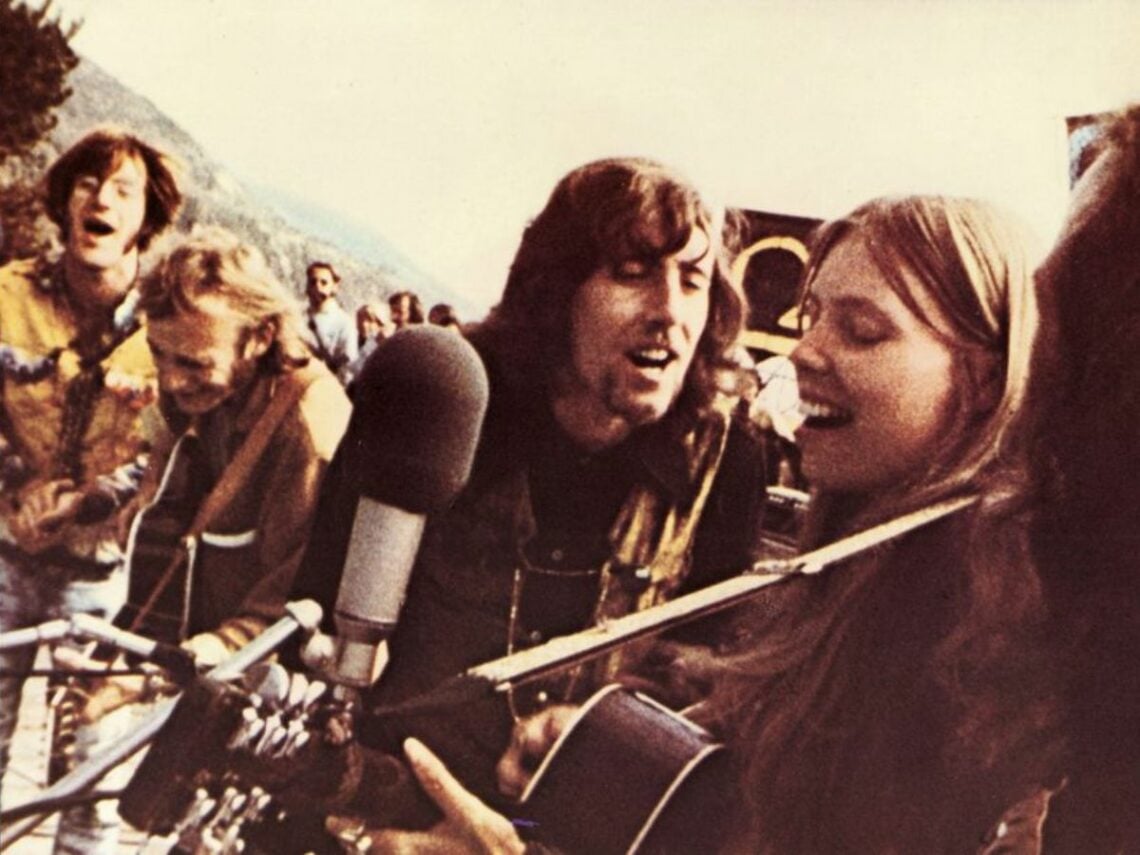
Graham Nash’s favourite Joni Mitchell song: “She had the courage to bare her soul”

As a true household name in not only the world of folk music but in the larger arena as a global musical legend, Joni Mitchell is often regarded as the female answer to Bob Dylan. Whether this statement is accurate is a matter of conjecture, but her poetic songwriting skills and emotive arrangements are certainly worthy of the immortal legacy she upholds.
In 1965, after cutting her teeth circulating the nightclubs of Toronto, Canada, Mitchell moved to the USA. Settling in Southern California but frequenting the East Coast, Mitchell immersed herself in the country’s burgeoning folk scene and became a salient presence at the annual Newport Folk Festival.
By 1970, Mitchell had made a name for herself on a national scale with three well-received albums, but 1971’s Blue sent the ball out of the park and into the stratosphere. Widely regarded as an essential of the singer-songwriter boom and one of the greatest albums of all time, Blue contains a platter of perfect compositions.
There are two prominent motifs that run through Joni Mitchell’s iconic 1971 record Blue. Two profound themes are a perfect summation of Mitchell as a songwriter: firstly, her intent to share herself more than ever before on this album and secondly, to do it while using the often forgotten instrument, the dulcimer.
“I was opened up,” Mitchell reflected. “As a matter of fact, we had to close the doors and lock them while I recorded [Blue] because I was in a state of mind that in this culture would be called a nervous breakdown. In pockets of the Orient, it would be considered a shamanic conversion.” The album is seen as one of her most personal and even encouraged Kris Kristofferson to plead with Joni to “saving something for yourself.”

Much of Blue’s beauty stems from a melancholy rooted in Mitchell’s breakup with Graham Nash. She left the British musician, formerly a member of The Hollies, in 1970 and had begun dating James Taylor; however, Nash was still playing on her mind, as the anti-Christmas ballad, ‘River’, attests.
Just after her split from Nash, Mitchell travelled to Crete, where she wrote ‘River’. Ostensibly, the river she skated away on to “quit this crazy scene” was the Atlantic Ocean. The song’s lyrics expose feelings of regret and self-loathing as she explains: “I’m so hard to handle, I’m selfish and I’m sad, now I’ve gone and lost the best baby that I ever had.”
In 2021, The Guardian asked several musicians to discuss their favourite Joni Mitchell songs. Understandably, ‘River’ holds a particularly poignant and powerful position in Nash’s heart. Singling out the wintry ballad as a personal favourite, Nash remembered meeting Mitchell in the late 1960s.
“I met Joni in 1967 when I was in the Hollies and we played Ottawa,” he began. “Later, I flew from London to spend a few days with her in Los Angeles. When I arrived, I could hear voices in the house. David Crosby and Stephen Stills were having dinner with her. The Byrds had thrown David out, and Stephen’s band, Buffalo Springfield, were over. We smoked a big one, and Stephen played this fabulous song, ‘You Don’t Have to Cry’, with David and me singing harmonies. So Joni witnessed the birth of Crosby, Stills and Nash.”
“We were a couple for two years – and I watched her write many of the songs on Blue. She didn’t finish it until after we parted,” Nash continued. “‘River’ made me sad, because it chronicled the end of our relationship, but also elated, because it was such a beautiful song and she had the courage to bare her soul. We were very much in love. I treasured that relationship.
“I remember leaving the house to give her the space to finish ‘My Old Man’,” he added. “I’m sad that it’s about me again, but it’s so brilliant. As the song suggests, I asked her to marry me, but I think she thought I wanted a ‘wife” to cook meals and so on, which was never my intention. I wanted her to be as free as possible, to be as brilliant as possible. She’s an amazing woman. I’m proud to have been a part of her life. In 100 years’ time, people will remember the Beatles, Bob Dylan and Joni.”
It’s quite the compliment, but one that Mitchell has rarely done much to avoid deserving. Her skill as a songwriter has always been in bringing her personal moments into undiervasl understanidng, and it would see it doesn’t really matter to those subjects of the songs if the tracks are good enough.
