


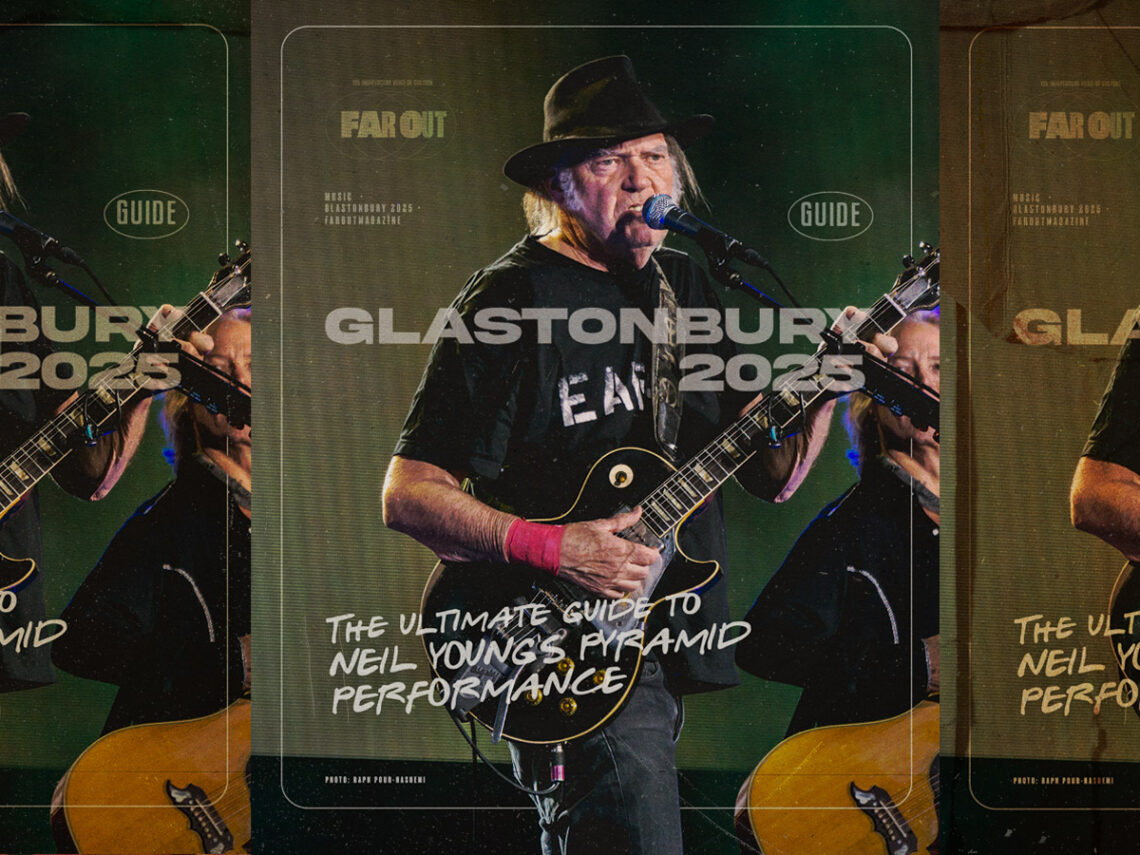
Glastonbury 2025: The ultimate guide to Neil Young’s Pyramid stage performance

“He does things his own way, and that’s why we love him,” Emily Eavis said upon her official announcement of Neil Young headlining Glastonbury. Well, I say announcement, it was more like a verbal extinguisher desperately defusing the fire Young started days earlier. Will he play? Won’t he play? This was the tug of war that took place at the beginning of this year.
For those uninitiated, that was truly the only way Neil Young could have been announced to play the biggest show of the year. A perennial contrarian and cynic, a simple photo accompanied by a glossy press release would have done little to reflect the true nature of the man. Instead, he opted to jump the scheduled gun and release a statement of his own, saying:
“The Chrome Hearts and I were looking forward to playing Glastonbury, one of my all-time favourite outdoor gigs.” It continued, stating: “We were told the BBC was now a partner in Glastonbury and wanted us to do a lot for things we were not interested in.”
Continuing, Young shared, “It seems Glastonbury is now under corporate control and is not the way I remember it being. We will not be playing Glastonbury on this tour because it is a corporate turn-off, and not for me like it used to be.”
It took just 24 hours for him to complete his U-turn, confirm his headline status and waste an entire PR campaign for the Glastonbury team. It was clunky, ill-informed and a disappointing way to unveil one of the most talked about moments in the music calendar.
But if Young isn’t rocking in the free world, then he doesn’t want to rock at all. In 2025, the clouds of normal society seem to be growing darker, and despite whatever corporate influences you think are slowly polluting them, music festivals seem to be the last pockets of true societal freedom. Largely devoid of conventional law and fertile soil for mass communal love, they’re a space ready-made to foster egalitarian change. So while Young’s grumbling may have felt largely cantankerous, it was rooted in an uncompromising sentiment that makes him perfect for the job.
While it’s easy to dismiss legacy acts as nothing more than nostalgia porn, scratching the itch of the Pyramid camping boomers, there’s something more to Young. Don’t get his longevity twisted with a newfound sense of artistic integrity. Long before his financial freedom was secured by a glittering half-century career, Young was stood on the artistic front lines calling out injustice.

In 1970, he wrote ‘Ohio’ in protest against the horrific Kent State University shootings. That same year, he released ‘Southern Man’, a scathing takedown of America’s colonial history and in 1974’s ‘Vampire Blues’, he broodingly condemned man’s role in creating irreparable environmental damage.
So, in 2025, with authoritarian presidencies and brutal mass murders of innocent communities providing the societal pushback to the world’s biggest party of escapism, you think Young will avoid confronting that? While legacy acts use the world’s biggest stages to roll out their final farewell, Young will use it to plant his foot further into the trenches and arm younger generations with the tools to articulate their frustrations.
He’s likely to aim both barrels at Donald Trump during his show. Ever since the inauguration of the President and his sweeping policies that have bordered on the authoritarian, Young has taken every possible opportunity to swipe at the legs of Trump and publicly criticise his administration.
While most of his takedowns have been hosted on his website or the safety of his own show, ironically for Young, the televised platform the BBC provide him and his headline set will be the ideal place for Young to deliver crucial blows to Trump and reaffirm his stance on his administration as a whole. He’s openly welcomed threats of deportation and silencing, and on the Pyramid Stage this June, it’s safe to say we can expect no less.
What can we expect from his setlist?
With an hour and 45 minutes to play with, there will be plenty of chances for Young to rattle through his greatest hits. Everything from ‘Harvest Moon’, ‘Powderfinger’, and a rousing rendition of ‘Rockin’ In The Free World’ to all of the deeper cuts like ‘Ordinary People’ and the Crosby, Stills, Nash and Young hit, ‘Helpless’.
But perhaps what that time gives Young more than anything is space to indulge. He’s one of music’s quintessential jam musicians, diving deep into pockets of musical space and losing himself to the realms of experimentalism. Unlike his predecessors, The 1975, Young’s stage will be devoid of thrills, tricks and complicated set designs, and will lean into a more simplistic layout, giving space to the purity of live music.
But it wouldn’t be a Glastonbury headline set without the age-old question: who is he going to bring out? Well, if you ask me, no one would be the best move. He is a standalone titan, a history maker in the books of music not beholden to the power of someone else’s appearance on stage. The only line-up true fans would care to see is rendered impossible, and so without the ability to reunite Crosby, Stills, Nash and Young, it would be nothing more than a novelty play for Young to wheel out collaborators.
But in 2009, he treated festival goers to a unique take of The Beatles’ ‘Day In The Life’ during the encore. It’s safe to say that repetition isn’t in Young’s interest, but there is a wonder at what classic rock contemporary he would love to pay tribute to this year. While his vocal range might differ vastly, I don’t think fans would turn down an opportunity to sing along to a rendition of ‘God Only Knows’ given the context.
