


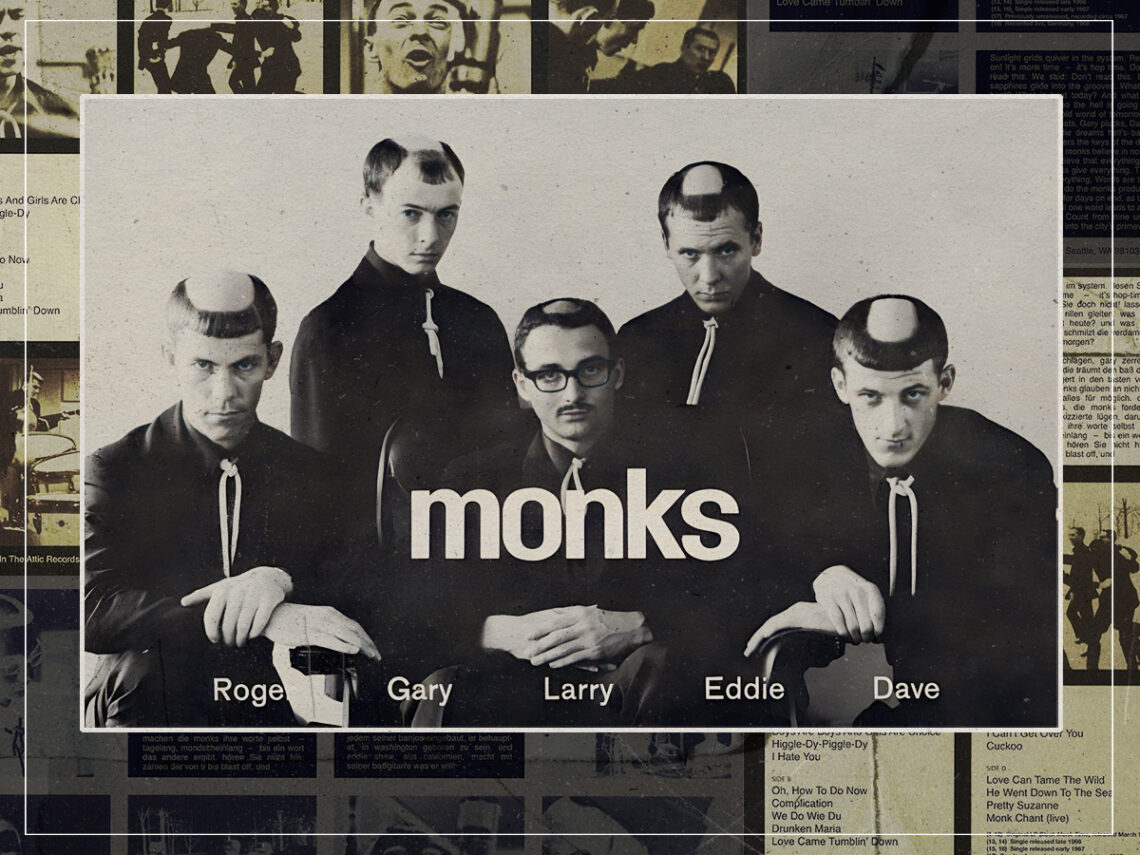
“It’s Monk time”: how five GIs in Germany invented political punk rock

When examining the history of punk, we tend to look at the genre’s direct progenitors in New York and Michigan. But long before the likes of Patti Smith, Television, The Stooges, MC5 and even The Velvet Underground, there was a musical movement already underway, pregnant with the sound of punk. This movement later became known as garage rock.
Driven by the rawest elements of rhythm and blues, rock and roll and surf music, garage rock began to flourish across the United States in the early 1960s, particularly in the Pacific north-west. Teenage bands were formed literally in their garages, college dorms and frat houses, playing the simplest, hardest-hitting guitar chords they could get their hands on.
The movement really exploded in late 1963 with The Kingsmen’s raucous hit single ‘Louie Louie’. Building on the razor-sharp guitars of the song’s little brother, ‘You Really Got Me’ by The Kinks, Here Are the Sonics emerged as the first fully-fledged garage rock album in early 1965. Perhaps no other act throughout the 1960s was able to replicate the sheer rawness of the noise The Sonics made on their first two records. It was the sound of punk itself, pre-defined for the Ramones, Sex Pistols and The Clash to pick up a decade later.
However, the garage rock movement wasn’t just limited to the United States. Over in West Germany, four young American GIs were forming their own band. Stationed there as conscripts like many other Americans during the post-war period, these soldiers were actually radically anti-army and anti-war.
Their sentiments couldn’t be legally expressed in military or political terms, though, as conscription was obligatory in US law at the time. With that, they channelled those feelings into music. Lead singer and guitarist Gary Burger joined the band to get him out of his army job as a fuel truck driver. The band began playing Chuck Berry covers at their fellow GIs’ favourite watering holes.

So, who were The Monks?
By 1965, the group had settled on their final line-up of Burger, Dave Day on rhythm guitar and banjo, Larry Clark on keys, Eddie Shaw on bass and Roger Johnston as drummer. At the behest of some German students in Stuttgart interested in the avant-garde art scene, they’d also changed their on-stage outfits to matching black priest cassocks, with nooses hung around their necks and tonsure haircuts.
They subsequently changed their name, too, to go with their outfits. From The Torquays to The Monks. And their sound, to some of the most out-there and offensive noise being produced by a rock and roll band anywhere in the world. By now, they’d penned some original songs, including a theme tune of sorts, ‘Monk Time’.
This song is about as far away from “Hey-hey, we’re the Monkees” as you could possibly imagine. In a 2011 interview with Psychedelic Baby Magazine, Burger described it as “anti-war all the way, all the way”. He stated emphatically, “There is no other reason for this song.”
‘Monk Time’ starts with hard-hitting, lightning-quick floor toms, pulsating high-tone bass and an off-key organ drone before Burger starts ranting and raving over the top:
You know, we don’t like the army
What army? Who cares what army
Why do you kill all those kids over there in Vietnam?
Mad Viet Cong! My brother died in Vietnam!
Other 1960s anti-war songs may have made their point more eloquently and got more air time, but none sounded nearly as impassioned. After dealing with the Vietnam War, Burger takes aim at the atomic bomb before introducing his bandmates.
The song only accelerates as a scratched banjo is added to the rhythm section. The organ goes up a key and back down again as the drums continue to pound underneath a chorus of “It’s hop time! It’s monk time!” Above all, Burger sounds completely out of control.

The first political punk album?
Polydor Records agreed to offer The Monks an album deal, provided that they toured the clubs of Hamburg’s Reeperbahn as The Beatles had done previously. They did, as part of a tour of Germany in which Burger was nearly strangled to death by an audience member before he beat him off with his tuning pegs.
They began recording Black Monk Time at 3am straight after a gig in Cologne in November 1965. The album was released the following March, including ‘Monk Time’ alongside 11 other self-penned tracks. These included punk prototypes ‘Shut Up’, ‘I Hate You’, and a second anti-war song ‘Complication’. All the tracks are live takes. They’re tight-knit with few lyrics but have wild, spontaneous-sounding arrangements.
Following a successful European tour, the band returned to Germany and found out that Black Monk Time had been barred from release in the US due to its anti-Vietnam War sentiments. Performing alongside bigger names such as The Kinks, The Troggs and Jimi Hendrix placed more pressure on them to tour more venues and adapt their set. By mid-1967, they were exhausted, infighting had set in, and drummer Johnston quit the band.
“Without the original five Monks, the contract was not valid,” Burger explained. “That was the end of The Monks.”
Still, the band had already left their mark. Their sole album created a legacy that would only be fully realised years later when the hardcore political punk band Dead Kennedys covered one of their songs. The Fall, The Beastie Boys and Jack White have also cited them as a key influence on their music.
While The Kinks, The Sonics, and The Who were busy trying to create the hardest guitar sound imaginable in the mid-1960s, The Monks were sticking it to the man not just with their music but also with their explicitly anti-establishment lyrics. Frank Zappa, Hendrix, and others may have expressed anti-war messages in their music at a later stage, but The Monks got there first.
