

Fela Kuti: Perhaps the craziest life in music history
Read More


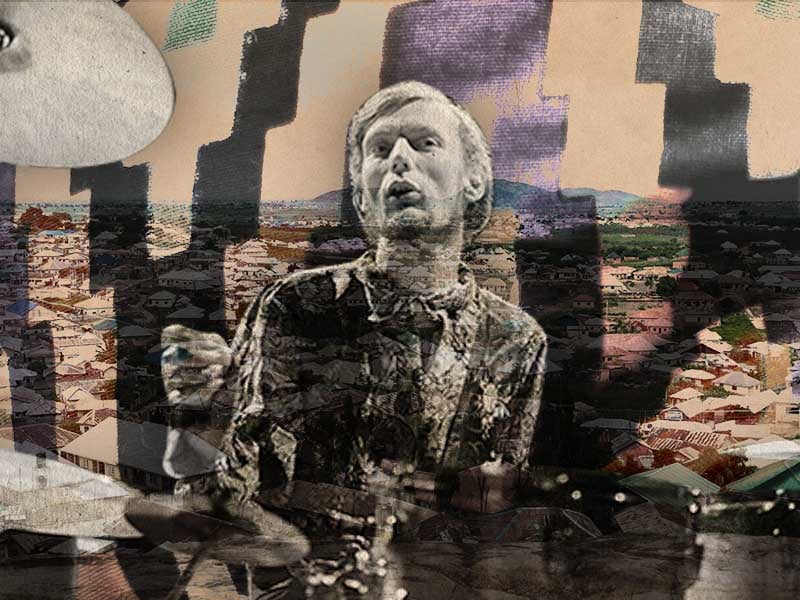
If you’re Ginger Baker, what do you do after you’ve achieved the pinnacle of rock ‘n’ roll drumming with Cream? You head down to your local Land Rover dealer, pick up a new Range Rover and drive it down to Nigeria to set up a recording studio in Lagos. It’s as simple as that. Sure, there are obvious hurdles like the Saharan desert, and the fact that you’re a redheaded fellow with the complexion of an Alaskan Vampire, but that’s why you bought a sturdy Bahama gold British vehicle.
Today, you can drive from London to Lagos, Nigeria in a 97-hour solid stretch if you’re someone who doesn’t need sleep. You weave from London, through France and Spain, before a short boat ride across the Mediterranean gets you into North Africa and onto the Trans-Sahara Highway. However, in 1971, those 4327.7 miles were far more ragged and wavering than they are today. It took a rough and tumble lunatic like Baker to even attempt it.
The legendary drummer and notorious bastard was in hot pursuit of Fela Kuti and his emerging Afrobeat explosion. Most people would’ve flown but Baker thought that slugging everything over in a boot would’ve been more suiting. A sort of spiritual pilgrimage, if you will, leaving the rock world of London and Primrose Hill parties behind for a different kick. There were no half measures with Baker, so if he was going to play Afrobeat, then he’d tune himself to the natural rhythms first.
As he poetically logs it when he first crested the continent: “Algeria, North Africa, the Atlas Mountains, 40 miles south of Algiers. Mountain monkeys come down for breakfast, seven every morning. We leave the mountains, and our journey begins, through Algeria, Niger and Nigeria.” South and then south some more through the Sahara where “the desert sun waits. Soon the mountains disappear. The desert is here. Drive all day through the sun. South.”
And then, on route to the equator, the road ended for Baker. As he puts it, “2000 miles of sand” lay ahead. Thus, the mad man had to load his vehicle with “65 gallons of super inflammable fuel.” Here he learnt that “powdered sand is no good for cars” as the gold Rover acquired a burnt orange skin, and the rusted, wheelless skeletons of old cars lined the flat track of nothingness like roadside warning signs, mechanical roadkill.
Along the way, Baker’s travelling naivety would prove costly. In the Sahara, you have to report to the leaders of the town that you stop in to visit. This local law was something he hadn’t taken into account. Thus, in Tamanrasset, he and his travelling party were arrested for making a stay unannounced. In truth, while this hurdle could’ve been overcome, if you chose to follow in his tire tracks on such a journey, then you will also encounter potholes on your fabled road trip. It’s the lore of such excursions that you have to hit the highs and the lows.
This route was a daring and dangerous one. It still is. With militia groups operating in the area, you have to have your wits about you to navigate it safely. However, just as Baker reported back then, the rewards are bountiful. The stars cloak the black-blue ceiling of night like a chandelier. And this crystalline notion is as apparent in the elemental hue of Earth and dirt in the day. The feeling is a primordial one—a wonder fit for the trance rhythms of a drummer. Baker felt he was getting away from something and moving towards something else. That surely still rings true.
Along the. way, he emersed himself in the technicolour culture of the left corner of Africa. He witnessed tribal dances, jammed with a mass assortment of African musicians, met Tuareg travellers herding camels, embraced sand and rainstorms on the boundary of Nigeria and came across magic marble rock fields, and limestone outcrops that look like desert icebergs. He got lost, and he got directed by chiefs and herdsman, and he got lost again marvelling at birds of prey circling over carcasses.
The Sahara then ended as abruptly as it started, a foreign concept now in the age of increasing desertification. Nevertheless, when Baker went from gold to green some 200 miles away from Nigeria, he was greeted by villages blowing horns in celebration. The sounds of the south were evidently different, and he was all ears. He was all eyes too, blown away by ant architecture that rose from the roadside like little earthly abstract sculptures, then mound mountains confounded him even more as they pushed into Nigeria.
And then he made it to the first recognisable outpost of Kuti’s cultural reverberations: the Afrospot. Here bands blasted out a maelstrom of sound and The Sweet Thing dancers gave Regan’s movements in The Exorcist a run for her money. With this song humming in his head still, Baker pushed on through the final miles to the sun, sand, sea, high rises, parties, booming bands, wandering chickens, roving cows, blossoming developments, and Fela Kuti.
“What can you say about Fela?” Baker mused upon arrival. “In Calabar, they have over 200 inches of rain a year and this night they proved it. Everybody got soaked.” Huddled in clubs, wild bands played all through the storm and Baker was intoxicated—this time on the sheer energy of the thing. His journey was complete, and the wildest party of his life was the reward. Such a place might have been lost now, but the same spirit and adventure remain.
It’s not an easy journey, but, hell, if Baker can do it then with the right wits, then so can you. If you do, the dangers are plentiful, but the rewards are a bountiful munificent harvest of pure joy.
