


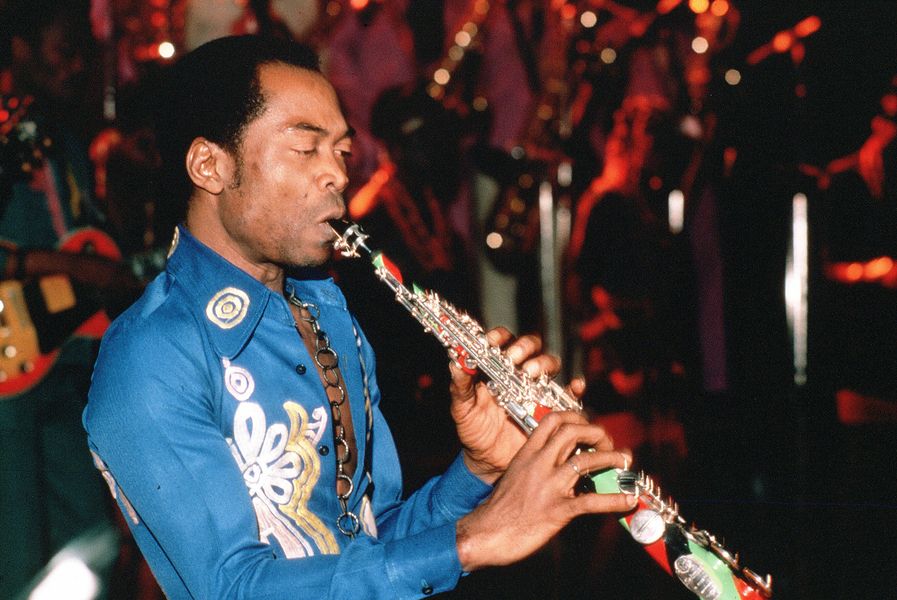
Fela Kuti: Perhaps the craziest life in music history

The worlds of music and medicine are two very incompatible spheres. While one requires strict discipline, a steady head and a measured heart, the other is the province of scoundrels and spiritual slackers where a state of idle reverie is paramount and crackbrain pursuits are an essential stock in trade. There was a time when Fela Kuti was well on his way to being a white-coated seraph of everyday society; the way his life would unfurl when he ventured off that predetermined path makes the notion of him being the sort of reserved sturdy folk that you can trust with a scalpel as absurd as the Prince of Darkness being a primary school teacher with a sanctuary for winged mammals on the side.
Born in the Western region of Nigeria among the countries elite in 1938, he ventured away from the blue skies of home to the rather grey climes of London in the mid-1950s to be trained up as a doctor. He was already musically inclined when he arrived in the capital, but soon he’d be so intoxicated by the spirit of American Jazz that he was essentially unfit to attend school. He downed his scalpel, picked up his shaker, and entered the Trinity College of Music.
Kuti was coming at music from a different perspective to most. He was proficient on the drums, keyboard, guitar, saxophone and singing as well as being able to jive about like a Lemur behind a jackhammer. However, he was far from the only multi-instrumentalist with character on the scene. What made him stand out was the wavering path of his eventful life and the views he had collected along the way.
He took his politically conscious party on the road and became a global sensation of wild acclaim. His music was invigorating and astoundingly different, concocting the eponymous Afrobeat from the heady mix and West African rhythms, American jazz and a whiff of rock ‘n’ roll. According to his manager, Rikki Stein, he would parade around conservative Western five-star hotels in nothing but speedos, high-tail to party for days on end, and, in short, seemed to never fully return to Earth following the walloping uplift he received when he first fell in love with music.
If beneath the simple joy of a pleasant tune and the time passing ways of our sonic pursuits, lingers some sort of primordial need to rise above the dull drudgery of the everyday, then it would seem Kuti’s spiritual record never stopped playing and he remained lofted someplace well above this mortal coil of car insurance and errands for the rest of his life.
This might have led him to attack music with the utmost passion, but being uncompromising doesn’t often go hand in hand with success. Often the acclaim for his wild 50-person 20-minute jams didn’t translate into huge western fanbases. Thus, he spent most of his days in his native Nigeria where he was a constant thorn in the side of corrupt authorities.
He was jailed a whopping 200+ times and on each of those occasions, he left 27 wives at home sorely missing his company (all of which he would later divorce). Eventually, he grew so tired of the law and the lack of equality that he set up what was essentially his own separatist state on the outskirts of Lagos. With 27 wives, their extended families, a legion of fans, and many converts to his trailblazing ways amid the dispossessed masses of Nigeria and beyond, his little Kuti-dom turned out to be quite a big one.

In the centre of his outlaw realm, which he declared the Kalakuti Republic and named himself president, was a recording studio. Naturally, this bohemian principality was one that the government were quick to attempt to snuff out. However, it wasn’t all that easy. He had a growing following and an international standing that they couldn’t just snuff out without any backlash. But with the release of his record Zombie, which likened the military to the brainless undead following orders without thinking, he pushed them a bit too far.
His private utopia was raided by the Nigerian Military. On previous raids, they had exercised caution and proceeded more in warning than anything else, but this time they brutally tore Kalakuti to bits, allegedly raping as they went along. They beat Kuti mercilessly, almost killing him, and threw his elderly mother out of a window to her death. In response, Kuti regained his strength, refused to put his mother’s coffin in the ground at her funeral, sent it to the military headquarters, and eternalised the whole thing in the song ‘Coffin For Head of State’. The track is a 22-minute long celebratory number akin to the drawn-out nuclear reversal of ‘A Whiter Shade of Pale’.
If he had not already been a hero to Africa’s poor then he was a bulletproof overlord now. In response, to the raid, Kuti returned to politics, this time in an official sense. He set up his own political party that aimed to illuminate the neo-colonialism of transnational organisations in Africa.
To a large extent, he was successful in this. Not many in the West were aware of the unfair terms of trade that the continent faced at the time and through his position alone he brought attention to it, maybe not to many people, but a few is better than none at all.
However, as has hopefully been established, Kuti was a man who dealt in black and white and often where a judicious mind was needed, he was the wrong voice on the right stage. He disagreed with the use of condoms in Africa and as such his voice proved very damaging when the AIDS epidemic resurfaced. He himself would die of the virus in 1997 at the age of 58. This murky palette is all part of his tortuous legacy.

All too often now it seems that the championed narrative of his life is split down the middle; some remembering him as a shamanistic lunatic who garnered a legion of loving fans as he pelted towards an Afrobeat future like a Cheetah on speed, and others portray him as a feudal lord out to set corrupt noses out of joint and bring meaningful change in his own individualistic way.
In truth, he was both and a hell of a lot more. Everything about him is hard to reconcile and as such very little has been. His unruly ways and huge mistakes are at odds with his largely benevolent approach, that according to his manager, sought a better humanity for all. Likewise, his musical brilliance and maniacal methods muddy the canvas of his life into even murkier tones.
You could conclude that he was a genius who, like everybody else, proved flawed and fallible but to a flamboyant extreme. However, can you really apply the usual rules to a man who invented a music genre, had 27 failed marriages, started his own Republic, went to war with Nigeria and inequality, had outspoken beliefs that were plain right damaging and wrong, and trailblazed while swaggering around emanating a plume of Igbo smoke extolling joy, spiritualism and madness?
