


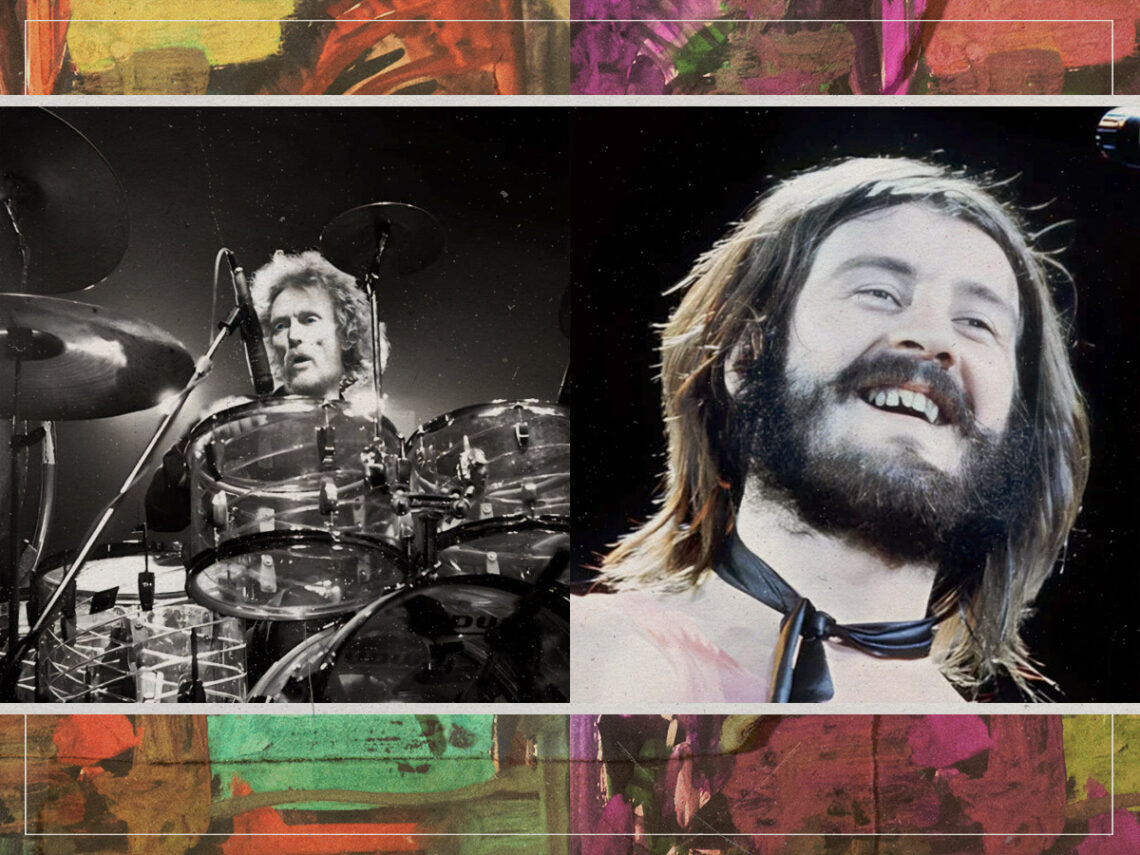
“He is himself”: Why Ginger Baker was John Bonham’s ultimate influence

Drummers, like goalkeepers, usually stick at the back, make the most noise and receive the least praise. Their job is to keep a rhythm and allow the guitarists and vocalists to dash about in colourful fits of performance. This stereotype fits many bands, but there is certainly no hard and fast rule. To be recognised as a drummer, you need a creative approach, virtuosity and a heap of charisma. The late legends John Bonham and Ginger Baker had these attributes by the bucketload.
Originality in a rhythm section isn’t such a necessity as it is elsewhere in a rock group. Traditionally, music in the genre plods along to a 4/4 signature with a couple of breaks and fills for intensity. This is all well and good, but what if you have the melodic bass talent of John Entwistle or the dynamic jazz sensibilities of Ginger Baker?
As far as Baker was concerned, his drumming was an integral colour in Cream’s sonic tapestry. Far beyond providing a rhythmic structure for the band’s songs, he rivalled Eric Clapton’s guitar prowess with prominent solos and unprecedented signature transitions. Baker was so dissatisfied with the 4/4 rule that he had contempt for those who regarded him as a rock drummer. In his eyes, he was a jazz drummer in a psych-rock outfit.
Baker’s peers remember him as a remarkably assured musician, often to the point of abrasive conceit. When Bonham rose to fame with Led Zeppelin in the late 1960s, he looked up to Baker as his elder and towering force in the recent psychedelic scene in London. While Bonham might have avoided adopting some of Baker’s infamous personality traits, he saw something in the drummer’s cocky idiosyncrasies.
Baker wrote his own rules and ensured that he always brought his strong personality to the fore. “When I listen to drummers, I like to be able to say, ‘Oh! I haven’t heard that before,'” Bonham mused in Mick Bonham’s biography. “Being yourself is so much better than sounding like anyone else. Ginger Baker’s thing is that he is himself. So it’s no good trying to do what he does.”
Of course, Baker wasn’t Bonham’s only influence as a drummer. Bev Bevan, the drummer famed most for his work with ELO, remembered the Led Zeppelin drummer’s fascination with musicians across the pond. “I’m not sure John was a fan of British drummers, though he must have been influenced by Tony Meehan and Brian Bennett and Clem Cattini’s session work,” Bevan recalled. “John and I generally shared musical tastes, all of them American. I remember John and I agreeing that the two best rock and roll drummers were Earl Palmer and Hal Blaine.”
Despite Bevan’s claims, Bonham greatly admired Bakr as his British rival and a high watermark in his stylistic territory. In his humbly-titled memoir, Hellraiser: The Autobiography of the World’s Greatest Drummer, Baker recalled that Bonham always said they shared a position at the very top of the British drumming hierarchy. “John Bonham once made a statement that there were only two drummers in British rock ‘n’ roll: himself and Ginger Baker,” Baker wrote. “My reaction to this was: ‘You cheeky little bastard!'”
By placing himself on par with Baker, Bonham challenged himself to push the preconceived boundaries for rock drumming. Alongside Jimmy Page’s innovative guitar work, he helped establish Led Zeppelin as a leading force in the prog-rock and heavy metal arenas. Associations with the former were achieved through complex compositions like ‘Four Sticks’, which, due to irregular time signatures, is the most complex Zeppelin song to drum.

Never Miss A Beat
The Far Out Led Zeppelin Newsletter
All the latest stories about Led Zeppelin from the independent voice of culture.
Straight to your inbox.